
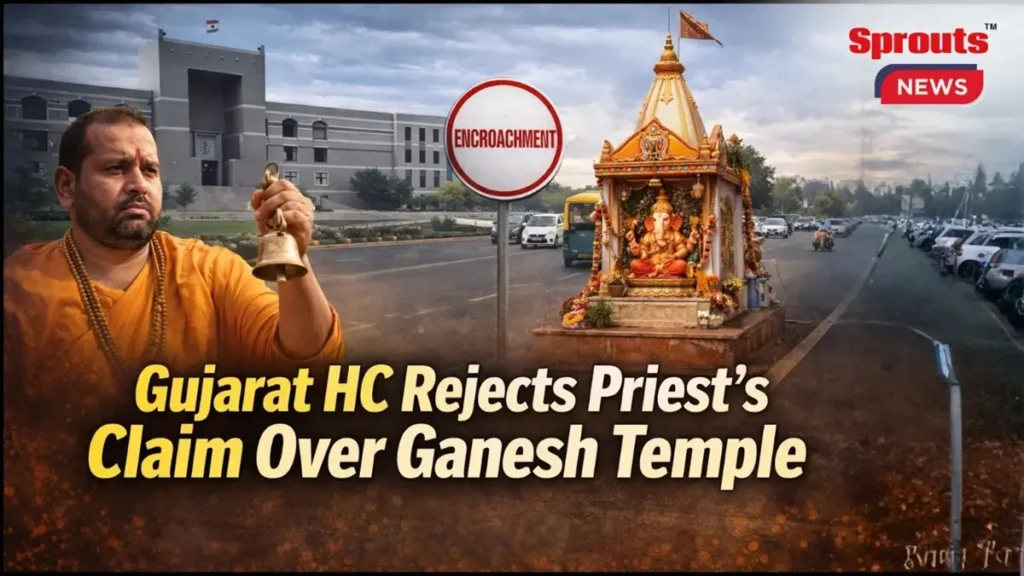
Gujarat High Court Rejects Temple Priest’s Ownership Claim Over Ganesh Temple on Public Road
The Gujarat High Court dismissed a temple priest’s ownership claim over a Ganesh temple built on a public road, ruling that a pujari is merely a servant of the deity and long-standing religious service cannot establish adverse possession or property rights.
- Gujarat High Court Rejects Temple Priest’s Ownership Claim Over Ganesh Temple on Public Road
- Priest Not Landowner, Merely Servant of Deity: Court
- Dispute Originated From Objection by Adjacent Landowner
- Adverse Possession Claim Found Legally Unsustainable
- No Claim by Trustees or Deity Representatives
- Court Flags Encroachments on Public Roads
The Gujarat High Court has dismissed an appeal filed by a temple priest claiming ownership rights over a Ganesh temple constructed on a public access road, reinforcing limits on religious occupation claims.
The ruling came in Rameshbhai Umakant Sharma v. Ashaben Kamleshkumar Modi & Ors, where the Court held that a pujari has no proprietary interest in land.
Justice JC Doshi categorically ruled that a priest functions only as a “servant of the deity” and cannot claim ownership merely due to long-standing religious service.
The Court clarified that performing rituals over several years does not create legal rights over land, particularly when the structure stands on public property.
The judgment carries significance amid growing disputes involving religious structures constructed on public roads and disputed private land across India.
Priest Not Landowner, Merely Servant of Deity: Court
Justice JC Doshi explained the limited legal status of a pujari while rejecting the second appeal filed by the temple priest.
“He is not Bhumiswami, he is just servant of deity,” the Court observed while dismissing claims based on adverse possession.
The Court further stated that a servant cannot argue possession on behalf of a master to claim ownership through adverse possession principles.
It emphasised that religious service does not automatically translate into possessory or proprietary rights under property law.
The High Court ruled that the priest had no authority to stop demolition of the temple or prevent lawful removal ordered by lower courts.
Dispute Originated From Objection by Adjacent Landowner
The dispute began when a landowner objected to the construction of a Ganesh temple on a public access road adjoining her property.
She approached a civil court seeking removal of the unauthorised structure, citing obstruction and infringement of her access rights.
Both the trial court and the first appellate court ruled in her favour, directing demolition of the temple structure.
The courts held that the temple was built on a public road without lawful permission or ownership rights.
Aggrieved by these findings, the temple priest approached the Gujarat High Court in a second appeal.
Adverse Possession Claim Found Legally Unsustainable
Before the High Court, the priest argued that his long-standing occupation and religious duties conferred ownership through adverse possession.
The Court firmly rejected this claim, stating adverse possession requires open, continuous, and hostile occupation against the true owner.
Justice Doshi noted that the priest failed to establish hostility or exclusivity essential to sustain an adverse possession plea.
The priest himself admitted performing rituals with knowledge and consent of others, undermining any claim of hostile possession.
The Court observed that such permissive presence cannot mature into legal title under established property law principles.
Also Read: RBI Slaps Penalty on Co-operative Banks, NBFC Over Lapses.
No Claim by Trustees or Deity Representatives
The High Court also noted that neither temple trustees nor any authorised representative of the deity asserted ownership claims over the land.
The priest acted independently, without mandate or authority, in asserting rights over the temple property.
The Court reiterated that a pujari cannot acquire ownership rights on behalf of a deity without trustee participation.
In absence of claims by lawful custodians, individual priests cannot invoke religious service to assert property rights.
This observation further weakened the priest’s argument and supported the demolition orders.
Court Flags Encroachments on Public Roads
Justice Doshi highlighted broader concerns regarding unauthorised religious structures on public property and access roads.
The Court warned that recognising ownership claims over such constructions would legitimise encroachments and harm public rights.
It stressed that courts must act firmly to prevent misuse of legal doctrines to protect illegal occupations.
Unauthorised religious structures, the Court noted, often infringe upon landowners’ rights and public access.
The judgment reinforces judicial consistency against encroachments, irrespective of religious or sentimental considerations.
Advocate Vijal P Desai appeared on behalf of the temple priest in the matter.
Sprouts News Special Investigation Team notes that the ruling sets a clear precedent limiting adverse possession claims tied to religious service.
The decision is expected to influence similar disputes involving temples, shrines, and religious structures built on public land.