

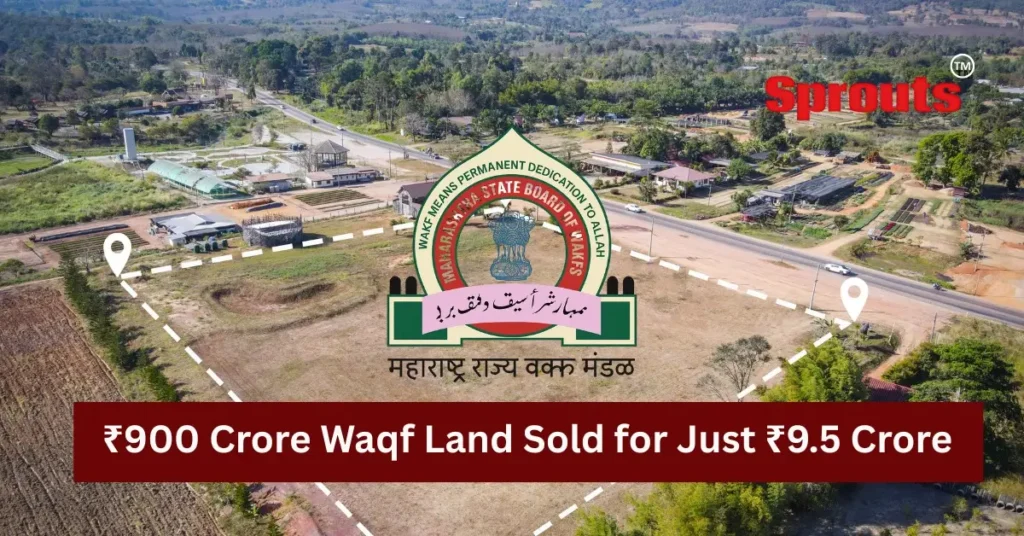
₹900 Crore Waqf Land Sold for Just ₹9.5 Crore
• A 19-Year-Old Cancelled Deal Revived
• Junaid Syed Under Fire for Waqf Land Clearance
• Waqf Act Violated. Pune Land Sold Without Legal Mandate
Unmesh Gujarathi
Sprouts News Exclusive
Contact: +91 9322755098
Sprouts News Exclusive
Contact: +91 9322755098
A massive ₹900 crore Waqf land scam has erupted in Pune’s Baner area, where prime land was sold for just ₹9.5 crore—based on a 19-year-old cancelled deal. Waqf CEO Junaid Syed approved the undervalued sale, sparking demands for a judicial probe. Sprouts SIT reveals deep regulatory and legal violations.
Contents
- ₹900 Crore Waqf Land Sold for Just ₹9.5 Crore
- • A 19-Year-Old Cancelled Deal Revived
- • Junaid Syed Under Fire for Waqf Land Clearance
- • Waqf Act Violated. Pune Land Sold Without Legal Mandate
- Waqf Land Scam: Pune Waqf Land Deal Sparks ₹900 Crore Scam Allegation
- Click Here To Download the News Attachment
- Revival of Cancelled Deal Raises Legal and Ethical Red Flags
- Pressure Mounts for Investigation Amid Public Outcry
- Legal Loopholes and Classification Manipulation Exploited
- Also Read: EOW Charges Anchor Co‑Founder Jadavji Lalji Shah in ₹51 Cr Ambivli Land Scam.
- Sprouts SIT Demands Accountability from Waqf Authorities
- Waqf Land Scam: A Wake-Up Call for Waqf Land Governance
Waqf Land Scam: Pune Waqf Land Deal Sparks ₹900 Crore Scam Allegation
In a shocking turn of events, the Maharashtra State Waqf Board has reignited a land scam involving prime property in Baner, Pune. The land in question—measuring 7 hectares and 34 gunthas (approximately 18.35 acres)—was recently approved for sale at a grossly undervalued rate of ₹9.5 crore, despite its current market value nearing ₹900 crore. The controversial decision was authorised by Waqf CEO Junaid Syed, raising serious concerns of deliberate undervaluation and procedural fraud.
Located adjacent to the Pune–Mumbai Highway and home to the Hazrat Wali Shah Dargah and mosque, the land has historical records dating back to 1860. A similar transaction was proposed in 2006 and later cancelled by the Waqf Board due to non-payment of dues. However, in a surprising move, the same deal—cancelled 19 years ago—has now been revived without price revision or competitive bidding.

Click Here To Download the News Attachment

Revival of Cancelled Deal Raises Legal and Ethical Red Flags
Documents reviewed by the Sprouts News Investigation Team (SIT) confirm that the original 2006 deal involved a sale at ₹9.5 crore, of which ₹7 crore was due to the Waqf Board. The buyer failed to remit this amount by 2009, leading to the deal’s official cancellation. Yet on May 27, 2025, CEO Junaid Syed unilaterally issued a letter declaring the old deal “valid at the same price”, ignoring both inflation and current land rates in the high-demand Baner locality.
Legal experts argue that such a move violates multiple provisions of the Waqf Act, 1995, particularly those related to land protection and fair value extraction for community benefit. “A deal cancelled for non-payment cannot be revived without proper legal vetting and public transparency,” noted a former High Court judge.

Pressure Mounts for Investigation Amid Public Outcry
The decision has caused uproar within the Muslim community and civil society, with activist Mohsin Shaikh demanding a full investigation into what he calls a “deliberate, high-level land grab.” Shaikh has urged the community to speak up, citing systemic misuse of Waqf land under political and bureaucratic pressure.
The Sprouts SIT has also found that multiple cases related to this land have passed through courts over the past two decades. However, none of the judgments support a one-sided revival of the cancelled deal at outdated rates. Legal precedents and court orders were seemingly bypassed or ignored in the CEO’s decision.

Legal Loopholes and Classification Manipulation Exploited
A detailed examination of the official communication reveals another troubling aspect. CEO Junaid Syed, in his letter to the sub-divisional officer (SDO), instructed that the land be reclassified under “Bhogwatdar Varg 1” (private ownership). This request was made under the Waqf Act’s Section 51, claiming exemption from standard land restriction laws. This maneuver effectively attempts to convert trust land into freehold, a violation that could open the floodgates for further land misuse across the state.
Additionally, orders were issued to remove all regulatory notations such as “Waqf-restricted,” “Inam,” or “Vatan” from the 7/12 extracts, further weakening land protection. Experts warn that if left unchecked, this could set a precedent for massive illegal privatization of public religious properties.
Also Read: EOW Charges Anchor Co‑Founder Jadavji Lalji Shah in ₹51 Cr Ambivli Land Scam.
Sprouts SIT Demands Accountability from Waqf Authorities
The Sprouts News Investigation Team (SIT) urges the Government of Maharashtra and the Central Waqf Council to:
•Immediately suspend CEO Junaid Syed pending investigation
•Initiate a judicial inquiry into the 2025 letter and its legality
•Freeze the land transaction until independent valuation and review
•Publish all Waqf land sale decisions from 2000 onwards for public audit
The scale and brazenness of this land undervaluation scandal suggest institutional complicity, possibly spanning political, administrative, and real estate circles.

Waqf Land Scam: A Wake-Up Call for Waqf Land Governance
This episode isn’t just about one plot of land—it reflects a systemic issue in Waqf property governance in India. Protected under the Waqf Act, 1995, such lands are meant for public, religious, and community welfare—not for private profiteering. The Pune Baner land scam, with its ₹890+ crore gap between real and sale value, could emerge as one of the largest Waqf frauds in the country if corrective action is delayed.
For now, the public waits to see if the authorities will stand with the law—or with the dealmakers.