
Vadhavan Port Land Acquisition Sparks Protest as Supreme Court Orders Allegedly Ignored
Fresh protests have erupted over Maharashtra’s Vadhavan Port after locals alleged Supreme Court directions were ignored by starting road construction before land acquisition completion. Fishing communities warn of livelihood and environmental risks, while experts caution violations could delay the project.
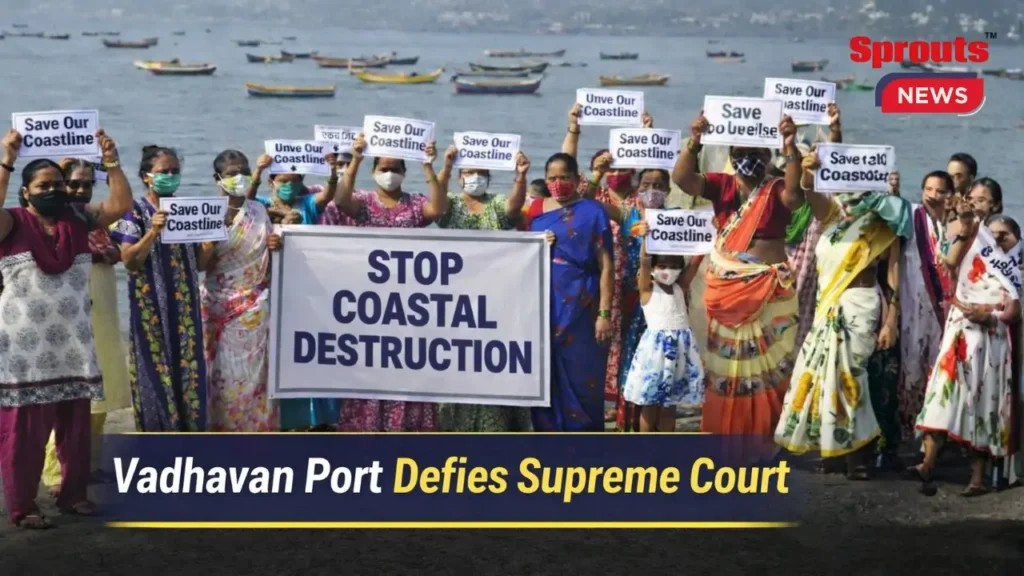
Land acquisition work for the proposed Vadhavan Port project in Maharashtra has triggered fresh protests after locals alleged that authorities violated Supreme Court directions by starting road construction before completing acquisition procedures.
The controversy has reignited tensions in Palghar district, where fishing communities and farmers accuse the Jawaharlal Nehru Port Authority and state agencies of bypassing legal safeguards meant to protect livelihoods and coastal ecosystems.
According to local representatives, access roads and preliminary infrastructure work began even though compensation processes, environmental clearances, and rehabilitation plans remain incomplete, raising serious questions about regulatory compliance.
Activists argue that the Supreme Court had clearly instructed authorities to finish land acquisition and related procedures before initiating any construction linked to the Vadhavan Port project.
They claim the early start of roadwork represents not just administrative haste but a direct challenge to judicial authority, potentially setting a troubling precedent for future infrastructure projects nationwide.
Local residents say the sudden movement of machinery has intensified anxiety among fishing families who depend on coastal access routes for daily livelihoods and fear irreversible damage to marine biodiversity.
Officials associated with the project have maintained that preliminary work does not amount to full-scale construction and falls within permissible limits under existing approvals.
However, legal experts note that Indian courts have repeatedly emphasised procedural completion, including consent and compensation, before any physical alteration of disputed land begins.
Supreme Court Orders, Land Rights, and Coastal Livelihood Concerns
The Vadhavan Port project, envisioned as one of India’s largest deep-water ports, has been positioned as a strategic boost to maritime trade and logistics capacity along the western coast.
Government projections highlight long-term economic gains, including employment generation, increased cargo handling, and reduced congestion at existing ports near Mumbai.
Yet critics argue that these macroeconomic benefits obscure significant social and environmental costs borne disproportionately by local communities in Palghar’s coastal villages.
Fishing unions estimate that thousands of families rely on the affected shoreline for sustenance, seasonal migration, and traditional fishing practices passed down generations.
Environmental groups warn that large-scale dredging and land reclamation could disrupt fish breeding cycles and permanently alter fragile coastal ecosystems.
They also point out that India’s coastal regulation framework mandates strict impact assessments, especially for projects of this scale, before any ground activity commences.
The allegation of Supreme Court order violations has therefore amplified mistrust between local communities and authorities overseeing the project.
Legal analysts say if the claims are substantiated, courts could order an immediate halt to ongoing work and demand accountability from implementing agencies.
Such interventions have occurred in previous infrastructure disputes, where procedural lapses led to prolonged delays and cost escalations.
Protests, Governance Accountability, and Future Implications
Local protest committees have indicated plans for intensified demonstrations if construction activities continue without transparent clarification from authorities.
They are demanding written assurances, public disclosure of approvals, and an independent review of compliance with judicial directions.
Community leaders argue that development should not come at the cost of democratic consultation and constitutional protections for land and livelihood rights.
From a governance perspective, the dispute highlights persistent challenges in balancing rapid infrastructure expansion with rule of law and social consent.
Policy experts warn that ignoring judicial processes can erode investor confidence by increasing legal uncertainty around mega projects.
They also note that early-stage conflicts often snowball into prolonged litigation, delaying economic benefits that such projects aim to deliver.
For policymakers, the Vadhavan Port controversy underscores the need for transparent sequencing of approvals, acquisitions, and construction activities.
Clear communication, fair compensation, and visible respect for court orders are increasingly seen as essential to sustainable infrastructure development.
The Sprouts News Special Investigation Team has learned that legal petitions challenging the roadwork may soon reach higher courts, potentially reshaping the project timeline.
As India accelerates port-led growth under its maritime strategy, the outcome of this dispute could influence how future coastal projects navigate law, livelihoods, and legitimacy.
Unmesh Gujarathi, a senior Indian journalist, along with his Sprouts News team, has consistently raised critical questions on government-led projects. Readers with similar information or concerns may contact the newsroom at 9322755098.