
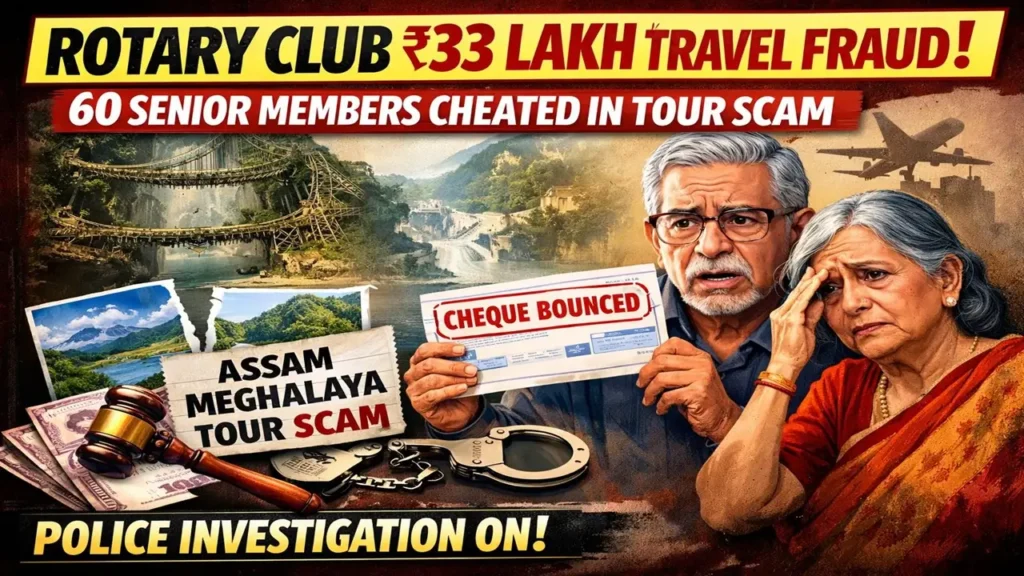
A Rotary Club 33 lakh travel fraud case has emerged in Mumbai after nearly 60 members alleged they were cheated in an Assam and Meghalaya tour plan. Members reportedly paid in instalments for the November 2025 trip, but refund cheques later bounced. A police complaint has been filed at Vakola Police Station, and investigators are reviewing bank transactions and communication records. Most complainants are senior citizens who relied on trust within their social network. The case highlights risks in informal group travel arrangements and the need for stronger financial safeguards.
Rotary Club 33 Lakh Travel Fraud in Mumbai: 60 Members Allegedly Cheated in Assam Meghalaya Tour Scam
A Mumbai based Rotary Club travel scam has surfaced after 60 members alleged a 33 lakh fraud in an Assam Meghalaya tour plan. Refund cheques reportedly bounced, prompting a police complaint and investigation into financial transactions and possible cheating charges.
A 33 lakh travel fraud involving Rotary Club members has surfaced in Mumbai, triggering a police investigation and raising fresh concerns over trust based group tour arrangements.
The alleged scam targets nearly 60 senior citizens associated with a local chapter of Rotary International, who paid for an organised Assam and Meghalaya tour scheduled for November 2025.
According to the complaint, members transferred funds in instalments to a travel planner identified as Rahul Jain, who promised confirmed bookings and structured travel logistics.
The matter came to light after several cheques issued as refunds were dishonoured, prompting affected members to approach Vakola Police Station and file a formal complaint.
Police officials have initiated preliminary inquiries and are examining bank records, payment trails, and communication exchanged between the organiser and the club representatives.
Most complainants are retired professionals who relied on longstanding social networks and internal recommendations before transferring amounts ranging between fifty five thousand and seventy five thousand rupees per person.
Investigators believe approximately thirty three lakh rupees were collectively transferred in two phases during July and September 2025 through bank transfers into the accused’s account.
Members claim the organiser initially projected confidence, citing prior successful tours and presenting detailed itineraries covering Guwahati, Shillong, Cherrapunji, and Kaziranga National Park.
However, on 30 October 2025, travellers were informed that heavy rainfall in the Northeast would force postponement, followed by assurances of full refunds within days.
Mumbai Rotary Club Travel Scam: Cheque Bounce, Refund Promises and Financial Trail
Complainants state that post dated cheques were issued in early November with a request not to deposit them immediately, citing temporary liquidity constraints.
When members finally presented the cheques in December, banks reportedly returned them due to insufficient funds, intensifying suspicions of deliberate financial misrepresentation.
Repeated attempts to contact the organiser allegedly failed, with phone lines switched off and no response to messages or emails seeking clarification.
Senior citizens involved describe emotional distress, noting that many had planned the trip as a post retirement group experience after earlier successful domestic tours.
Financial experts point out that group travel fraud often exploits community trust, especially within service organisations, housing societies, and senior citizen associations.
Such cases frequently involve advance collection of funds, delayed confirmations, and refund assurances that collapse once cumulative liabilities exceed available liquidity.
Police sources indicate that investigators are verifying whether the accused operated independently or through a registered travel agency with valid tourism licences.
Authorities are also expected to assess whether sections related to cheating, criminal breach of trust, and cheque dishonour under applicable laws may be invoked.
Banking professionals advise that large group payments should ideally be routed through escrow mechanisms or corporate accounts rather than personal savings accounts.
Also Read: Kandivali BMC Garden Land Use Sparks Civic Debate.
Senior Citizens, Group Tours and Rising Travel Fraud Cases in India
The case underscores growing vulnerabilities in India’s expanding domestic tourism market, where informal operators often compete aggressively with established travel companies.
Assam and Meghalaya remain popular destinations, especially during winter months, attracting group bookings from metropolitan cities seeking scenic landscapes and moderate weather.
Industry observers note that extreme weather explanations are sometimes misused to justify postponements, though such claims must be independently verified before accepting cancellation narratives.
Consumer rights advocates stress that written contracts, GST invoices, and verified business registrations are essential safeguards when organising high value group travel.
The Sprouts News Special Investigation Team has learned that internal coordination within the club initially relied on verbal confirmations rather than formal vendor due diligence.
Legal experts argue that recovery in cheque bounce cases can be prolonged, particularly when multiple complainants pursue parallel legal remedies without consolidated strategy.
For policymakers, the incident highlights the need for stricter compliance norms for tour operators collecting advance bulk payments from vulnerable groups.
As the investigation progresses, affected members hope for swift accountability and partial recovery, while authorities caution citizens to exercise heightened financial vigilance in community organised travel plans.
If you have credible documents, evidence, or information about corruption, financial fraud, fake degrees, land scams, or abuse of power, contact Unmesh Gujarathi, investigative journalist in Mumbai and Editor in Chief of Sprouts News, on 9322755098. Your identity will be protected.