

IDFC FIRST Bank ₹590 Crore Fraud: Chandigarh Branch Irregularities Exceed Quarterly Profit
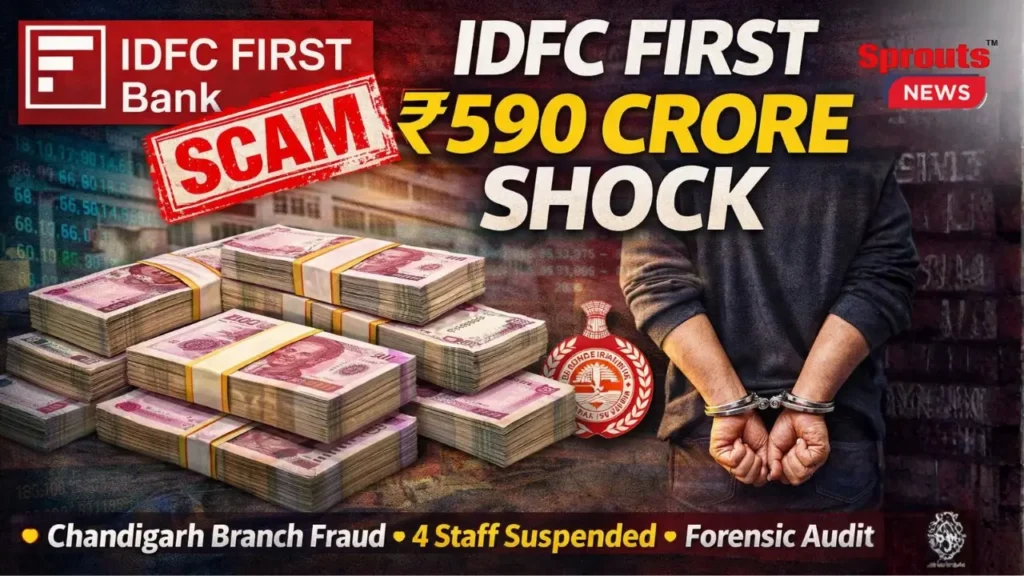
IDFC FIRST Bank has disclosed a ₹590 crore fraud at its Chandigarh branch involving government linked accounts. The amount exceeds the bank’s quarterly profit, raising fresh concerns over internal controls. The issue surfaced during reconciliation after a Haryana government department sought account closure. Multiple accounts reportedly showed balance mismatches. The bank has suspended four employees, initiated a forensic audit and begun recovery efforts. It stated that the irregularities appear confined to a specific cluster of accounts, with the final financial impact dependent on ongoing verification and legal proceedings.
IDFC FIRST Bank ₹590 crore fraud has triggered fresh concerns over internal controls at the private sector lender, coming at a time when it was attempting to stabilise earnings after a bruising microfinance downturn.
On 21 February 2026, IDFC FIRST Bank informed stock exchanges about unauthorised and fraudulent transactions at its Chandigarh branch. The amount under reconciliation stands at approximately ₹590 crore, subject to validation and recoveries.
The scale of the alleged fraud is significant. The amount exceeds the bank’s Q3FY26 net profit of ₹503 crore. It equals roughly 45 percent of its nine month net profit of ₹1,317 crore.
It also represents nearly 40 percent of its FY25 full year net profit of ₹1,490 crore. For investors tracking recovery momentum, the disclosure has reopened risk perception questions around governance and monitoring systems.
How a Haryana Government Account Triggered the Banking Fraud Detection
The fraud surfaced through a routine administrative request. A department of the Government of Haryana sought closure of its account and transfer of funds to another bank.
During reconciliation, bank officials identified a mismatch between the balance quoted by the department and the actual balance recorded internally. That discrepancy prompted deeper scrutiny of linked accounts.
From 18 February 2026 onwards, other Haryana government entities approached the branch with similar concerns. Each case reportedly revealed inconsistencies between expected and available balances.
Preliminary internal findings suggest the issue was confined to a specific cluster of government linked accounts handled at the Chandigarh branch. The bank clarified that the irregularities did not impact other customers.
However, the fact that multiple institutional accounts were affected raises serious operational questions. Government accounts typically involve structured reporting, layered approvals, and periodic reconciliations.
The final financial impact remains uncertain. The bank stated that outcomes will depend on claim validation, recoveries from beneficiary accounts, external liabilities, and the legal process.
Board Action, Forensic Audit and Internal Control Questions
The bank initiated formal steps soon after detection. Four employees suspected of involvement have been suspended pending investigation.
The Special Committee of the Board for Monitoring and Follow up of Cases of Frauds met on 20 February 2026. The Audit Committee and Board of Directors convened the following day before public disclosure.
Statutory auditors were informed and a police complaint has been filed. The bank said it will fully cooperate with investigating agencies.
Crucially, an independent external agency will conduct a forensic audit. This investigation will determine whether the incident was limited to rogue employees or indicative of systemic control lapses.
The bank has also issued recall notices to certain beneficiary banks, requesting lien marking of balances in suspected accounts. The extent of recoveries from these accounts will influence the ultimate financial damage.
For banking experts, the core issue is not only the ₹590 crore exposure but the duration over which such discrepancies remained undetected. Institutional account monitoring mechanisms will likely face scrutiny.
Also Read: Holy Cross Church Kurla Seek Clarity in Legal Dispute.
Microfinance Stress, Profit Recovery and Investor Confidence
The fraud comes amid fragile recovery in profitability. In FY25, the bank’s net profit fell 48 percent to ₹1,490 crore from ₹2,957 crore in FY24.
The decline was driven largely by ₹5,515 crore in provisioning linked to microfinance stress. The lender subsequently reduced its microfinance portfolio by around 40 percent to contain risks.
In Q3FY26, net profit rose 48 percent year on year to ₹503 crore, offering early signs of stabilisation. Managing Director V. Vaidyanathan had indicated that the worst phase of the microfinance cycle might be behind the bank.
In the FY25 annual report, Vaidyanathan acknowledged that the microfinance business is structurally vulnerable to periodic shocks. He stated that insurance coverage could have cushioned losses significantly.
Now, the ₹590 crore fraud disclosure adds a new layer of uncertainty. While not existential for a bank of this size, the reputational cost could be substantial.
For policymakers and regulators, the episode underscores the need for tighter reconciliation protocols in high value institutional accounts. For investors, the forensic audit findings will be decisive.
Until recoveries are quantified and responsibility established, IDFC FIRST Bank faces renewed governance scrutiny at a delicate phase in its recovery journey.
Readers’ Appeal
Sprouts News appeals to readers, banking insiders, regulators, and concerned citizens to come forward with credible information related to the ₹590 crore IDFC FIRST Bank fraud case. Transparency and accountability are essential to protect public funds and strengthen financial governance.
If you have verified documents, insider inputs, or evidence regarding banking irregularities, institutional account discrepancies, or regulatory lapses, you may confidentially contact investigative journalist Unmesh Gujarathi.
(Contact: 9322755098)
Your responsible disclosure can help ensure truth, accountability, and systemic reform.