

DevendrThe Maharashtra medical procurement controversy has escalated after Chief Minister Devendra Fadnavis ordered the transfer of Maharashtra Medical Goods Procurement Authority CEO Mahesh Awhad. The decision follows concerns over unsafe iron syrup supplied for government health programmes targeting malnourished children and pregnant women. Laboratory testing reportedly found the medicine unfit for consumption before large scale distribution. The issue has also raised questions about transparency in a major pharmaceutical procurement process linked to a ₹700 crore drug purchase tender. Health authorities are now reviewing procurement procedures, drug quality monitoring and supplier accountability within the state’s public health system.
- CM Fadnavis Orders Transfer of Maharashtra Medical Procurement CEO Mahesh Awhad After Iron Syrup Safety Scare
- Unsafe Iron Syrup Supply Raises Public Health Alarm
- Questions Over Blacklisting and Tender Transparency
- Tender Conditions and Alleged Manipulation in Drug Procurement
- Calls for Investigation and Audit of Pharmaceutical Supply
- ’Readers’ Information Appeal
CM Fadnavis Orders Transfer of Maharashtra Medical Procurement CEO Mahesh Awhad After Iron Syrup Safety Scare
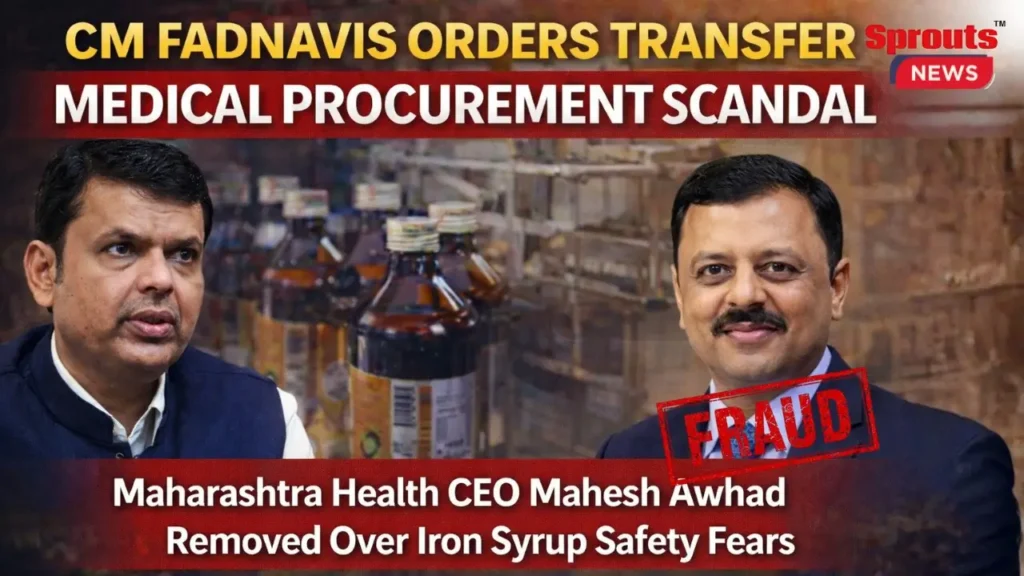
Maharashtra Chief Minister Devendra Fadnavis ordered the transfer of MMGPA CEO Mahesh Awhad after controversy over unsafe iron syrup supplied to government programmes and alleged manipulation in a ₹700 crore drug procurement tender, exposed by investigative journalist Unmesh Gujarathi.
Maharashtra medical procurement controversy has intensified after Chief Minister Devendra Fadnavis ordered the sudden transfer of Maharashtra Medical Goods Procurement Authority CEO Mahesh Awhad following allegations linked to unsafe iron syrup supply and tender manipulation.
The administrative decision has triggered strong reactions within Maharashtra’s public health system, where officials and contractors are now facing closer scrutiny over procurement practices and drug quality monitoring.
According to officials familiar with the matter, the decision came after serious concerns emerged regarding the handling of a defective iron syrup batch intended for malnourished children and pregnant women across the state.
The controversy also relates to alleged irregularities surrounding a large scale pharmaceutical procurement process connected to a ₹700 crore drug purchase tender known as E-215.
Sources in the state administration indicate that the Chief Minister’s Office intervened after questions were raised about procurement transparency and the safety implications of distributing potentially harmful medicines.
Investigative reporting by Sprouts News earlier highlighted multiple irregularities in the case, prompting wider discussion within the health department and among policy observers.
Unsafe Iron Syrup Supply Raises Public Health Alarm
The controversy centres on iron syrup distributed under government health programmes designed to treat anaemia among children and pregnant women in Maharashtra.
Iron supplementation programmes play a crucial role in public health policy because iron deficiency remains one of the most common nutritional disorders affecting vulnerable populations in India.
However, laboratory testing conducted by the Food and Drug Administration reportedly found that the supplied iron syrup was unsafe for human consumption, raising immediate alarm among health authorities.
The iron syrup had been supplied by Hindustan Laboratories Limited, a pharmaceutical company based in Palghar district of Maharashtra.
Officials confirmed that the product had been procured under a government contract valued at approximately ₹10 crore.
The contract involved supplying nearly 12.5 million bottles of iron syrup intended for distribution through government health facilities across Maharashtra.
Health experts say such supplements are widely used in maternal and child healthcare programmes to combat anaemia and improve nutritional outcomes.
If defective medicines had reached beneficiaries, the consequences could have been extremely serious for children and pregnant women relying on these supplements.
Fortunately, the issue reportedly came to light before large scale distribution could take place.
As a result, the iron syrup stock remains stored in government warehouses across the state instead of being distributed through public health centres.
Public health specialists emphasise that strict quality testing is essential because medicines supplied under government programmes often reach vulnerable populations who depend entirely on state healthcare systems.
Questions Over Blacklisting and Tender Transparency
Another controversial aspect of the case involves the administrative response after the iron syrup was declared unsafe.
Under standard procurement guidelines, pharmaceutical companies supplying defective medicines may face blacklisting for a fixed period, typically two years, depending on the severity of the violation.
However, officials reportedly considered blacklisting only the specific medicine batch rather than the entire company.
This approach attracted criticism from observers who argued that such a decision could allow the company to participate in future government tenders.
Concerns grew further because the company was reportedly expected to participate in a ₹700 crore pharmaceutical procurement tender planned by the state health department.
Some officials suggested that the same firm could receive contracts worth ₹80 to ₹100 crore under the upcoming tender.
These developments raised questions about transparency in government procurement procedures and whether defective suppliers should be allowed to continue bidding for public contracts.
Experts in public procurement say strict enforcement of quality compliance is essential to maintain trust in state healthcare programmes.
Also Read: LiveLaw Reporting Debates Grow Over Legal Journalism.
Related News: Unsafe Iron Syrup Found in Maharashtra Health Scheme.
Tender Conditions and Alleged Manipulation in Drug Procurement
The controversy also extends to the design of eligibility criteria in the ₹700 crore procurement tender identified as E-215.
According to administrative sources, revised eligibility conditions under Schedule M manufacturing standards were reportedly introduced in the tender framework.
These conditions could significantly limit the number of eligible suppliers participating in the procurement process.
Out of approximately 151 potential pharmaceutical suppliers, only around 15 to 20 companies might qualify under the revised criteria.
Policy observers say such changes can influence competition levels in government tenders if not implemented with adequate transparency.
Procurement experts stress that fair competition remains essential to ensure cost efficiency and quality standards in large scale public healthcare purchases.
Officials say the Chief Minister reviewed the situation after receiving reports regarding the tender conditions and the handling of the defective iron syrup issue.
Following the review, CEO Mahesh Awhad was transferred from his position at the Maharashtra Medical Goods Procurement Authority.
Administrative officials described the move as a signal that the government intends to enforce greater accountability within public procurement systems.
Calls for Investigation and Audit of Pharmaceutical Supply
The controversy has now triggered demands for a broader investigation into the pharmaceutical supply chain connected to government health programmes in Maharashtra.
Some public health advocates have suggested that authorities should examine whether similar quality issues occurred in previous supplies delivered by the same company.
Experts argue that a comprehensive audit of drug procurement over the past two years could help identify systemic weaknesses in quality monitoring.
Legal observers also note that if negligence in supplying unsafe medicines is proven, criminal liability under relevant public health laws could potentially arise.
Policy analysts say the episode highlights the importance of strong regulatory oversight, transparent tender processes and strict enforcement of pharmaceutical quality standards.
As the investigation continues, officials expect additional scrutiny of procurement procedures within the Maharashtra Medical Goods Procurement Authority.
The outcome of this case could influence how large scale healthcare procurement is monitored in the future.
For policymakers, the incident underscores a critical lesson that safeguarding public health requires uncompromising vigilance in drug procurement and distribution systems.
Experts say stronger compliance mechanisms and independent audits may become increasingly necessary to protect vulnerable beneficiaries who depend on government healthcare programmes.
’Readers’ Information Appeal
Senior investigative journalist Unmesh Gujarathi has been closely investigating and exposing irregularities related to this case. Individuals who possess documents, evidence or information related to scams, corruption or public interest matters may confidentially share details on 9322755098.