


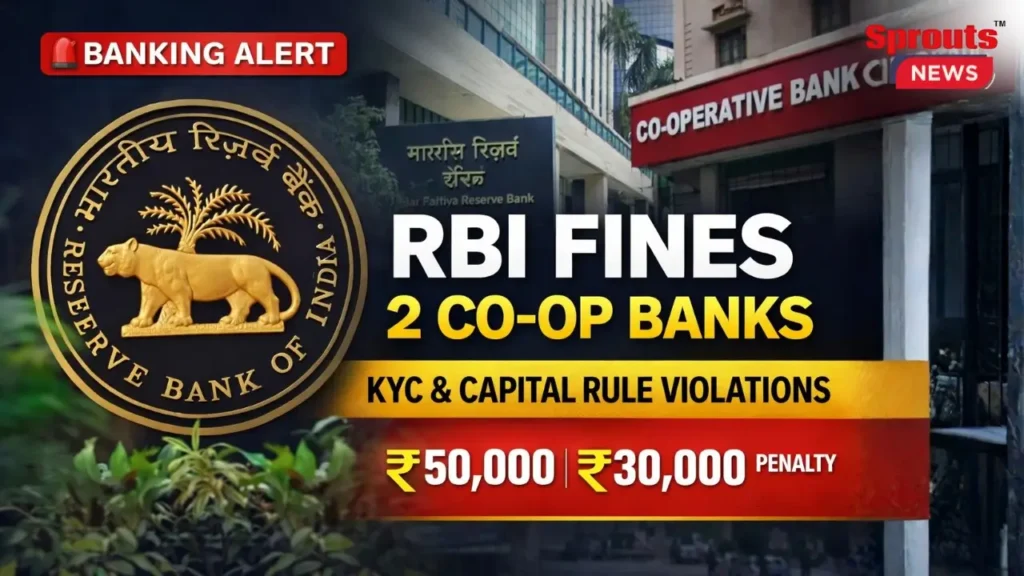
The RBI penalty on two cooperative banks has brought renewed focus on regulatory compliance in India’s urban cooperative banking sector. The Reserve Bank of India imposed monetary penalties on Walchandnagar Sahakari Bank in Maharashtra and Pallikonda Cooperative Urban Bank in Tamil Nadu after inspections found violations of supervisory guidelines. Officials identified deficiencies related to customer due diligence, risk categorisation reviews and capital adequacy monitoring. Banking experts say such actions are part of the RBI’s efforts to strengthen oversight and ensure cooperative banks maintain strict compliance standards to prevent financial risks and maintain trust in the banking system.
- RBI Penalty on Cooperative Banks: Walchandnagar Sahakari Bank and Pallikonda Cooperative Urban Bank Fined for Regulatory Violations
- RBI Penalty on Two Cooperative Banks Highlights KYC Compliance and Risk Monitoring Failures
- Pallikonda Cooperative Urban Bank Penalised for Capital Adequacy and Loan Norm Violations
- Regulatory Oversight and Future Implications for India’s Cooperative Banking Sector
- Readers’ Appeal:
RBI Penalty on Cooperative Banks: Walchandnagar Sahakari Bank and Pallikonda Cooperative Urban Bank Fined for Regulatory Violations
The Reserve Bank of India imposed penalties on Walchandnagar Sahakari Bank and Pallikonda Cooperative Urban Bank for violating regulatory norms. The action highlights lapses in KYC compliance, capital adequacy, and lending practices, reinforcing RBI’s stricter oversight of cooperative banks.
The RBI penalty on cooperative banks has once again highlighted concerns about regulatory compliance within India’s urban cooperative banking sector. The Reserve Bank of India recently imposed monetary penalties on two cooperative banks for failing to follow mandatory banking regulations.
The central bank fined Walchandnagar Sahakari Bank Ltd in Maharashtra ₹50,000 and Pallikonda Cooperative Urban Bank Ltd in Tamil Nadu ₹30,000 for violations linked to regulatory norms and supervisory guidelines.
According to RBI officials, the penalties were imposed after statutory inspections revealed lapses in regulatory compliance, particularly involving customer due diligence requirements and capital adequacy norms.
While the financial penalties are relatively modest, banking experts say the action serves as an important reminder about the importance of regulatory discipline among cooperative banks.
Authorities emphasised that the penalties relate specifically to deficiencies in compliance procedures and do not question the validity of transactions conducted between the banks and their customers.
RBI Penalty on Two Cooperative Banks Highlights KYC Compliance and Risk Monitoring Failures
The largest penalty was imposed on Walchandnagar Sahakari Bank Ltd, a cooperative bank operating in Maharashtra.
The Reserve Bank found that the bank had failed to maintain an effective system for periodically reviewing the risk categorisation of customer accounts, which forms a core component of know your customer compliance requirements.
Under RBI regulations, banks must conduct a periodic review of customer risk profiles at least once every six months to identify potential risks related to money laundering or suspicious financial activity.
The central bank’s statutory inspection concluded that Walchandnagar Sahakari Bank did not implement a robust system to ensure such periodic risk assessments were consistently conducted.
Banking regulators consider risk categorisation reviews essential because they help institutions monitor high-risk accounts and maintain safeguards against financial crimes.
Failure to conduct these reviews can weaken anti-money laundering frameworks and expose banks to regulatory scrutiny.
The RBI, therefore, determined that the bank had failed to comply with specific supervisory directions issued by the central bank.
Following the inspection, the regulator issued a show-cause notice to the bank seeking explanations for the observed deficiencies.
After reviewing the bank’s written response and hearing its oral submissions during a personal hearing, the RBI concluded that the violations warranted a monetary penalty.
Also Read: ED Raids 19 Locations in ₹597 Crore IDFC First Bank Scam.
Pallikonda Cooperative Urban Bank Penalised for Capital Adequacy and Loan Norm Violations
The second penalty was imposed on Pallikonda Cooperative Urban Bank Ltd, a primary urban cooperative bank based in Tamil Nadu.
The bank was fined ₹30,000 after the Reserve Bank identified irregularities related to prudential norms governing capital adequacy and lending practices.
During the statutory inspection, RBI officials found that the bank had allowed members to receive refunds of share capital despite the bank’s capital-to-risk-weighted assets ratio remaining below the regulatory minimum requirement.
Capital adequacy ratios are critical indicators of a bank’s financial stability because they measure the institution’s ability to absorb potential losses.
Allowing share capital refunds under such circumstances can weaken the bank’s capital base and undermine regulatory safeguards designed to protect depositors.
The inspection also revealed that Pallikonda Cooperative Urban Bank sanctioned certain loans without complying with the mandatory share linking to borrowing norms, even though the bank’s capital adequacy ratio remained below the prescribed threshold.
Investigators also discovered that loans had been sanctioned to nominal members beyond the limits permitted under regulatory guidelines.
Such practices raise concerns about governance standards within cooperative banking institutions.
Regulatory Oversight and Future Implications for India’s Cooperative Banking Sector
The RBI stated that the penalties imposed on both institutions were based solely on regulatory deficiencies identified during inspections.
The central bank clarified that the monetary penalties should not be interpreted as a judgment on the validity of any individual transaction between the banks and their customers.
Experts note that cooperative banks play an important role in India’s financial ecosystem, particularly in semi-urban and rural areas where they provide access to credit for small businesses and households.
However, the sector has periodically faced regulatory scrutiny due to governance lapses, weak compliance systems, and inadequate risk management frameworks.
Over the past decade, several cooperative bank failures have prompted regulators to strengthen oversight mechanisms and enforce stricter compliance requirements.
Regulatory experts say even relatively small penalties can serve as warning signals that encourage banks to strengthen internal control systems and improve compliance culture.
The latest action by the Reserve Bank also reflects its continued efforts to ensure that cooperative banks maintain proper governance standards while safeguarding depositor interests.
Officials indicated that supervisory monitoring will continue and that banks must strengthen internal compliance systems to avoid further regulatory action.
According to the Sprouts News Special Investigation Team, increased regulatory vigilance is likely to remain a key feature of India’s cooperative banking oversight framework as authorities seek to prevent financial risks and maintain public confidence in the sector.
Readers’ Appeal:
“Truth needs courage.” Share credible information with Unmesh Gujarathi, senior journalist in Mumbai, or his team at 9322755098.