
The Dharavi Adani protest march has been announced for May 4 in Mumbai, led by Dharavi Bachav Andolan, raising concerns over rehabilitation and redevelopment transparency. Protesters plan to march to an office linked to the Adani Group, demanding that all residents be accommodated within Dharavi. Organisers have also questioned ongoing survey processes and eligibility classifications, alleging that many residents risk exclusion. Authorities have not publicly confirmed these claims. The issue highlights ongoing tensions around one of India’s largest redevelopment projects, with calls for dialogue, clarity, and fair implementation.
- Dharavi Adani protest march announced: Demonstration planned at Matunga office on May 4 over rehabilitation demands
- Dharavi redevelopment background and survey concerns
- A meeting at Shiv Sena Bhavan gathers multiple leaders
- Statements by Anil Desai, Baburao Mane and Mahesh Sawant
- Koliwada exclusion demand and legal route discussed
- What happens next on May 4
- Adani Group controversies: Key disputes involving Gautam Adani, Hindenburg report and project scrutiny
- Hindenburg Research report triggered global market attention
- Environmental disputes around ports, mining and coastal projects
- Australia’s Carmichael mine became a symbolic controversy
- Political scrutiny and debt concerns in India
- What happens next for Gautam Adani and the group
Dharavi Adani protest march announced: Demonstration planned at Matunga office on May 4 over rehabilitation demands
Dharavi Bachav Andolan has announced a major march to an Adani-linked office in Matunga on May 4, citing concerns over survey eligibility, rehabilitation, and redevelopment transparency.
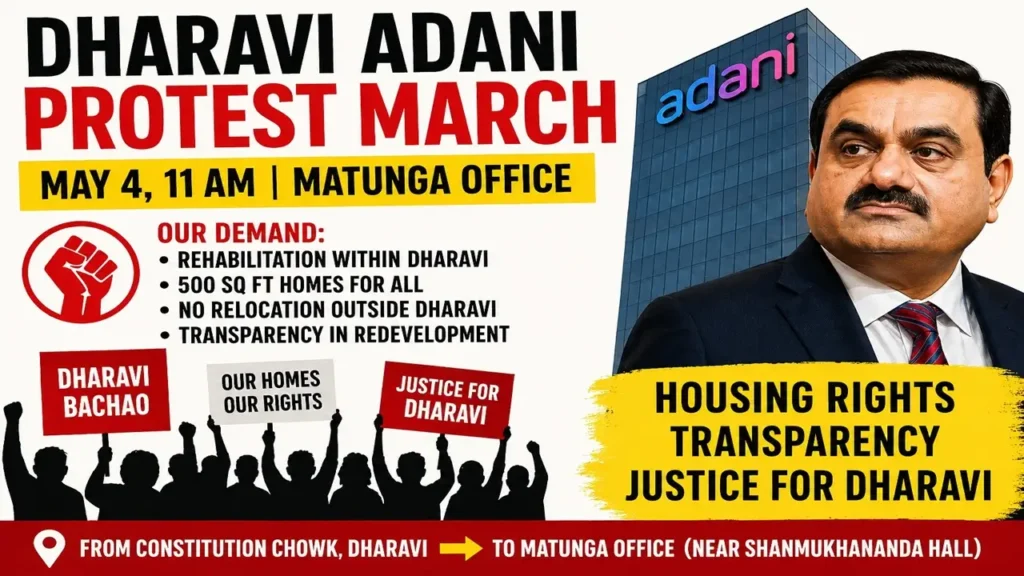
The Dharavi Adani protest march has been announced for May 4 at 11 am, with organisers alleging repeated neglect of long-pending rehabilitation demands by authorities.
The proposed demonstration is expected to proceed toward an office in Matunga associated with the Dharavi redevelopment process involving the Adani Group.
Organisers stated their principal demand is that all eligible and ineligible slum residents be accommodated within Dharavi through 500 square feet housing units.
They further asserted that no existing resident should be relocated outside Dharavi during the implementation of the large-scale redevelopment programme now under public scrutiny.
Dharavi redevelopment background and survey concerns
Dharavi is widely recognised as one of Asia’s largest informal settlements, spread across roughly 600 acres with dense residential and commercial activity.
Organisers claimed the state awarded rehabilitation responsibilities to Navbharat Mega Developers Pvt Ltd for project execution in coordination with SRA authorities.
They alleged that current surveys undertaken with the Slum Rehabilitation Authority had recognised only around 5,000 structures as eligible.
According to protest leaders, many residents fear large-scale disqualification could eventually result in relocation outside Dharavi, though authorities have not publicly confirmed those claims.
Sprouts News has not independently verified the latest survey totals or final eligibility classifications at the time of publication.

A meeting at Shiv Sena Bhavan gathers multiple leaders
A preparatory meeting was reportedly held at Shiv Sena Bhavan in the presence of Anil Desai.
Attendees named by organisers included Baburao Mane, Mahesh Sawant, Vitthal Pawar, Mahadev Shinde, Kiran Kale, Anand Bhosale, Munna Shaikh, Satish Katke, Mani Kadan, Ganesh Tevar, Suresh Sawant, Ganga Derbar, Ulesh Gajkosh, Vasant Khandare, Rafael Paul, Shyamlal Jaiswar, Rahul Gaikwad, Nasrul Haq, and Jagan Bhosale.
Organisers said representatives from Shiv Sena (Thackeray faction), Congress, NCP (Sharad Pawar faction), CPI, CPM, Samajwadi Party, BSP, and Aam Aadmi Party attended.
Statements by Anil Desai, Baburao Mane and Mahesh Sawant
Anil Desai reportedly reviewed concerns about alleged one-sided functioning by project agencies and assured participants that he would join the May 4 march.
Baburao Mane alleged the current eligibility count was inadequate and claimed authorities had failed to respond despite repeated representations from residents and activists.
He further alleged some residents could be shifted to locations such as Mulund, Dahisar, or Govandi, though no official relocation plan was cited.
Mahesh Sawant questioned why presentations reportedly conducted for redevelopment elsewhere, including Motilal Nagar in Goregaon, had not been similarly organised in Dharavi.
Koliwada exclusion demand and legal route discussed
Organisers also raised demands by local Koli community groups seeking exclusion of Koliwada areas from the Dharavi redevelopment project.
They argued that traditional fishing communities are among Mumbai’s original inhabitants and should retain cultural identity, settlement patterns, and occupational continuity.
Some speakers reportedly suggested that a review petition before the Bombay High Court could be explored.
What happens next on May 4
The march is expected to begin from Constitution Chowk in Dharavi before proceeding toward the Matunga office near Shanmukhananda Hall, organisers said.
Authorities may issue traffic advisories, security arrangements, or clarifications regarding redevelopment surveys and rehabilitation policy ahead of the planned mobilisation.
The Dharavi Adani protest march is likely to intensify debate over housing rights, urban renewal, and transparency in one of Mumbai’s most consequential projects.
Also Read: Raj Kundra, Shilpa Shetty SFL FIR Row Back in Spotlight.
Related News: Dharavi Dumped: Fury Grows Over Adani Relocation Plan.
Related News: Adani vs Dharavi: Residents Rise Against Evictions.
Related News: Adani’s Dharavi Redevelopment BKC Dream Hits a Showdown.
Adani Group controversies: Key disputes involving Gautam Adani, Hindenburg report and project scrutiny
Adani Group and chairman Gautam Adani have faced recurring scrutiny over markets, environment, debt, and political influence, while consistently denying wrongdoing.
The Adani Group controversies debate has remained prominent as the conglomerate expanded rapidly across ports, airports, mining, power, logistics, and renewable energy sectors.
Founded by Gautam Adani, the group grew into one of India’s most influential corporate networks with interests spanning strategic infrastructure and global commodity markets.
Alongside growth, the conglomerate has periodically faced criticism from investors, activists, opposition parties, and research firms over governance and regulatory concerns.
The group has repeatedly maintained that it complies with applicable laws, follows due process, and rejects unsupported allegations made against it.
Hindenburg Research report triggered global market attention
One of the most consequential episodes emerged in 2023 when Hindenburg Research released a report targeting Adani companies.
The report alleged stock manipulation, improper offshore structures, and accounting irregularities across parts of the business empire, creating immediate international market attention.
Following publication, the listed Adani companies witnessed steep declines in market capitalisation, prompting volatility across Indian equity markets and renewed debate on corporate disclosures.
Adani Group strongly rejected the claims, describing them as baseless, malicious, and motivated by short-selling interests rather than public accountability.
The controversy also triggered wider calls for regulatory clarity, parliamentary debate, and enhanced transparency standards within India’s listed corporate sector.
Environmental disputes around ports, mining and coastal projects
Several Adani-linked infrastructure projects have drawn objections from environmental organisations and community groups in India and overseas jurisdictions.
Critics have raised concerns involving land acquisition, ecological damage, air quality, coastal systems, and possible displacement of affected populations.
Adani entities have generally responded that required permissions were obtained through lawful channels and that sustainability commitments remain part of project execution.
Such disputes reflect broader tensions between industrial expansion, employment generation, infrastructure needs, and long-term environmental preservation.
These issues have often placed the conglomerate at the centre of national conversations on development versus ecological responsibility.
Australia’s Carmichael mine became a symbolic controversy
The Carmichael coal mine project in Australia, later operated under Bravus Mining & Resources, became internationally controversial.
Climate campaigners argued the project could worsen carbon emissions and affect ecosystems linked to the Great Barrier Reef region.
Supporters, however, said the mine would generate jobs, export revenues, and infrastructure benefits for surrounding regions.
The dispute elevated Adani’s profile globally, making the group a symbol in wider climate and energy-transition debates.
Political scrutiny and debt concerns in India
In India, opposition leaders have periodically questioned the pace of the Adani Group’s expansion and alleged favourable treatment by governments.
The group has denied receiving undue advantages, stating that projects were won through competitive bidding, technical capability, and execution strength.
Financial analysts have also tracked leverage levels across group companies during phases of aggressive acquisition and expansion.
In response, Adani firms have highlighted debt reduction measures, fresh investor participation, refinancing efforts, and asset-backed balance sheet strength.
Sprouts News notes that debt scrutiny is common for capital-intensive infrastructure conglomerates and does not itself establish misconduct.
What happens next for Gautam Adani and the group
As Adani Group continues investing in renewable energy, transport, logistics, and utilities, scrutiny from markets and civil society is likely to continue.
Future developments may depend on regulatory outcomes, project performance, disclosure standards, and the group’s ability to manage reputation risks.
Despite repeated controversies, Gautam Adani’s conglomerate remains central to India’s infrastructure story and one of the country’s most closely watched business houses.
Appeal to Readers
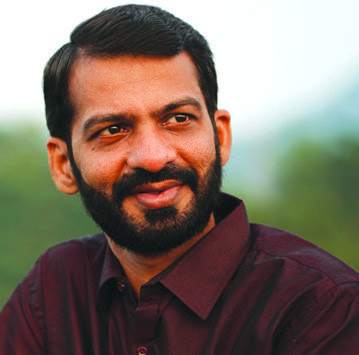
Unmesh Gujarathi, an investigative journalist in Mumbai, has reported on several controversies linked to the Adani Group, including issues surrounding the Dharavi redevelopment project. Readers with credible documents, verified leads, or public-interest information may contribute to the team by contacting 9322755098.
Editorial Note:
This article is based on publicly available FIR records, court case references, and reports published by multiple media organisations. The information is presented in the context of ongoing investigations and public interest reporting. Sprouts News does not make any judicial determination regarding the individuals mentioned and does not intend to defame any person or organisation. Any individual seeking clarification or wishing to provide an official response may contact the editorial team with verifiable documentation. The information is presented for journalistic and informational purposes.