

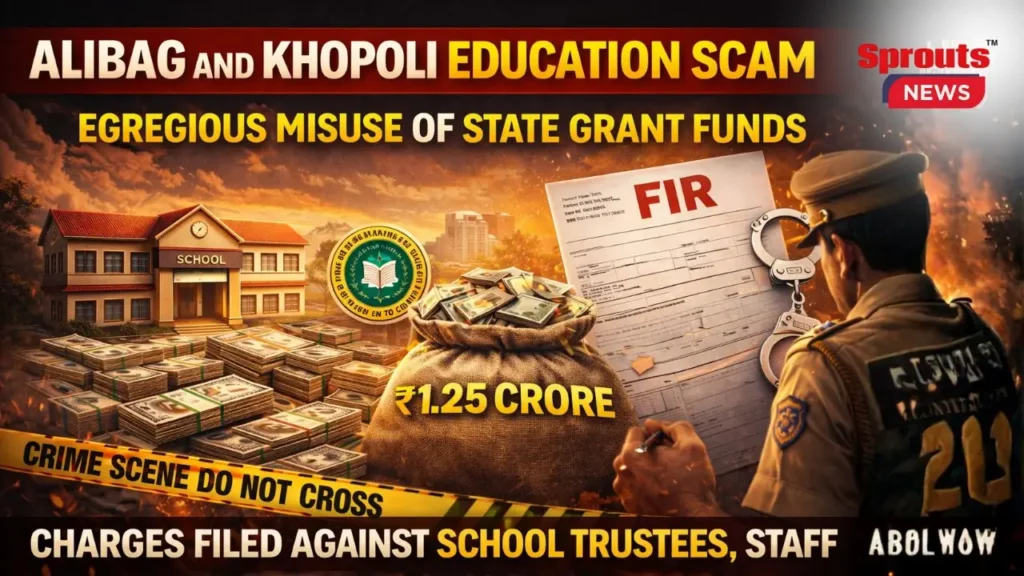
Alibag and Khopoli Education Scam: Maharashtra Board Files Criminal Case in ₹1.25 Crore Grant Misappropriation
The Alibag and Khopoli Education Scam has come to light after the Maharashtra State Board of Secondary and Higher Secondary Education filed a criminal complaint over alleged misuse of ₹1.25 crore in school grants. Police have named trustees, principals and staff linked to aided institutions. The probe focuses on possible diversion of funds meant for teacher salaries and development. Authorities say the investigation will determine individual responsibility.
- Alibag and Khopoli Education Scam: Maharashtra Board Files Criminal Case in ₹1.25 Crore Grant Misappropriation
- Names of Accused and Role of Education Authorities in Grant Probe
- Public Education Funding, Accountability and Governance Implications
- Names of Accused and Role of Education Authorities in Grant Probe
- Public Education Funding, Accountability and Governance Implications
According to official sources, the case involves grant funds meant for aided schools under the education department, raising serious questions about accountability in public education financing.
Police have reportedly registered offences against trustees, principals and teaching staff associated with Janata Shikshan Prasarak Mandal in Alibag and Khopoli Shikshan Prasarak Mandal.
The complaint was lodged following internal scrutiny by divisional authorities of the Maharashtra education board, which detected discrepancies in utilisation of government sanctioned grants.
Preliminary findings suggest that funds allocated for teachers’ salaries and institutional development were allegedly diverted through irregular documentation and accounting practices.
Officials familiar with the investigation stated that the suspected amount of misappropriation stands at approximately ₹1,25,22,747 based on financial records reviewed so far.
This case matters beyond a single institution because grant based education funding in Maharashtra supports thousands of rural and semi urban schools.
Any diversion of funds directly impacts teacher salaries, classroom infrastructure and students from economically weaker sections who depend on aided institutions.
Names of Accused and Role of Education Authorities in Grant Probe
Police records indicate that a total of twenty individuals have been named in the FIR, including office bearers and administrative staff of the concerned trusts.
Among those named are Milind Patil, Ramnath Patil, DP Haribhau Patil and Pramod Patil, who are reportedly linked to management roles within the institutions.
Other individuals include Dilip Patil, Vijayanand Patil, Dnyaneshwar Patil, and Sangeeta Patil, whose names appear in documentation connected to financial approvals.
The complaint also mentions teachers and administrative personnel such as Mugdha Gawand, Jayesh Patil and Sudhir Raut in connection with grant utilisation procedures.
Authorities have clarified that naming in the FIR does not imply guilt, and all accused will have the opportunity to present evidence during investigation and trial.
The Maharashtra State Board’s divisional chairman is understood to have forwarded the matter to the police after identifying procedural violations during departmental audit.
Education officials emphasised that government grants are released after verification of enrolment strength, teacher appointments and compliance with regulatory norms.
If proven, manipulation of grant claims may involve offences under sections related to criminal breach of trust, forgery and cheating under the Indian Penal Code.

Investigators are now examining salary registers, bank statements and sanction orders to determine whether inflated staff positions were shown to secure higher grants.
The case has been registered at the local police station in Alibag, with further inquiry expected to include forensic accounting review.
Also Read: ED Action against J M Mhat.es Panvel Assembly politics.
Public Education Funding, Accountability and Governance Implications
Education policy experts warn that grant misappropriation erodes public confidence in aided school systems, particularly in districts like Raigad where private trusts manage several institutions.
The alleged diversion highlights systemic vulnerabilities in documentation, monitoring and verification processes within the grant disbursement mechanism.
Under existing rules, schools must submit audited utilisation certificates annually, yet enforcement often depends on periodic inspections rather than continuous digital oversight.
Officials from the education department indicated that corrective administrative action may follow independent of criminal proceedings if procedural lapses are confirmed.
The controversy also places renewed focus on governance of education trusts, which operate as public charitable bodies but handle substantial taxpayer funded grants.
Legal experts state that if evidence establishes deliberate falsification of records, penalties could include imprisonment and recovery of funds under criminal law.
At the same time, due process requires careful examination to ensure that genuine administrative errors are not conflated with intentional fraud.
The Maharashtra government has in recent years attempted to digitise salary disbursement through direct benefit mechanisms to reduce scope for manipulation.
However, this case suggests that oversight gaps may still exist in documentation submitted prior to release of funds.
Sprouts News will continue to monitor official statements, court filings and audit findings as the investigation progresses.
For parents and students in Alibag and Khopoli, the outcome of this case will determine whether trust in aided educational institutions can be restored through transparent accountability.
The Alibag and Khopoli education scam has surfaced after the Maharashtra State Board of Secondary and Higher Secondary Education registered a criminal complaint over alleged financial irregularities exceeding ₹1.25 crore.

According to official sources, the case involves grant funds meant for aided schools under the education department, raising serious questions about accountability in public education financing.
Police have reportedly registered offences against trustees, principals and teaching staff associated with Janata Shikshan Prasarak Mandal in Alibag and Khopoli Shikshan Prasarak Mandal.
The complaint was lodged following internal scrutiny by divisional authorities of the Maharashtra education board, which detected discrepancies in utilisation of government sanctioned grants.
Preliminary findings suggest that funds allocated for teachers’ salaries and institutional development were allegedly diverted through irregular documentation and accounting practices.
Officials familiar with the investigation stated that the suspected amount of misappropriation stands at approximately ₹1,25,22,747 based on financial records reviewed so far.
This case matters beyond a single institution because grant based education funding in Maharashtra supports thousands of rural and semi urban schools.
Any diversion of funds directly impacts teacher salaries, classroom infrastructure and students from economically weaker sections who depend on aided institutions.
Names of Accused and Role of Education Authorities in Grant Probe
Police records indicate that a total of twenty individuals have been named in the FIR, including office bearers and administrative staff of the concerned trusts.
Among those named are Milind Patil, Ramnath Patil, DP Haribhau Patil and Pramod Patil, who are reportedly linked to management roles within the institutions.
Other individuals include Dilip Patil, Vijayanand Patil, Dnyaneshwar Patil, and Sangeeta Patil, whose names appear in documentation connected to financial approvals.
The complaint also mentions teachers and administrative personnel such as Mugdha Gawand, Jayesh Patil and Sudhir Raut in connection with grant utilisation procedures.
Authorities have clarified that naming in the FIR does not imply guilt, and all accused will have the opportunity to present evidence during investigation and trial.
The Maharashtra State Board’s divisional chairman is understood to have forwarded the matter to the police after identifying procedural violations during departmental audit.
Education officials emphasised that government grants are released after verification of enrolment strength, teacher appointments and compliance with regulatory norms.
If proven, manipulation of grant claims may involve offences under sections related to criminal breach of trust, forgery and cheating under the Indian Penal Code.

Investigators are now examining salary registers, bank statements and sanction orders to determine whether inflated staff positions were shown to secure higher grants.
The case has been registered at the local police station in Alibag, with further inquiry expected to include forensic accounting review.
Public Education Funding, Accountability and Governance Implications
Education policy experts warn that grant misappropriation erodes public confidence in aided school systems, particularly in districts like Raigad where private trusts manage several institutions.
The alleged diversion highlights systemic vulnerabilities in documentation, monitoring and verification processes within the grant disbursement mechanism.
Under existing rules, schools must submit audited utilisation certificates annually, yet enforcement often depends on periodic inspections rather than continuous digital oversight.
Officials from the education department indicated that corrective administrative action may follow independent of criminal proceedings if procedural lapses are confirmed.
The controversy also places renewed focus on governance of education trusts, which operate as public charitable bodies but handle substantial taxpayer funded grants.
Legal experts state that if evidence establishes deliberate falsification of records, penalties could include imprisonment and recovery of funds under criminal law.
At the same time, due process requires careful examination to ensure that genuine administrative errors are not conflated with intentional fraud.
The Maharashtra government has in recent years attempted to digitise salary disbursement through direct benefit mechanisms to reduce scope for manipulation.
However, this case suggests that oversight gaps may still exist in documentation submitted prior to release of funds.
Sprouts News will continue to monitor official statements, court filings and audit findings as the investigation progresses.
For parents and students in Alibag and Khopoli, the outcome of this case will determine whether trust in aided educational institutions can be restored through transparent accountability.