

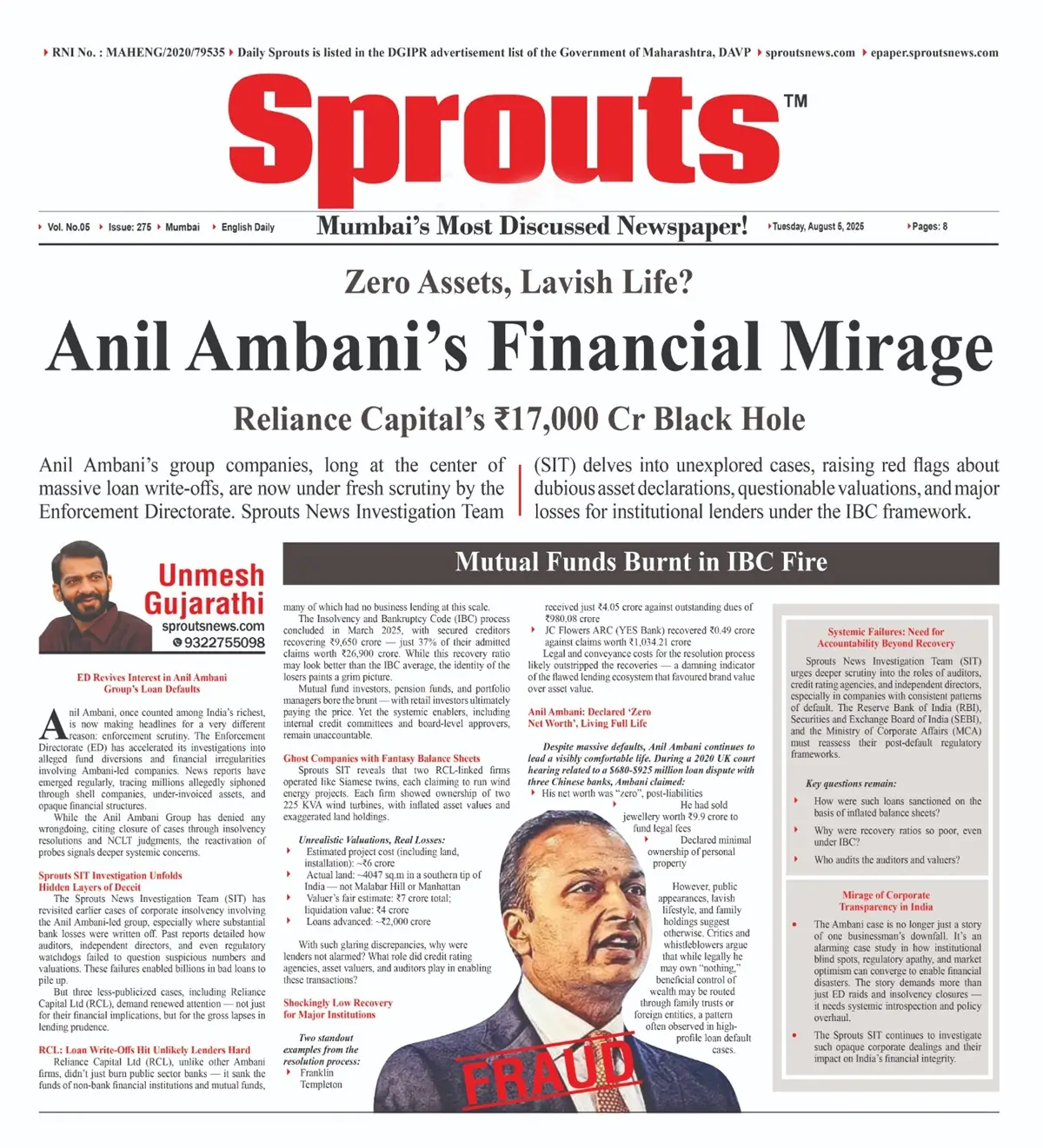
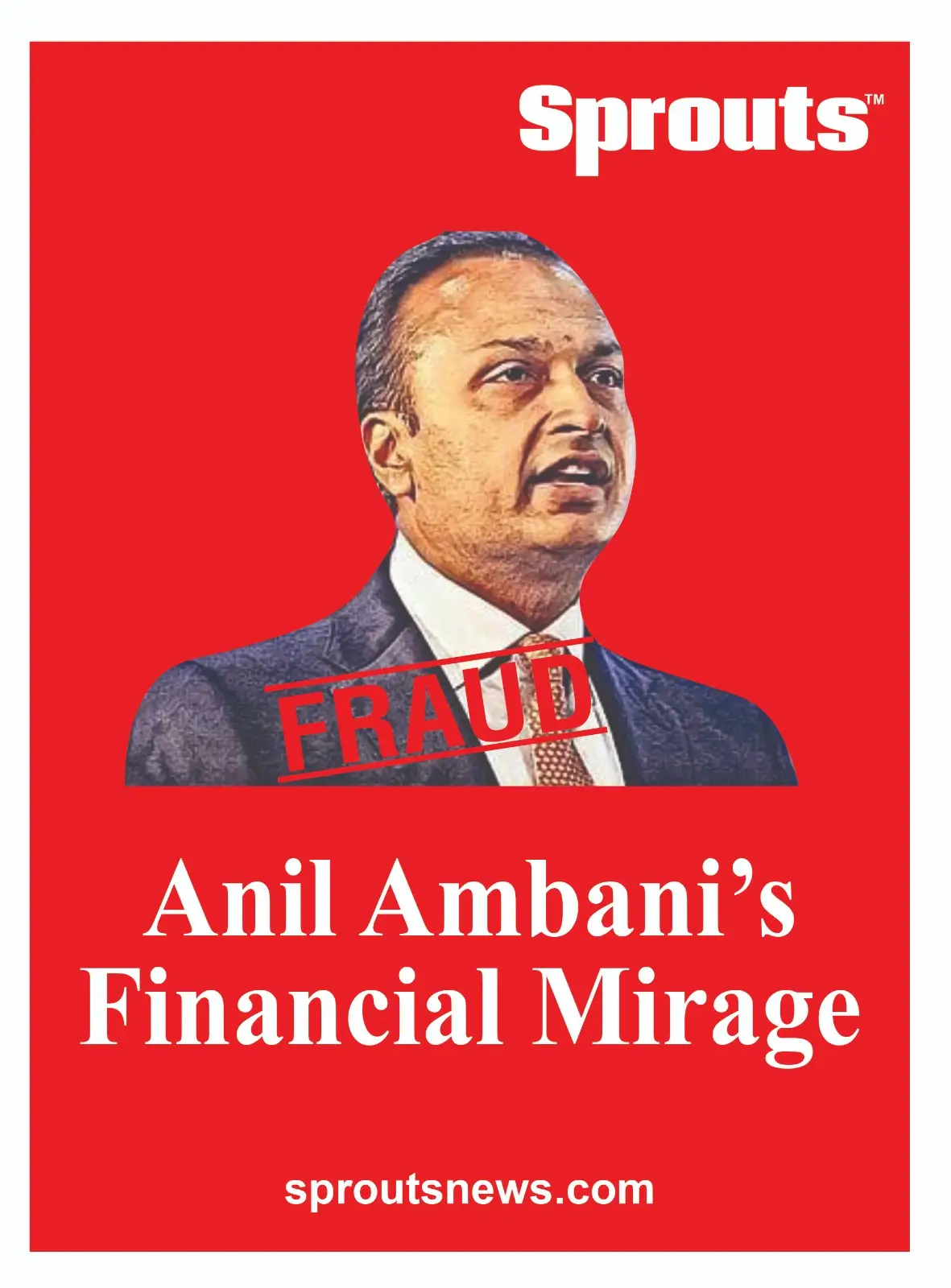
Anil Ambani’s Financial Mirage
• Zero Assets, Lavish Life?
• Reliance Capital’s ₹17,000 Cr Black Hole
• Mutual Funds Burnt in IBC Fire
Unmesh Gujarathi
Sprouts News Exclusive
Contact: +91 9322755098
Sprouts News Exclusive
Contact: +91 9322755098
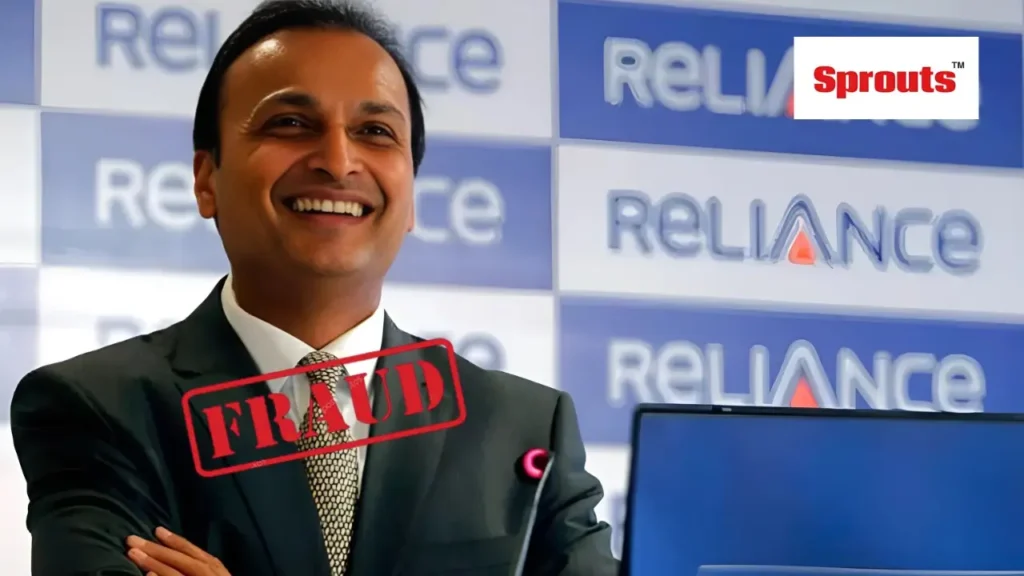
Anil Ambani’s group companies, long at the center of massive loan write-offs, are now under fresh scrutiny by the Enforcement Directorate. Sprouts News Investigation Team (SIT) delves into unexplored cases, raising red flags about dubious asset declarations, questionable valuations, and major losses for institutional lenders under the IBC framework.
ED Revives Interest in Anil Ambani Group’s Loan Defaults
Anil Ambani, once counted among India’s richest, is now making headlines for a very different reason: enforcement scrutiny. The Enforcement Directorate (ED) has accelerated its investigations into alleged fund diversions and financial irregularities involving Ambani-led companies. News reports have emerged regularly, tracing millions allegedly siphoned through shell companies, under-invoiced assets, and opaque financial structures.
While the Anil Ambani Group has denied any wrongdoing, citing closure of cases through insolvency resolutions and NCLT judgments, the reactivation of probes signals deeper systemic concerns.
Click Here To Download the News Attachment
Contents
- Anil Ambani’s Financial Mirage
- • Zero Assets, Lavish Life?
- • Reliance Capital’s ₹17,000 Cr Black Hole
- • Mutual Funds Burnt in IBC Fire
- ED Revives Interest in Anil Ambani Group’s Loan Defaults
- Sprouts SIT Investigation Unfolds Hidden Layers of Deceit
- RCL: Loan Write-Offs Hit Unlikely Lenders Hard
- Ghost Companies with Fantasy Balance Sheets
- Shockingly Low Recovery for Major Institutions
- Anil Ambani: Declared ‘Zero Net Worth’, Living Full Life
- Also Read: Sr Panvel Civic Official Booked In Sexually Assaulting And Rape Case.
- Related Article: ED Probe Into ₹3,000 crore Yes Bank loan fraud linked to Anil Ambani’s Reliance ADAG group.
- Systemic Failures: Need for Accountability Beyond Recovery
- Mirage of Corporate Transparency in India
Sprouts SIT Investigation Unfolds Hidden Layers of Deceit
The Sprouts News Investigation Team (SIT) has revisited earlier cases of corporate insolvency involving the Anil Ambani-led group, especially where substantial bank losses were written off. Past reports detailed how auditors, independent directors, and even regulatory watchdogs failed to question suspicious numbers and valuations. These failures enabled billions in bad loans to pile up.
But three less-publicized cases, including Reliance Capital Ltd (RCL), demand renewed attention — not just for their financial implications, but for the gross lapses in lending prudence.
RCL: Loan Write-Offs Hit Unlikely Lenders Hard
Reliance Capital Ltd (RCL), unlike other Ambani firms, didn’t just burn public sector banks — it sank the funds of non-bank financial institutions and mutual funds, many of which had no business lending at this scale.
The Insolvency and Bankruptcy Code (IBC) process concluded in March 2025, with secured creditors recovering ₹9,650 crore — just 37% of their admitted claims worth ₹26,900 crore. While this recovery ratio may look better than the IBC average, the identity of the losers paints a grim picture.
Mutual fund investors, pension funds, and portfolio managers bore the brunt — with retail investors ultimately paying the price. Yet the systemic enablers, including internal credit committees and board-level approvers, remain unaccountable.
Ghost Companies with Fantasy Balance Sheets
Sprouts SIT reveals that two RCL-linked firms operated like Siamese twins, each claiming to run wind energy projects. Each firm showed ownership of two 225 KVA wind turbines, with inflated asset values and exaggerated land holdings.
Unrealistic Valuations, Real Losses:
•Estimated project cost (including land, installation): ~₹6 crore
•Actual land: ~4047 sq.m in a southern tip of India — not Malabar Hill or Manhattan
•Valuer’s fair estimate: ₹7 crore total; liquidation value: ₹4 crore
•Loans advanced: ~₹2,000 crore
With such glaring discrepancies, why were lenders not alarmed? What role did credit rating agencies, asset valuers, and auditors play in enabling these transactions?
Shockingly Low Recovery for Major Institutions
Two standout examples from the resolution process:
•Franklin Templeton received just ₹4.05 crore against outstanding dues of ₹980.08 crore
•JC Flowers ARC (YES Bank) recovered ₹0.49 crore against claims worth ₹1,034.21 crore
Legal and conveyance costs for the resolution process likely outstripped the recoveries — a damning indicator of the flawed lending ecosystem that favoured brand value over asset value.
Anil Ambani: Declared ‘Zero Net Worth’, Living Full Life
Despite massive defaults, Anil Ambani continues to lead a visibly comfortable life. During a 2020 UK court hearing related to a $680-$925 million loan dispute with three Chinese banks, Ambani claimed:
•His net worth was “zero”, post-liabilities
•He had sold jewellery worth ₹9.9 crore to fund legal fees
•Declared minimal ownership of personal property
However, public appearances, lavish lifestyle, and family holdings suggest otherwise. Critics and whistleblowers argue that while legally he may own “nothing,” beneficial control of wealth may be routed through family trusts or foreign entities, a pattern often observed in high-profile loan default cases.
Also Read: Sr Panvel Civic Official Booked In Sexually Assaulting And Rape Case.
Related Article: ED Probe Into ₹3,000 crore Yes Bank loan fraud linked to Anil Ambani’s Reliance ADAG group.
Systemic Failures: Need for Accountability Beyond Recovery
Sprouts News Investigation Team (SIT) urges deeper scrutiny into the roles of auditors, credit rating agencies, and independent directors, especially in companies with consistent patterns of default. The Reserve Bank of India (RBI), Securities and Exchange Board of India (SEBI), and the Ministry of Corporate Affairs (MCA) must reassess their post-default regulatory frameworks.
Key questions remain:
•How were such loans sanctioned on the basis of inflated balance sheets?
•Why were recovery ratios so poor, even under IBC?
•Who audits the auditors and valuers?
Mirage of Corporate Transparency in India
The Ambani case is no longer just a story of one businessman’s downfall. It’s an alarming case study in how institutional blind spots, regulatory apathy, and market optimism can converge to enable financial disasters. The story demands more than just ED raids and insolvency closures — it needs systemic introspection and policy overhaul.
The Sprouts SIT continues to investigate such opaque corporate dealings and their impact on India’s financial integrity.