

Madras High Court Allows Reliance to Withdraw Dhurandhar Anti-Piracy Suit Against Telecom Operators
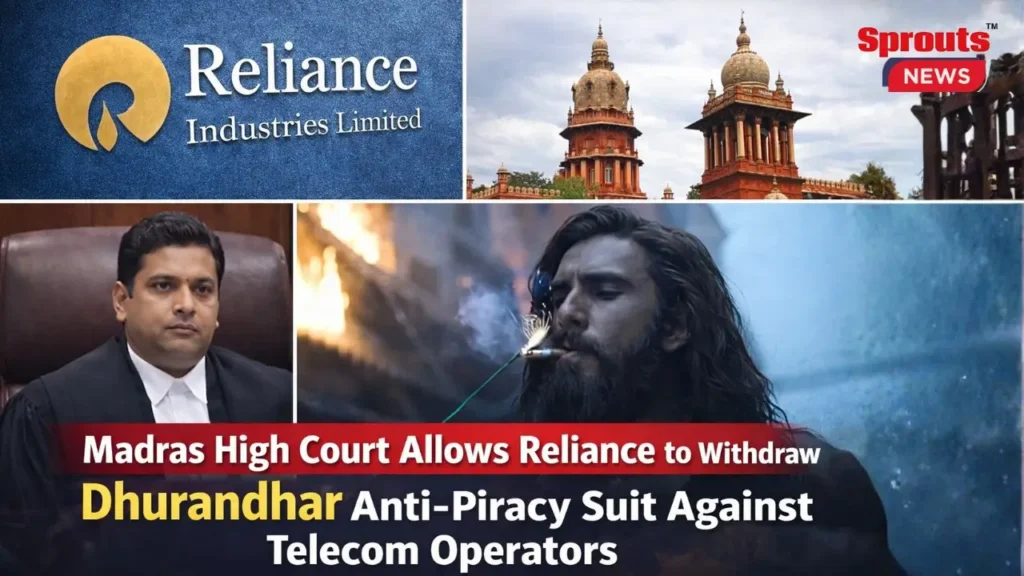
The Madras High Court has allowed Reliance Industries’ Jio Studios to withdraw its Dhurandhar anti piracy suit filed against major telecom and internet service providers. The commercial copyright case sought injunctions to block alleged piracy of the film before release. Justice Senthil kumar Ramamoorthy dismissed the suit as withdrawn without costs and closed all connected interim applications. The order did not record reasons for the withdrawal. The development has drawn attention in the film industry, where pre release anti-piracy orders are commonly used to protect box office revenue.
Madras HC has permitted Reliance Industries Limited’s media division, Jio Studios, to withdraw its commercial copyright suit seeking anti piracy directions for the film Dhurandhar against major telecom and internet service providers.
The order was passed on February 18 in the case titled Reliance Industries Limited versus Bharat Sanchar Nigam Limited and others. The matter was heard by Justice Senthil Kumar Ramamoorthy.
The Court recorded the submission of Reliance’s counsel that instructions had been received to withdraw the suit. Accordingly, the case was dismissed as withdrawn without costs, and all connected interim applications were closed.
The order did not record any reasons for the withdrawal. This development has raised industry interest, especially given the increasing reliance on pre release anti piracy injunctions in India’s film sector.
Reliance had approached the High Court under the Copyright Act, 1957 seeking permanent injunctions to prevent online and cable piracy of its cinematographic film Dhurandhar.
The company had named a broad spectrum of defendants, including telecom service providers, internet intermediaries, cable networks and digital distribution platforms across India.
Among the defendants were MTNL, Bharti Airtel, Vodafone Idea, Tata Communications, Sify Technologies, Hathway, GTPL Hathway, Asianet Satellite Communications and Spectra ISP Networks.

To view the High Court order – click here
Pre Release Anti Piracy Orders and Copyright Enforcement in India
The relief sought by Reliance was in the nature of a pre release anti piracy or John Doe order. Such orders are commonly sought by film producers before theatrical release.
These orders typically direct telecom operators and internet service providers to block access to websites hosting infringing copies of films upon receiving specific notices of infringement.
Producers argue that piracy causes significant revenue loss within hours of a film’s release, particularly in the digital era where camcorded copies circulate rapidly on messaging platforms and streaming sites.
Reliance had also sought wide ranging injunctions against cable operators to restrain camcording, recording, reproduction, distribution, transmission or communication of Dhurandhar across cable television, DTH services, satellite networks, storage devices and internet platforms.
On December 5, the Court had granted an interim injunction restraining internet service providers and cable operators from broadcasting or transmitting pirated versions of the film.
Such interim relief is often time sensitive and aligned with a film’s release schedule. Courts usually balance copyright protection with safeguards to prevent over blocking of legitimate content.

Also Read: IDFC FIRST Bank ₹590 Crore Fraud Shocks Market.
Why Withdrawal of the Dhurandhar Suit Matters for Media and Telecom Sector
When the matter was listed on February 18, counsel for Reliance made an endorsement seeking withdrawal of the proceedings. The Court accepted the request and dismissed the suit as withdrawn without imposing costs.
No explanation for the strategic withdrawal was placed on record. Legal observers note that withdrawals in commercial copyright matters can occur for various business or settlement related reasons.
It is possible that the film’s release cycle, digital distribution arrangements or negotiated compliance mechanisms with intermediaries influenced the decision. However, the absence of recorded reasons leaves room for interpretation.
For telecom and internet intermediaries, such litigation underscores the continuing compliance burden under India’s copyright framework and the Information Technology rules governing intermediaries.
Pre release blocking orders have previously drawn debate over proportionality, due process and potential overreach, particularly when entire domains are blocked based on apprehended infringement.
From a policy perspective, the case reflects the ongoing tension between robust copyright enforcement and the operational realities of network service providers managing millions of users.

Reliance was represented by Advocate S Deepak, instructed by PK Law Firm. The brief order of the Court formally closes the chapter on this specific anti piracy action.
For the media industry, the withdrawal signals that litigation strategies may evolve alongside technological and distribution changes. As digital consumption grows, enforcement models may increasingly shift towards targeted takedown frameworks and platform level monitoring rather than broad injunctions.
Sprouts News will continue tracking developments in copyright enforcement, intermediary liability and judicial trends affecting India’s entertainment and telecom ecosystem.
Readers’ Appeal:
If you have credible information, documents, or evidence related to corruption, financial irregularities, corporate misconduct, or public interest issues, contact Unmesh Gujarathi, investigative journalist. Your identity will be kept confidential. Call or WhatsApp: 9322755098
Support fearless journalism. Speak up for truth.