

Fadnavis Government’s Davos Investment Claims Raise Questions Over Domestic MoUs
Maharashtra Chief Minister Devendra Fadnavis announced ₹14.5 lakh crore investment deals at the Davos World Economic Forum, claiming massive job creation. However, scrutiny shows most MoUs were signed with Mumbai-based domestic firms, raising questions over transparency, intent, and public spending.
Davos investment agreements Maharashtra dominated headlines after Chief Minister Devendra Fadnavis announced investment commitments worth ₹14.5 lakh crore at the World Economic Forum in Switzerland.
The Chief Minister claimed these agreements would generate nearly 3.5 million jobs across Maharashtra, presenting the Davos visit as a historic economic milestone for the state.
However, closer scrutiny reveals that most agreements signed in Davos were not with foreign investors but with Indian companies headquartered in Mumbai and other parts of Maharashtra.
Despite travelling thousands of kilometres to Switzerland, the Maharashtra government signed memorandums of understanding primarily with Lodha Developers, K Raheja Corp, Panchshil Realty, and Surjagad Ispat.
These revelations have triggered sharp questions about transparency, public expenditure, and the actual purpose of signing domestic investment agreements on an international platform like the World Economic Forum.
On the opening day of the summit, Chief Minister Fadnavis inaugurated the Maharashtra Pavilion, showcasing the state as an attractive global investment destination.
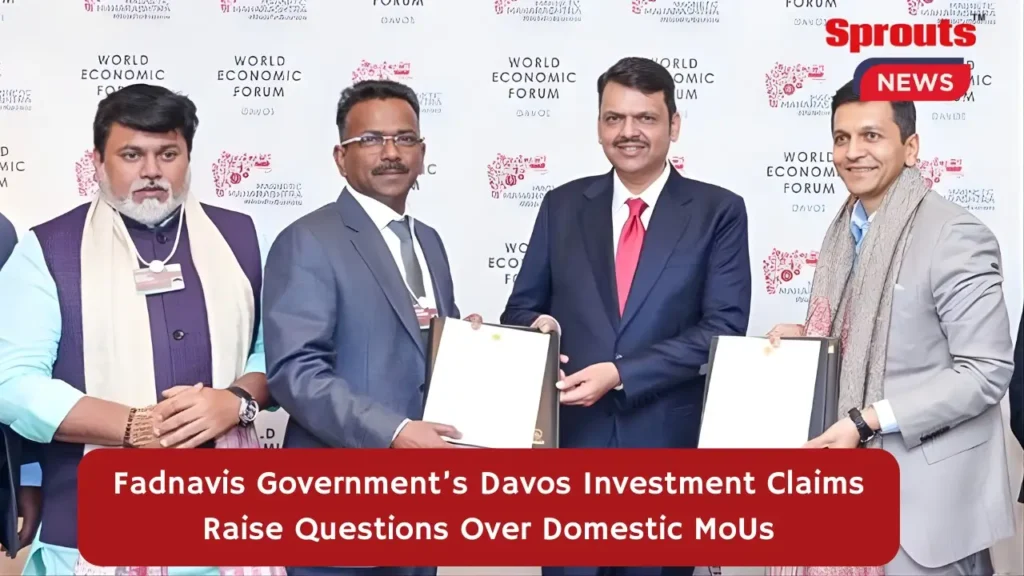
Nineteen companies signed MoUs on the first day itself, with agreements formalised in the presence of Chief Minister Devendra Fadnavis and Industries Minister Uday Samant.
Official statements indicate that at least eight of these companies are based in Maharashtra, raising concerns over why such agreements required a foreign venue.
Economic analysts note that MoUs do not automatically translate into actual investments, job creation, or project execution without clear timelines and accountability mechanisms.
Domestic Corporates Dominate Davos MoUs, Raising Transparency Concerns
Surjagad Ispat, a steel manufacturing company, signed an investment agreement worth ₹20,000 crore with the Maharashtra government during the Davos summit.
The company is headquartered in Wadlapeth, Aheri taluka of Gadchiroli district, where Chief Minister Fadnavis himself serves as the district’s guardian minister.
According to government claims, this investment is expected to create nearly 8,000 jobs, though project timelines and funding structures remain undisclosed.
Lodha Developers signed a ₹1 lakh crore investment agreement focused on IT parks and data centres, with officials projecting employment for approximately 1.5 lakh people.
Lodha Developers is led by Abhishek Lodha, son of Maharashtra minister Mangal Prabhat Lodha, adding a political dimension to the investment announcement.
The company’s office is located barely 2.6 kilometres from Mantralaya at Horniman Circle, reachable within eleven minutes by road.
K Raheja Corp entered into an agreement reportedly worth around USD 10 billion, with the government projecting employment for nearly 100,000 people.
The company’s headquarters are located in Khar, Mumbai, approximately 21 kilometres from the state secretariat, requiring about thirty-seven minutes of travel time.
Panchshil Realty and Alta Capital jointly signed a USD 25 billion agreement, with estimates suggesting potential employment generation for nearly 250,000 people.
Their corporate office is located in Express Towers, just one kilometre from Mantralaya, raising questions over the necessity of executing the agreement in Davos.
Also Read: Sameer Gaikwad’s Death Silences Truth in Pansare Case.
Costly Davos Visit, Limited Foreign Investment Clarity
The World Economic Forum is primarily intended to attract foreign direct investment, strategic partnerships, and global capital into regional economies.
Critics argue that signing agreements with domestic companies at Davos undermines the core objective of international investor outreach.
Public finance experts highlight that the Davos delegation involves significant taxpayer expenditure, including logistics, security, and international representation costs.
Despite repeated queries, the government has not released detailed data on fresh foreign capital inflows, implementation schedules, or sector-specific funding sources.
Past Davos announcements by successive governments have faced criticism for inflated job projections and delayed or incomplete project execution.
Policy observers stress that MoUs must be distinguished from legally binding contracts to avoid misleading narratives around economic growth and employment.
Sprouts News has initiated an independent review of these agreements, focusing on company track records, past investment delivery, and actual job creation outcomes.
As public scrutiny intensifies, experts emphasise the need for transparent disclosures, periodic progress reports, and legislative oversight of international investment claims.
Without measurable outcomes, critics argue that high-profile Davos announcements risk becoming political spectacle rather than substantive economic achievement.