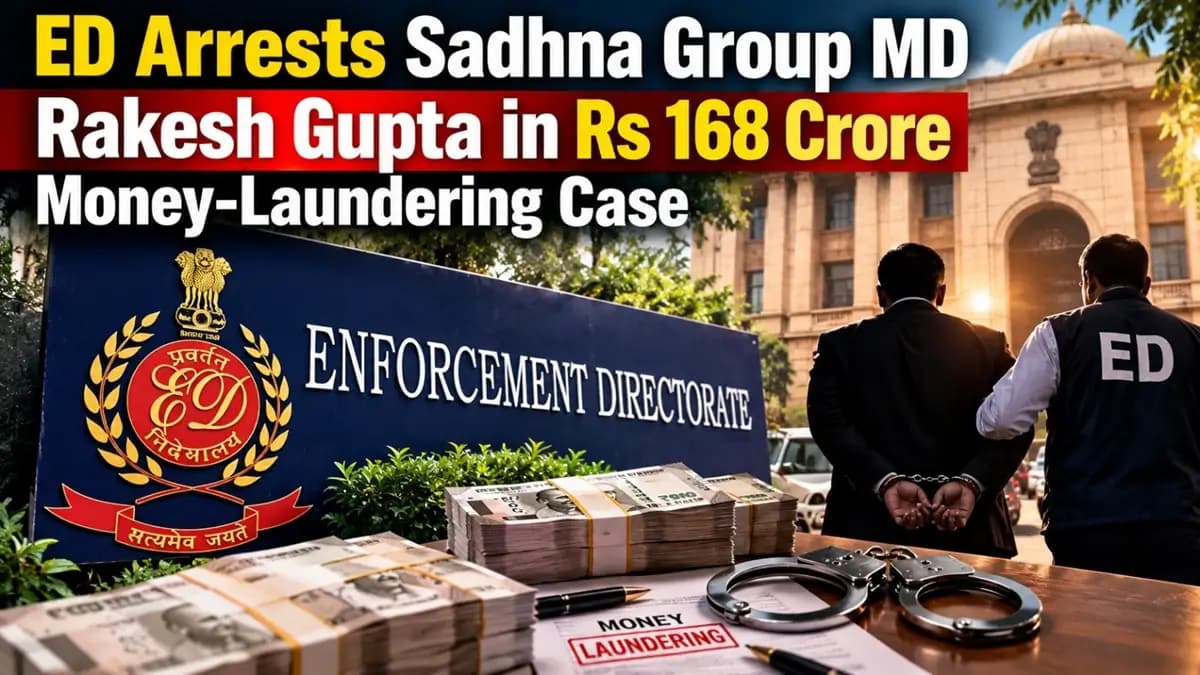
The Enforcement Directorate has arrested three more persons in its Goa-linked digital arrest money-laundering investigation, taking the total number of arrests to five. Chartered accountant Bhushan Suryakant Moye, Vilas Narayan Pawar and Shailesh Dagdu Chavan were arrested on August 27 under the Prevention of Money Laundering Act. Investigators are examining an alleged financial network through which cyber-fraud proceeds were routed across more than 400 beneficiary accounts. The ED has also traced banking transactions exceeding ₹27,850 crore as part of its wider investigation.
SED Uncovers Rs 27,850 Crore Banking Trail in Goa Digital Arrest Probe
The Enforcement Directorate arrested three more persons in a digital arrest money-laundering probe linked to Goa, taking the total number of arrests to five.
Goa digital arrest probe widens as Enforcement Directorate (ED) arrests chartered accountant Bhushan Suryakant Moye, Vilas Narayan Pawar and Shailesh Dagdu Chavan on August 27, 2026
The three were arrested by the ED's Panaji office under Section 19 of the Prevention of Money Laundering Act, 2002 for their alleged involvement in laundering proceeds generated through cyber fraud.
Investigators are looking into their alleged links with the larger network. A special PMLA court in Goa has remanded Moye, Pawar and Chavan to ED custody till September 1.
The latest arrests follow those of Fahim Moin Hussain Sayed and Naim Mueen Sayyed, who were taken into custody on August 23 and remain detained in the case.
Investigation began with a Goa cybercrime FIR
FIR No. 17/2025 was registered on June 9, 2025, at the Cyber Crime Police Station, North Goa, based on a complaint filed by a Goa resident, and an investigation has been initiated in this regard.
According to the investigation, the woman was allegedly kept on a continuous video call and falsely told that she was under investigation by authorities.
Between May 21 and June 2, 2025, she was allegedly pressured into transferring Rs 2,60,33,634 into bank accounts described to her as “Secret Supervision Accounts.”
Later, the money was routed into a financial structure in an organized manner to receive proceeds of cyber fraud as banking credits and convert them into cash, ED investigators claimed.
Allegedly, the money was converted into foreign currency through companies with Reserve Bank of India licences as Full Fledged Money Changers. The ED has not named the companies holding the licences.
The funds have been traced to over 400 beneficiary accounts, the money then being funneled through companies whose listed directors allegedly lacked the financial means associated with the transactions.
Also Read: Trump’s Kharg Island AI Video Sparks Iranian Reaction Amid Rising Tensions.
ED traces thousands of crores through network
The ED said the linked accounts of these entities feature in 330 victim complaints and 163 FIRs lodged in over 20 states and Union Territories.
The losses reported in relation to those complaints and cases have been estimated at Rs 417.49 crore, and the network’s banking transactions are alleged to be over Rs 27,850 crore.
Earlier, the agency had detected cash deposits of around Rs 2,904 crore, of which Rs 584.70 crore was deposited through 61,448 bulk-note-acceptance-machine transactions at different locations.
The ED has alleged that Moye used identification documents given to him to establish 21 companies and that he considered those companies and their 43 dummy directors as a single entity for the purpose of filing his taxes.
Pawar was able to move RTGS transfers into the accounts of the network, and Chavan allegedly provided cash for those transactions, investigators said.
ED conducted searches at the premises of Moye, Pawar and Chavan on August 21, following earlier searches under Section 17 of the PMLA.
Searches uncover cash and financial records
The alleged money-laundering activity continued even after searches were conducted on July 17 and went on till just before the first arrests on August 23, the ED said.
The July 17 operation covered 20 locations in Mumbai and Goa, and further searches were carried out at other locations on August 21.
In the course of the raids, the investigators recovered about Rs 3.25 crore in cash and froze bank accounts to the tune of Rs 30 crore plus linked to the alleged syndicate.
Officials also seized digital devices, account books, financial records and statutory registers, which are under examination as investigators seek to trace the movement of funds.
The case underscores the growing financial infrastructure tied to so-called digital arrest scams in which fraudsters pose as government or law enforcement officials to coerce victims.
Authorities say scammers can use fake documents, ongoing video calls and made-up investigations to convince victims their money needs to be moved into real official accounts.
Law-enforcement agencies have repeatedly warned that real authorities don’t make arrests by video call, and people receiving such calls should hang up immediately.
Victims or potential victims are advised to report suspected cybercrime through India’s national cybercrime helpline 1930, while preserving relevant messages, payment records and digital evidence.
The investigation is still on, with the ED probing huge banking, cash and digital records linked to the alleged network.
The agency would not identify where the foreign currency was allegedly sent after conversion or the licensed money changers involved, saying that those matters were under investigation.
Sprouts News has learned that as investigators trace the financial network and determine individual responsibilities based on the available facts, additional arrests or asset seizures are possible.