
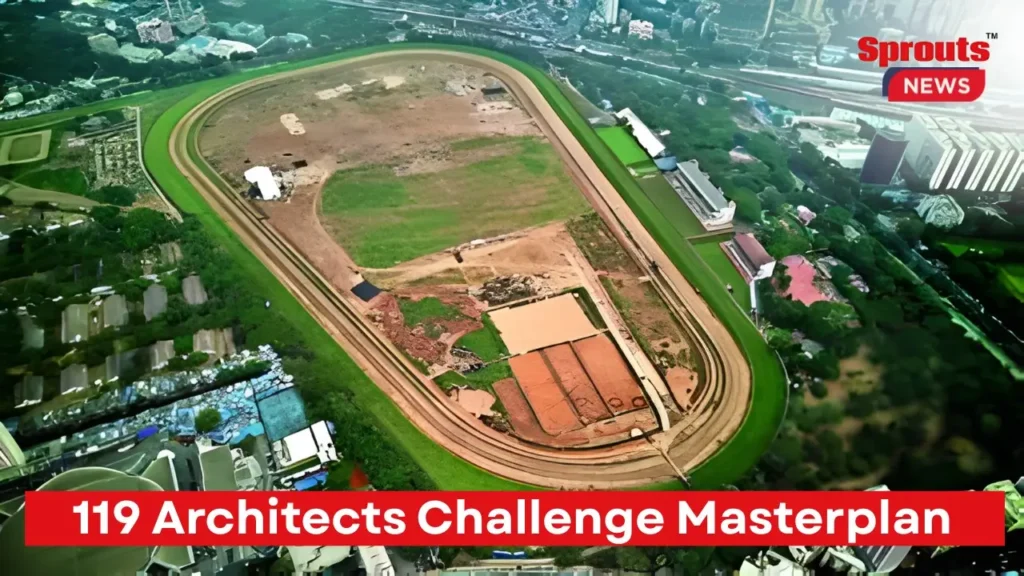
The Mahalaxmi Racecourse redevelopment plan has drawn strong opposition from 119 architects who have raised concerns about project costs, underground parking scale and flood vulnerability. The group has demanded detailed financial disclosures, traffic impact studies and climate risk assessments before approvals move forward. Questions have also been raised about governance transparency and long term maintenance costs. Given the racecourse’s strategic location and size, experts argue that any redevelopment must follow integrated urban planning principles and clear public accountability mechanisms.
- Mahalaxmi Racecourse Redevelopment: 119 Architects Flag Cost, Climate and Governance Risks in Mumbai Master Plan
- Cost Transparency, ₹500 Crore Subway and Underground Infrastructure Debate
- Parking Capacity, Traffic Impact and Multimodal Connectivity Concerns
- Climate Risk, Historic Marshland and Mumbai Climate Action Plan 2022
- Land Governance, FSI Allocation and Royal Western India Turf Club Lease Questions
- Open Space Deficit and Call for Integrated Planning
- Readers’ Appeal: Demand Transparency in Mahalaxmi Redevelopment
Mahalaxmi Racecourse Redevelopment: 119 Architects Flag Cost, Climate and Governance Risks in Mumbai Master Plan
Mahalaxmi Racecourse redevelopment faces intensified opposition from 119 architects who question project costs, underground parking scale, climate risks and land governance transparency. The collective has demanded detailed financial disclosures, traffic studies and integrated planning before authorities approve Mumbai’s high value master plan.
Mahalaxmi Racecourse redevelopment has triggered fresh controversy after 119 architects, urban designers and planners formally opposed the proposed master plan, citing financial opacity, flood risks and governance gaps in Mumbai’s high profile project.
In a detailed representation dated 26 February 2026, the Mumbai Architects Collective escalated concerns following the Brihanmumbai Municipal Corporation presentation of the master plan and Coastal Road Gardens concept.
The civic presentation held at Priyadarshini Park outlined underground construction, large scale parking and new facilities beneath the nearly 298 acre contiguous landscape spanning the racecourse and adjoining coastal open spaces.
Signatories argue the updated disclosures deepen doubts about cost viability, ecological resilience and the absence of an integrated urban vision for one of Mumbai’s largest remaining open grounds.
The issue carries citywide implications because the Mahalaxmi precinct sits at the intersection of transport infrastructure, coastal regulation, climate vulnerability and land governance questions that shape Mumbai’s long term planning direction.
Cost Transparency, ₹500 Crore Subway and Underground Infrastructure Debate
A central concern relates to project financing. The collective referenced public statements suggesting a proposed subway could cost nearly ₹500 crore, yet no consolidated estimate has been published for three planned basement levels.
Those basements are expected to house parking for 5,000 vehicles, along with a sports complex and convention facility beneath the existing open ground.
Architects estimate the broader outlay may range between ₹500 crore and ₹600 crore. They questioned how tenders could proceed without comprehensive cost disclosures and phased financial planning.
The representation also raises a contradiction. Earlier statements had reportedly indicated that approximately ₹400 crore was unavailable for developing and maintaining the 173 acre Coastal Road open spaces.
Urban finance experts note that capital intensive underground works often escalate due to waterproofing, structural reinforcement and long term pumping requirements, particularly in coastal and reclaimed landscapes such as south Mumbai.
Without transparent financial modelling and lifecycle cost assessment, critics argue that public accountability may weaken in projects of this magnitude.
Parking Capacity, Traffic Impact and Multimodal Connectivity Concerns
Another flashpoint is the scale of proposed parking. Around 1,200 parking spaces were recently created near Haji Ali. The new plan would introduce 5,000 additional underground spaces within the racecourse precinct.
That would increase total parking capacity in the immediate area to approximately 6,200 vehicles, significantly altering traffic dynamics in an already congested corridor.
The collective has asked whether a traffic demand study or multimodal transport assessment has been conducted. The site lies close to Mahalaxmi railway station and expanding Metro connectivity.
Transport planners caution that large parking facilities can induce private vehicle use, undermining public transport investments and climate mitigation goals outlined in city mobility frameworks.
In the absence of publicly released modelling data, the justification for such scale remains unclear.
Climate Risk, Historic Marshland and Mumbai Climate Action Plan 2022
The representation devotes substantial attention to hydrology and climate resilience. It references the Mumbai Climate Action Plan 2022, which emphasises nature based solutions and flood mitigation strategies.
Architects state that the 226 acre racecourse sits on historic marshland and functions as a permeable flood absorbing zone during intense monsoon rainfall.
Subsurface construction, they argue, would reduce natural infiltration capacity, increase surface runoff and require permanent mechanical drainage systems to prevent waterlogging.
Replacing natural soil with basement slabs and reinforced concrete structures may compromise long term resilience, especially as extreme rainfall events intensify under climate change scenarios.
Environmental planners warn that once subsurface permeability is lost, restoration becomes technically complex and financially burdensome.
Also Read: Chembur Construction Accident at Adityaraj Springs.
Land Governance, FSI Allocation and Royal Western India Turf Club Lease Questions
Governance transparency forms another pillar of the objection. Approximately 93 acres remain under the control of the Royal Western India Turf Club, prompting questions over lease terms and development rights.
The collective has sought disclosure of floor space index allocations, financial arrangements and arithmetic clarity in land distribution within the broader 226 acre site.
Concerns also extend to the Coastal Road gardens, reportedly developed and operated by a private entity under a corporate social responsibility framework.
Architects question why direct public funding was reportedly constrained for open space development, while substantial sums appear earmarked for underground infrastructure at the racecourse.
Such asymmetry, they argue, demands formal clarification from the state government and the civic administration.
Open Space Deficit and Call for Integrated Planning
An earlier letter dated 19 February 2026, signed by 102 professionals, had already opposed underground construction while supporting improved public access to the racecourse.
The signatories highlighted Mumbai’s open space deficit, widely cited at around 1.2 square metres per person, compared with the World Health Organisation benchmark of nine square metres.
Their ward level survey suggested accessible open space in H Ward could be as low as 0.87 square metres per person, intensifying the urgency of preserving permeable grounds.
The latest representation recommends treating the racecourse and Coastal Road lands as a single integrated precinct, supported by comprehensive surveys and formal public consultation.
The collective has requested written responses within 14 days and a joint meeting with the state government and the Brihanmumbai Municipal Corporation.
The debate now extends beyond design preferences. It raises foundational questions about climate resilience, fiscal prudence and democratic planning in Mumbai’s most valuable urban landscapes, as confirmed by the Sprouts News Special Investigation Team.
Readers’ Appeal: Demand Transparency in Mahalaxmi Redevelopment
Citizens must seek clarity on costs, climate impact and land governance. Share documents or ground reports with investigative journalist Unmesh Gujarathi at 9322755098 to strengthen public accountability.