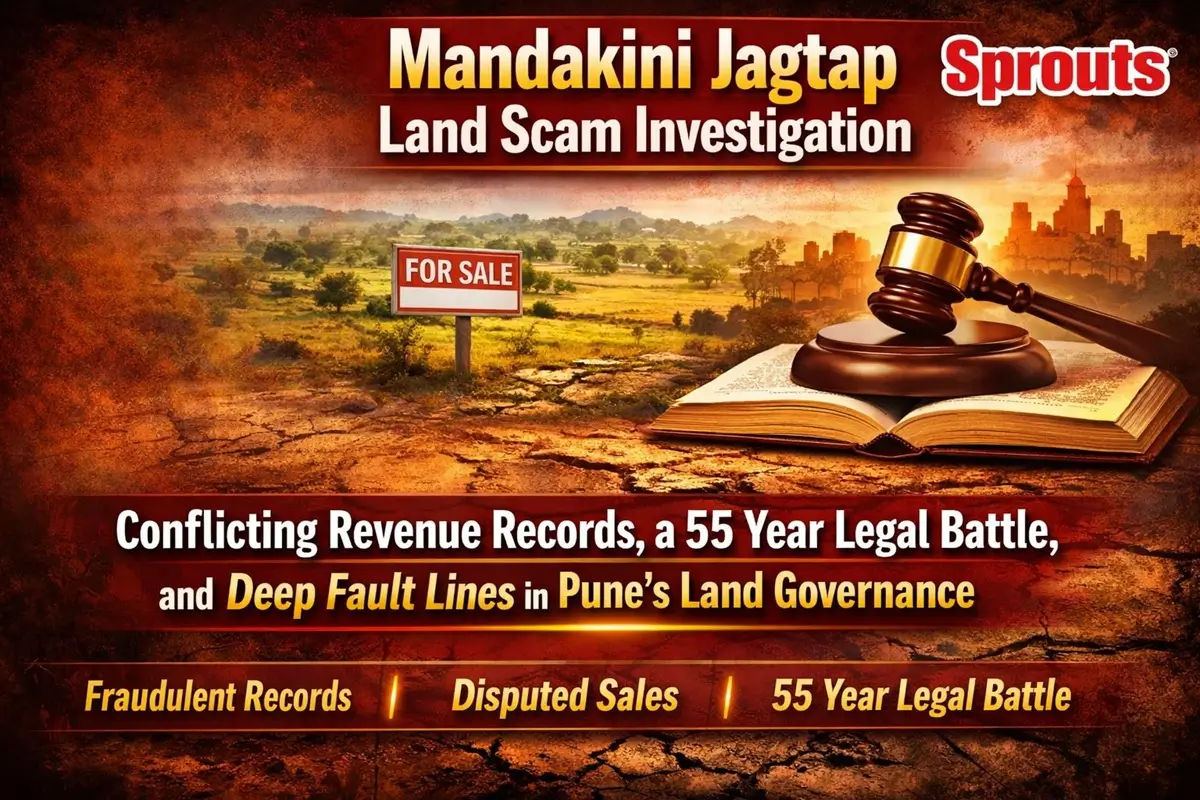
Mandakini Jagtap Land Scam Investigation: Conflicting Revenue Records, a 55 Year Legal Battle, and Deep Fault Lines in Pune’s Land Governance
Mandakini Jagtap’s 55 year land dispute exposes contradictory revenue records across Pune district, defective mutations, and disputed sales. The case highlights governance failures, risks to lawful heirs, and how delayed administrative corrections can undermine property rights and public trust statewide.
The Mandakini Jagtap land scam investigation has brought renewed scrutiny on Maharashtra’s revenue administration, exposing how conflicting land records across villages triggered a 55 year inheritance dispute in Pune district.
At the heart of the case lies a troubling contradiction where the same government system recognises a legal heir in two villages, yet erases her existence in another under the same taluka authority.
The dispute spans Saswad, Nandoshi, and Donje villages, revealing how administrative inconsistencies, delayed corrections, and disputed mutations can permanently alter property rights across generations.
Land governance experts warn that such cases are not isolated but reflect structural weaknesses that allow errors, or worse manipulation, to remain uncorrected for decades.
Conflicting Revenue Records in Pune District Raise Governance Alarms
Revenue documents in Saswad and Nandoshi officially identify Mandakini Jagtap as the daughter and lawful heir of late Narhari Jagtap, confirming her lineage beyond dispute.
However, Donje village records show a 1983 entry stating Narhari Jagtap died unmarried and without children, directly contradicting records maintained by the same administration.
Legal specialists note that a government authority cannot selectively deny a legal identity it has already validated elsewhere under identical jurisdictional control.
Such inconsistencies, they argue, create ideal conditions for fraudulent land transfers, prolonged litigation, and erosion of public trust in land administration systems.
To read the related documents - click here
Early Childhood Displacement and the Human Cost of Record Manipulation
Narhari Jagtap passed away on April 2, 1971, when Mandakini was five, leaving her mother Suman widowed and vulnerable within a hostile family environment.
According to case records, relatives allegedly forced the mother and child out, destroyed documents, and cut off access to ancestral land during Mandakini’s early years.
To protect her daughter, Suman relocated to Pune, choosing safety over confrontation, while revenue records continued to evolve without the child’s representation.
Social researchers say displaced minors often disappear from bureaucratic processes, enabling later record manipulation without resistance or timely challenge.
Disputed Mutations and Questions of Administrative Accountability
Mandakini’s exclusion originates from Mutation No. 255 recorded in 1983, claiming Narhari Jagtap died childless, followed by reinforcing Mutation No. 329 in 1986.
Revenue law experts emphasise that mutation entries are fiscal tools and cannot extinguish inheritance rights established through birth or contemporaneous public records.
The disputed entries raise potential violations involving false declarations, misrepresentation, and procedural lapses under revenue and penal provisions.
If mutations are proven defective, all subsequent transactions based on them become legally fragile and open to annulment.
Also Read: Nashik Bar Association accuses five Judge of Misconduct.
Land Sales Amid Unresolved Heirship Disputes Increase Complexity
Despite the unresolved heirship dispute, portions of the disputed land were sold to third parties, layering ownership claims and intensifying legal complexity.
These sales reportedly occurred while Mandakini faced severe personal hardship, including her daughter’s major heart surgery and her own medical challenges.
Property law practitioners caution that buyers in disputed heirship cases often inherit legal risk rather than clear title.
Such transactions can remain under challenge for decades, affecting financial institutions, developers, and future purchasers.
Earlier Official Records and a Key Administrative Finding
Mandakini produced a 1971 police panchnama and 1976 school records confirming her identity and parentage, both predating the disputed mutation entries.
In November 2018, Circle Officer R H Jadhav officially declared Mutation No. 255 defective, validating long standing concerns about record accuracy.
Separately, Dr Jayshree Katare, then Sub Divisional Officer in 2011, had earlier noted conflicts between two villages and ordered a fair chavkashi to determine original heirship.
Legal precedent consistently treats earlier contemporaneous records as superior evidence when later entries lack substantiation.
Survey Numbers, Supreme Court Principles, and Legal Implications
Multiple survey numbers in Donje village are now flagged, with authorities warning that titles derived from defective mutations may be legally void.
Supreme Court rulings, including principles that fraud vitiates all transactions and that daughters inherit property by birth, strongly shape this dispute.
The doctrine that no one can transfer better title than they possess further weakens subsequent land sales rooted in flawed records.
Legal analysts believe these principles could redefine outcomes in similar inheritance disputes across Maharashtra.
Why This Land Dispute Matters Beyond Donje Village
The Mandakini Jagtap case demonstrates how administrative delay can distort ownership for generations, affecting families, buyers, and governance credibility.
Land policy experts argue it underscores the urgency of synchronised digital records and strict accountability within revenue departments.
Mandakini has urged the Pune District Collector to enforce corrective findings and restore lawful titles, potentially ending a dispute spanning over five decades.
Investigated by the Sprouts News Special Investigation Team, the case could shape how future land inheritance disputes are addressed across the state. Individuals aware of similar scams may contact senior investigation journalist Unmedh Gujarathi at 9322755098.