

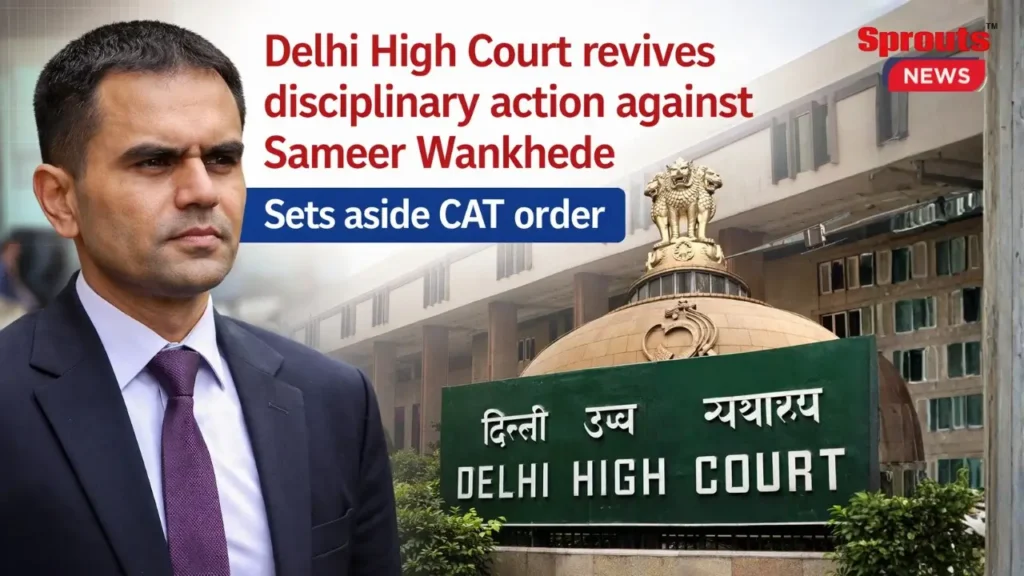
The Delhi High Court has revived disciplinary proceedings against IRS officer Sameer Wankhede, overturning a Central Administrative Tribunal order that had quashed the charge memorandum. The Court held that the Tribunal exceeded its jurisdiction by intervening at the charge stage before a full departmental inquiry. The ruling permits the Central Board of Indirect Taxes and Customs to continue its investigation linked to the 2021 Cordelia cruise case controversy. Legal experts say the judgment reinforces the principle that service inquiries should proceed unless clear illegality is established.
Delhi High Court revives disciplinary proceedings against Sameer Wankhede, sets aside CAT order
The Delhi High Court has revived disciplinary proceedings against Sameer Wankhede, setting aside a Central Administrative Tribunal order that had halted action against the Indian Revenue Service officer in January 2026.
A Division Bench of Justice Anil Kshetarpal and Justice Amit Mahajan allowed the Union government’s plea, ruling that the Tribunal had overstepped its jurisdiction by interfering at the charge stage.
The verdict clears the way for the Central Board of Indirect Taxes and Customs to continue its inquiry against Wankhede, whose name remains closely linked to the 2021 Cordelia cruise drug seizure case.
The case has generated sustained public attention due to the arrest of Aryan Khan, son of actor Shah Rukh Khan, during Wankhede’s tenure with the Narcotics Control Bureau.
Delhi High Court versus CAT: Jurisdiction, due process and disciplinary control
The core legal question before the High Court was whether the Central Administrative Tribunal could quash a charge memorandum before a full departmental inquiry had taken place.
In January 2026, the Tribunal had restrained the CBIC from proceeding further, observing that the disciplinary action appeared biased and possibly motivated by malice.
Wankhede had argued that findings from a preliminary inquiry conducted by a Special Enquiry Team could not legally form the foundation of formal disciplinary proceedings.
He maintained that the charge memorandum issued to him was arbitrary, legally unsustainable and in violation of established service rules governing civil servants.
The Union government countered that tribunals are not meant to assess evidence at a preliminary stage, especially before an inquiry officer has examined facts in detail.
Government counsel also objected strongly to the Tribunal’s observations suggesting malice, stating that such findings required substantive evidence tested during a full proceeding.
By restoring the disciplinary process, the High Court signalled judicial restraint in service matters, emphasising that courts and tribunals should rarely intervene at the stage of framing charges.
Legal experts say the ruling reinforces the principle that departmental proceedings must ordinarily run their course unless there is clear illegality on the face of the record.
Also Read: JJTU PhD Row Over 700+ Doctorates Despite UGC Ban.
Cordelia cruise drug case fallout and implications for IRS officers
The disciplinary action stems from allegations examined by a Special Enquiry Team following complaints related to the 2021 Cordelia cruise drug seizure operation.
At that time, Wankhede was serving with the Narcotics Control Bureau and led the operation that resulted in multiple arrests, including that of Aryan Khan.
The case attracted intense media scrutiny and political debate, raising questions about investigative procedures, evidence handling and alleged irregularities during the probe.
While Aryan Khan was later granted relief and not chargesheeted, the controversy continued to cast a shadow over the officers associated with the operation.
The CBIC initiated proceedings after reviewing the Special Enquiry Team’s preliminary findings, which reportedly examined procedural aspects and conduct issues.
Wankhede’s challenge before the Tribunal focused not on the merits of the allegations, but on whether the process adopted by the government was legally valid.
With the High Court now allowing the inquiry to proceed, the matter returns to the administrative framework governing disciplinary action against IRS officers.
Under service jurisprudence, a charge memorandum is only the starting point, and guilt or innocence is determined after evidence, cross examination and representation.
For policymakers and civil service observers, the ruling has broader implications. It clarifies the limits of judicial intervention in ongoing departmental proceedings.
The decision may also influence how future cases involving senior officers and high profile investigations are handled within institutional frameworks.
According to senior advocates tracking service law, the High Court’s approach aligns with earlier Supreme Court precedents discouraging premature quashing of charge sheets.
For Wankhede, the legal battle is far from over. He retains the right to contest findings during the inquiry and, if necessary, challenge adverse orders subsequently.
From an institutional perspective, the judgment underscores the balance between protecting civil servants from arbitrary action and preserving the government’s disciplinary authority.
Sprouts News Special Investigation Team will continue to track developments as the CBIC resumes proceedings, which are likely to draw significant administrative and public interest.
The case now moves from a jurisdictional contest back to a fact based examination, where evidence rather than preliminary objections will shape the final outcome.
Share Tips and Documents to Support Transparent Journalism
For credible updates and verified insights on this developing story, contact Unmesh Gujarathi, a senior journalist, on 9322755098. Share tips, documents or information to support transparent and accountable journalism responsibly.