Mukesh Ambani, Reliance Linked SevenHills Hospital Acquisition Proposal: Maharashtra Government Urged to Convert Mumbai Facility into Major Public Healthcare Hub
A proposal urging the Maharashtra government to acquire SevenHills Hospital in Andheri has reignited debate on Mumbai’s healthcare future. With 1,500 beds, advanced infrastructure, and a PPP legacy, advocates say converting the stalled facility into a public hospital could ease overcrowding, support medical education, and boost emergency preparedness. Despite ₹1,200 crore in outstanding dues, supporters argue a negotiated takeover could transform a struggling asset into a citywide healthcare lifeline.
The proposed acquisition of SevenHills Healthcare Private Limited in Andheri has emerged as a critical public health opportunity for Maharashtra, with calls urging Chief Minister Devendra Fadnavis to intervene decisively.
The proposal argues that reviving the stalled SevenHills Hospital as a government-run institution could significantly strengthen Mumbai’s strained healthcare infrastructure while protecting a valuable public asset from prolonged financial and legal uncertainty.
SevenHills Hospital occupies a strategic location in Andheri East, close to Mumbai International Airport, offering strong connectivity for emergency services, regional patients, and potential international medical travellers.
The hospital’s existing infrastructure is extensive, comprising nearly 1,500 beds, over 120 outpatient departments, and around 36 fully equipped operating theatres designed for multi-speciality care.
Given Mumbai’s rising population and increasing disease burden, health experts believe such large-scale infrastructure can immediately absorb patient overflow from overcrowded civic and state-run hospitals.
SevenHills was originally developed under a Public-Private Partnership model with the Brihanmumbai Municipal Corporation, making government acquisition procedurally smoother compared to fully private healthcare assets.
Supporters of the acquisition argue that existing contractual frameworks with BMC provide a foundation for negotiations, ensuring continuity of services while transitioning the hospital into a public healthcare model.
Financially, the hospital faces outstanding dues estimated at nearly ₹1,200 crore, involving lenders including SBI, Union Bank of India, and JM Financial, complicating ownership and operational control.
However, proponents suggest that a negotiated settlement could balance institutional recovery with public interest, enabling the state to secure land and assets without prolonged litigation.
Also Read: Why Teachers Are Falling for Fake Awards & Doctorates Scam.
Mumbai Healthcare Crisis and Public Health Imperatives
Mumbai’s public healthcare system continues to face intense pressure due to population density, limited hospital beds, and uneven distribution of specialised medical facilities across suburban regions.
The COVID-19 pandemic exposed critical gaps in emergency preparedness, oxygen availability, ICU capacity, and surge infrastructure, underscoring the need for robust, government-controlled healthcare assets.
Transforming SevenHills into a state-run hospital could immediately expand critical care capacity and reduce dependency on temporary emergency arrangements during future health crises.
Public health planners believe the facility could function as a tertiary referral centre, easing patient load on hospitals like KEM, Sion, JJ, and Nair, which remain perpetually overstretched.
There is also a strong case for developing SevenHills as an AIIMS-like institution, particularly as Maharashtra currently hosts only one AIIMS facility located in Nagpur.
Such a transformation would integrate advanced treatment, medical education, research, and specialist training, addressing long-term shortages of doctors, nurses, and allied healthcare professionals statewide.
Medical tourism potential further strengthens the case, as proximity to the airport allows regulated, government-led international patient inflows while prioritising affordable care for local residents.
Advocates stress that a public healthcare focus would shift priorities away from commercial profitability towards social responsibility, long-term sustainability, and equitable healthcare delivery.
[caption id="attachment_17477" align="aligncenter" width="576"]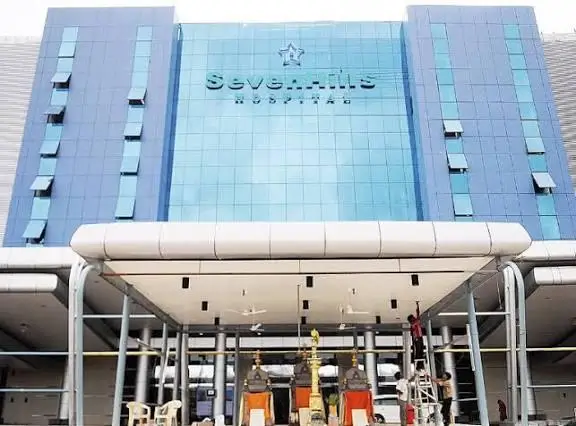 SevenHills Hospital in Andheri[/caption]
Political Consensus, Governance, and Next Steps
Political leaders argue that the acquisition could attract bipartisan and civic support, particularly from Mumbai’s municipal leadership and communities affected by healthcare access disparities.
The proposal, submitted by former Mumbai Deputy Mayor Rajesh Sharma, has been marked to Union and state health ministers, signalling the need for coordinated multi-level government action.
Suggested next steps include structured negotiations with financial institutions, legal due diligence on land ownership, and alignment with public interest litigation safeguards.
Policy experts also recommend drafting a comprehensive operational blueprint involving health economists, hospital administrators, and medical education authorities to ensure transparent governance.
Public awareness campaigns through credible media platforms, including Sprouts News Special Investigation Team, can further highlight the social and economic benefits of preserving SevenHills as a public asset.
Ultimately, stakeholders argue this intervention represents not just a hospital rescue, but a strategic investment in Mumbai’s healthcare resilience and Maharashtra’s long-term public health vision.
Congress Leader Rajesh Sharma First Flagged SevenHills Issue
Senior social activist and Vice President, Maharashtra Pradesh Congress Committee, Rajesh Sharma first exposed the SevenHills issue, led public agitations, and ensured Congress manifesto commitment to retain full BMC ownership, opposing privatisation. Senior journalist Unmesh Gujarathi supported the campaign and raised his voice with Sharma and his supporters.