


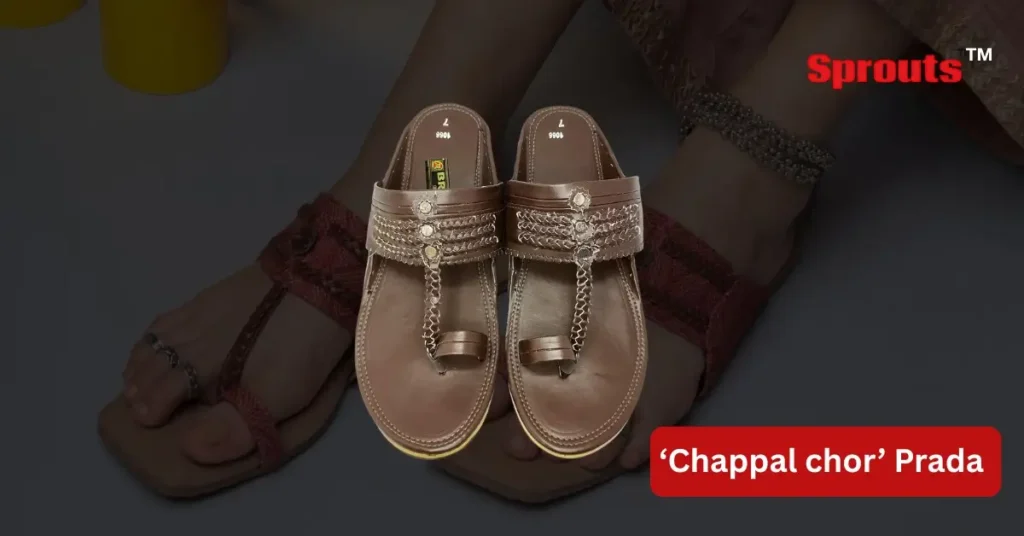
‘Chappal chor’ Prada
• Kolhapuri Chappal, Foreign Profit
• Luxury Brand, Local Betrayal
• India’s Heritage, Prada’s Profit
Unmesh Gujarathi
Sprouts News Exclusive
Contact: +91 9322755098
Sprouts News Exclusive
Contact: +91 9322755098
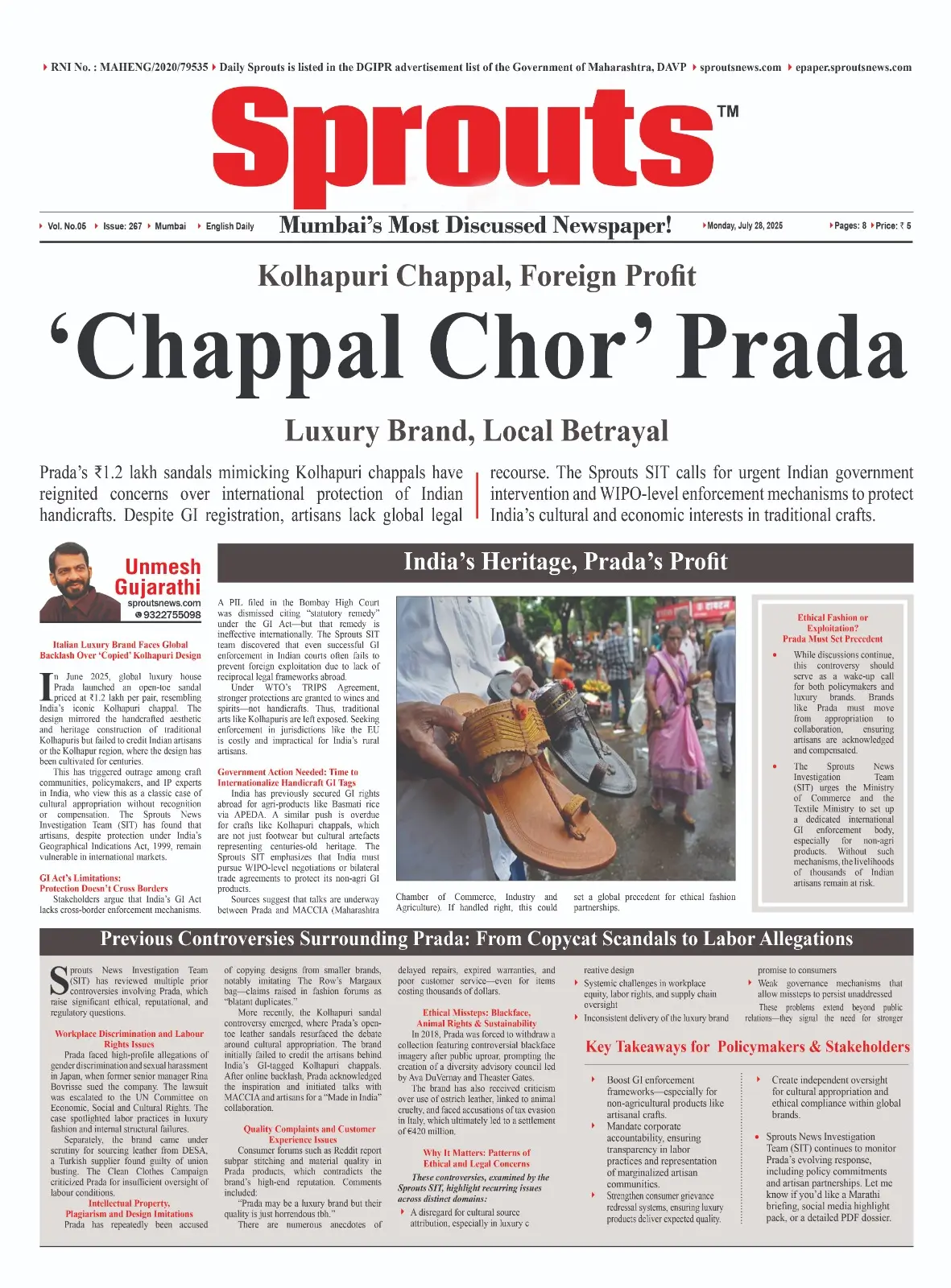
Prada’s ₹1.2 lakh sandals mimicking Kolhapuri chappals have reignited concerns over international protection of Indian handicrafts. Despite GI registration, artisans lack global legal recourse. The Sprouts SIT calls for urgent Indian government intervention and WIPO-level enforcement mechanisms to protect India’s cultural and economic interests in traditional crafts.
Italian Luxury Brand Faces Global Backlash Over ‘Copied’ Kolhapuri Chappal Design
In June 2025, global luxury house Prada launched an open-toe sandal priced at ₹1.2 lakh per pair, resembling India’s iconic Kolhapuri chappal. The design mirrored the handcrafted aesthetic and heritage construction of traditional Kolhapuris but failed to credit Indian artisans or the Kolhapur region, where the design has been cultivated for centuries.
This has triggered outrage among craft communities, policymakers, and IP experts in India, who view this as a classic case of cultural appropriation without recognition or compensation. The Sprouts News Investigation Team (SIT) has found that artisans, despite protection under India’s Geographical Indications Act, 1999, remain vulnerable in international markets.
Click Here To Download the News Attachment
Contents
- ‘Chappal chor’ Prada
- Italian Luxury Brand Faces Global Backlash Over ‘Copied’ Kolhapuri Chappal Design
- Click Here To Download the News Attachment
- GI Act’s Limitations: Protection Doesn’t Cross Borders
- Government Action Needed: Time to Internationalize Handicraft GI Tags
- Ethical Fashion or Exploitation? Prada Must Set Precedent
- Previous Controversies Surrounding Prada: From Copycat Scandals to Labor Allegations
- Workplace Discrimination and Labour Rights Issues
- Intellectual Property, Plagiarism & Design Imitations
- Quality Complaints & Customer Experience Issues
- Also Read: Eknath Khadse Son-in-law Arrested in Pune drug bust – Accuses BJP leader Girish Mahajan.
- Ethical Missteps: Blackface, Animal Rights & Sustainability
GI Act’s Limitations: Protection Doesn’t Cross Borders
Stakeholders argue that India’s GI Act lacks cross-border enforcement mechanisms. A PIL filed in the Bombay High Court was dismissed citing “statutory remedy” under the GI Act—but that remedy is ineffective internationally. The Sprouts SIT team discovered that even successful GI enforcement in Indian courts often fails to prevent foreign exploitation due to lack of reciprocal legal frameworks abroad.
Under WTO’s TRIPS Agreement, stronger protections are granted to wines and spirits—not handicrafts. Thus, traditional arts like Kolhapuris are left exposed. Seeking enforcement in jurisdictions like the EU is costly and impractical for India’s rural artisans.
Government Action Needed: Time to Internationalize Handicraft GI Tags
India has previously secured GI rights abroad for agri-products like Basmati rice via APEDA. A similar push is overdue for crafts like Kolhapuri chappals, which are not just footwear but cultural artefacts representing centuries-old heritage. The Sprouts SIT emphasizes that India must pursue WIPO-level negotiations or bilateral trade agreements to protect its non-agri GI products.
Sources suggest that talks are underway between Prada and MACCIA (Maharashtra Chamber of Commerce, Industry and Agriculture). If handled right, this could set a global precedent for ethical fashion partnerships.
Ethical Fashion or Exploitation? Prada Must Set Precedent
While discussions continue, this controversy should serve as a wake-up call for both policymakers and luxury brands. Brands like Prada must move from appropriation to collaboration, ensuring artisans are acknowledged and compensated.
The Sprouts News Investigation Team (SIT) urges the Ministry of Commerce and the Textile Ministry to set up a dedicated international GI enforcement body, especially for non-agri products. Without such mechanisms, the livelihoods of thousands of Indian artisans remain at risk.
Previous Controversies Surrounding Prada: From Copycat Scandals to Labor Allegations
Sprouts News Investigation Team (SIT) has reviewed multiple prior controversies involving Prada, which raise significant ethical, reputational, and regulatory questions.
Workplace Discrimination and Labour Rights Issues
Prada faced high-profile allegations of gender discrimination and sexual harassment in Japan, when former senior manager Rina Bovrisse sued the company. The lawsuit was escalated to the UN Committee on Economic, Social and Cultural Rights. The case spotlighted labor practices in luxury fashion and internal structural failures.
Separately, the brand came under scrutiny for sourcing leather from DESA, a Turkish supplier found guilty of union busting. The Clean Clothes Campaign criticized Prada for insufficient oversight of labour conditions.

Intellectual Property, Plagiarism & Design Imitations
Prada has repeatedly been accused of copying designs from smaller brands, notably imitating The Row’s Margaux bag—claims raised in fashion forums as “blatant duplicates.” 
More recently, the Kolhapuri sandal controversy emerged, where Prada’s open-toe leather sandals resurfaced the debate around cultural appropriation. The brand initially failed to credit the artisans behind India’s GI-tagged Kolhapuri chappals. After online backlash, Prada acknowledged the inspiration and initiated talks with MACCIA and artisans for a “Made in India” collaboration.
Quality Complaints & Customer Experience Issues
Consumer forums such as Reddit report subpar stitching and material quality in Prada products, which contradicts the brand’s high-end reputation. Comments included:
“Prada may be a luxury brand but their quality is just horrendous tbh.”
There are numerous anecdotes of delayed repairs, expired warranties, and poor customer service—even for items costing thousands of dollars.
Also Read: Eknath Khadse Son-in-law Arrested in Pune drug bust – Accuses BJP leader Girish Mahajan.
Ethical Missteps: Blackface, Animal Rights & Sustainability
In 2018, Prada was forced to withdraw a collection featuring controversial blackface imagery after public uproar, prompting the creation of a diversity advisory council led by Ava DuVernay and Theaster Gates.
The brand has also received criticism over use of ostrich leather, linked to animal cruelty, and faced accusations of tax evasion in Italy, which ultimately led to a settlement of €420 million.
Why It Matters: Patterns of Ethical and Legal Concerns
These controversies, examined by the Sprouts SIT, highlight recurring issues across distinct domains:
•A disregard for cultural source attribution, especially in luxury creative design
•Systemic challenges in workplace equity, labor rights, and supply chain oversight
•Inconsistent delivery of the luxury brand promise to consumers
•Weak governance mechanisms that allow missteps to persist unaddressed
These problems extend beyond public relations—they signal the need for stronger policies, regulatory scrutiny, and ethical standards within the global luxury fashion industry.
Key Takeaways for Policymakers & Stakeholders
•Boost GI enforcement frameworks—especially for non-agricultural products like artisanal crafts.
•Mandate corporate accountability, ensuring transparency in labor practices and representation of marginalized artisan communities.
•Strengthen consumer grievance redressal systems, ensuring luxury products deliver expected quality.
•Create independent oversight for cultural appropriation and ethical compliance within global brands.
Sprouts News Investigation Team (SIT) continues to monitor Prada’s evolving response, including policy commitments and artisan partnerships. Let me know if you’d like a Marathi briefing, social media highlight pack, or a detailed PDF dossier.