


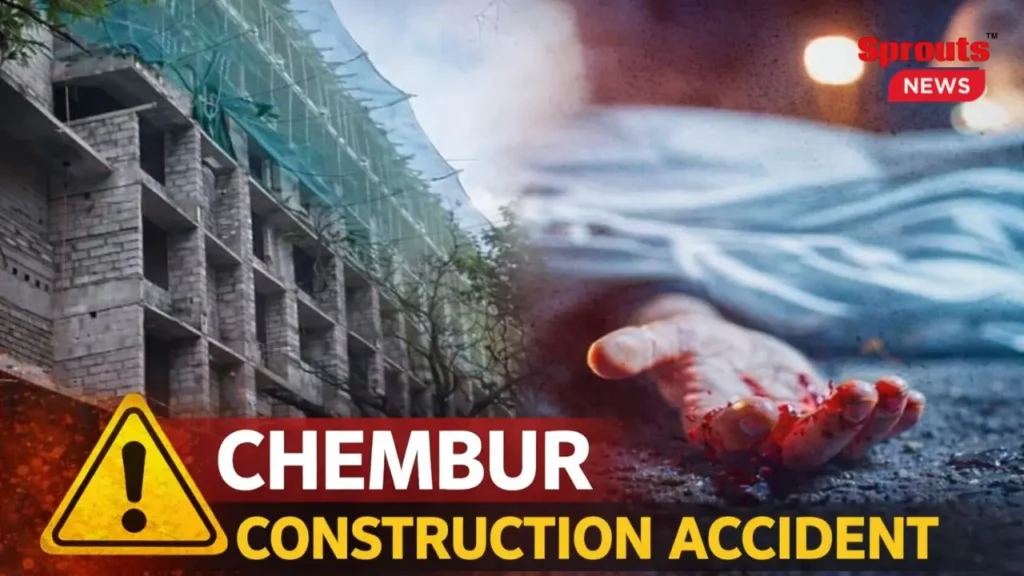
The Chembur Construction Accident at the Adityaraj Springs redevelopment project has resulted in one worker’s death and serious injuries to five others after a wooden plank collapsed on the sixth floor. The incident occurred during masonry work in Subhash Nagar and has raised fresh concerns about construction site safety in Mumbai. Civic authorities and police have begun investigations into possible safety violations. Residents and local leaders have demanded strict action against those responsible and stronger enforcement of safety norms at high rise redevelopment sites.
Chembur Construction Accident: Worker Killed, Five Injured After Sixth Floor Plank Collapse at Adityaraj Springs
A worker died and five were seriously injured after a wooden plank collapsed at the sixth floor of the Adityaraj Springs redevelopment project in Chembur. The incident has sparked allegations of safety violations, triggering police investigation and civic action.
Chembur construction accident has once again exposed glaring safety failures at Mumbai redevelopment sites after a worker died and five others suffered serious injuries in Subhash Nagar on Saturday morning.
The fatal incident occurred at the under construction Adityaraj Springs project in Chembur, where a wooden plank reportedly gave way during wall work on the sixth floor of a high rise tower.
Civic officials confirmed that 55 year old Ramallu was declared dead on arrival at Rajawadi Hospital. Five other workers are undergoing treatment, with one reported to be in critical condition.
The accident has triggered political outrage, civic intervention and renewed questions over builder accountability in Mumbai’s rapidly expanding eastern suburbs redevelopment corridor.
Safety Lapses at Adityaraj Springs Raise Questions Over Builder Accountability in Mumbai
The mishap occurred at the Adityaraj Springs redevelopment project, a G plus 16 storey structure coming up as part of the redevelopment of Building No 36 in Subhash Nagar.
Construction had progressed up to the eighth floor, but the accident took place while workers were carrying out wall related tasks in the parking section on the sixth floor.
According to eyewitness accounts, around 10 am six workers climbed onto a temporary wooden plank positioned for masonry work. The plank reportedly collapsed without warning.
Ramallu fell directly to the ground after a safety net tore under the impact. Twenty two year old Gunadhar Rai struck the fifth floor during the fall and sustained critical injuries.
The remaining four workers were partially saved by the protective net, which slowed their descent before locals and emergency responders rescued them from the debris.
Residents have alleged that essential safety equipment including helmets and safety harnesses were either absent or not properly enforced at the site.
Deepak Sisode, a former corporator present at the site, claimed that workers were operating in hazardous conditions without adequate supervision or structured safety compliance.
The injured workers have been identified as Gunadhar Rai, Usrai, Ramesh Rai, Vijay and Sandeep. All are currently receiving treatment at Rajawadi Hospital under medical observation.
Officials from the Mumbai Fire Brigade and Chembur police station reached the location shortly after the incident and initiated rescue and legal procedures.
Also Read: Fino Bank CEO Rishi Gupta Arrested Under GST Act.
Mumbai Redevelopment Boom and Construction Safety Norm Violations Under Scrutiny
The Chembur construction accident has intensified debate over adherence to building safety regulations during redevelopment projects across Mumbai’s eastern suburbs.
Subhash Nagar, Vikhroli and Bhandup have witnessed a surge in redevelopment driven by ageing housing stock and high real estate demand.
However, labour safety experts argue that rapid project timelines and cost pressures often result in compromised safety oversight at ground level.
Under Indian labour and construction laws, developers are required to provide protective equipment, certified scaffolding systems and on site supervision by qualified engineers.
Mayor Ritu Tawde visited both the accident site and Rajawadi Hospital, directing authorities to examine the possibility of registering a culpable homicide case against those responsible.
She was accompanied by Deputy Mayor Sanjay Ghadi and Opposition Leader Kishori Pednekar during the inspection and review process.
The Mayor stated that prima facie observations indicated serious negligence and questioned the absence of the designated site engineer at the time of the accident.
She instructed the Brihanmumbai Municipal Corporation and MHADA to enforce strict preventive audits across ongoing construction projects in the area.
Local corporator Asha Marathe has demanded a comprehensive safety audit of all redevelopment projects in Subhash Nagar, alleging repeated violations by certain builders.
Industry analysts note that fatal construction accidents not only attract criminal liability but can also lead to project suspension, insurance scrutiny and regulatory penalties.
According to labour rights advocates, migrant construction workers often lack bargaining power and depend entirely on developers for safety enforcement and compliance.
Sprouts News Special Investigation Team has previously reported on rising workplace safety concerns linked to accelerated urban redevelopment in Mumbai.
The Chembur tragedy highlights systemic gaps in monitoring mechanisms despite existing statutory frameworks intended to safeguard construction workers.
Police have registered a case and are conducting further investigation to determine liability of the developer, contractor and supervisory personnel involved.
As Mumbai continues vertical expansion, the key question remains whether regulatory enforcement will match the speed of redevelopment or remain reactive after fatal incidents.
For policymakers, this incident underscores the urgent need for real time compliance checks, digital safety logs and third party structural audits.
For workers and their families, however, the issue is immediate and human. Accountability, compensation and structural reform now define the next phase of this investigation.