


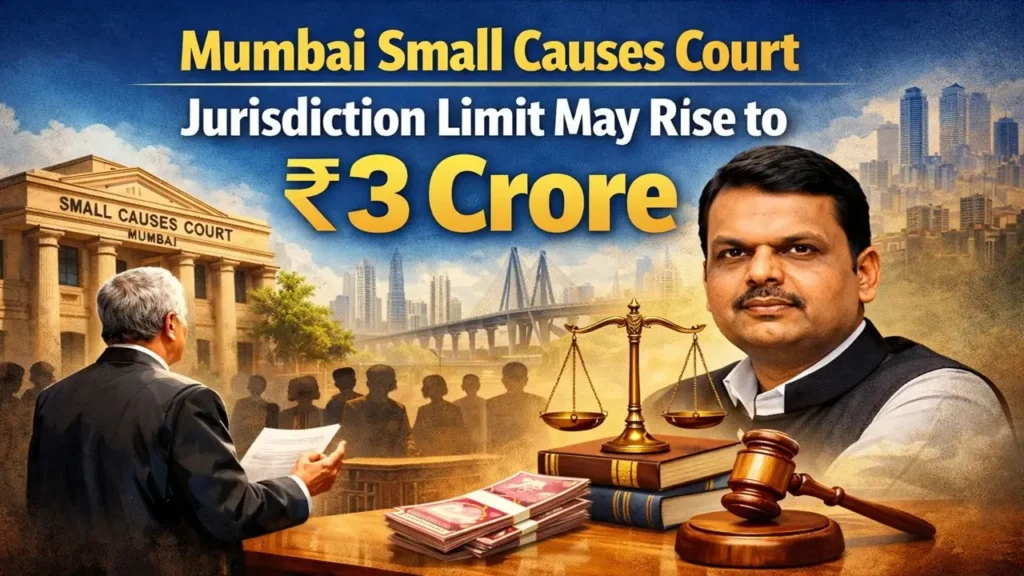
The Mumbai Small Causes Court jurisdiction debate has resurfaced after advocates urged the Maharashtra government to increase the court’s monetary limit to ₹3 crore. Lawyers say the existing jurisdiction under the Presidency Small Causes Courts Act is outdated and does not reflect current economic realities in Mumbai. According to legal professionals, the low financial limit forces litigants to approach higher civil courts even for moderate claims, increasing legal costs and adding to case backlogs. Expanding the jurisdiction could help faster dispute resolution and improve access to affordable civil justice for individuals and small businesses.
- Mumbai Small Causes Court Jurisdiction Limit May Rise to ₹3 Crore, Advocates Urge Maharashtra Government
- Why Advocates Want the Mumbai Small Causes Court Jurisdiction Raised
- Mumbai Small Causes Court: Historical Role and Existing Legal Powers
- Impact on Citizens, Businesses and Case Backlogs
- Legislative Changes Required for Jurisdiction Expansion
Mumbai Small Causes Court Jurisdiction Limit May Rise to ₹3 Crore, Advocates Urge Maharashtra Government
Lawyers in Mumbai have urged the Maharashtra government to raise the Mumbai Small Causes Court jurisdiction limit to ₹3 crore, arguing the current ₹10,000 cap is outdated. The proposal aims to ease civil court backlogs and improve affordable access to justice.
Mumbai Small Causes Court jurisdiction limit has come under fresh debate after lawyers demanded that the Maharashtra government increase the court’s monetary authority to ₹3 crore, citing outdated legal provisions and rising commercial disputes in India’s financial capital.
Members of the Small Causes Court Advocates Association recently submitted a formal representation to Maharashtra Chief Minister and Law and Judiciary Minister Devendra Fadnavis, urging immediate legislative reform.
Advocates argue that the existing financial jurisdiction of the Mumbai Small Causes Court is no longer relevant in today’s economic environment. They say inflation, expanding commercial activity, and rising property disputes require a major revision of the court’s monetary powers.
Currently, the court can hear money recovery suits only up to ₹10,000 under Section 18 of the Presidency Small Causes Courts Act, 1882. Legal experts describe this limit as outdated and inconsistent with present-day financial realities.
Although Maharashtra Act No. XV of 1987 increased the jurisdiction to ₹25,000, advocates claim the revised limit has never been effectively implemented. As a result, the court continues to function under restrictions set more than a century ago.
According to the representation submitted to the government, raising the jurisdiction limit to ₹3 crore would modernise the functioning of the historic court and align it with contemporary economic conditions in Mumbai.
Why Advocates Want the Mumbai Small Causes Court Jurisdiction Raised
Legal professionals believe the proposal could transform access to civil justice in Mumbai, where commercial disputes and property-related claims often involve significantly larger financial stakes.
Mumbai’s legal ecosystem currently sees a high volume of civil litigation in district courts and higher civil courts. Many of these cases involve monetary claims that could be efficiently handled by the Small Causes Court if its jurisdiction were expanded.
Advocates say the current threshold forces litigants to approach higher civil courts even for relatively moderate claims. This not only increases legal costs but also contributes to heavy case backlogs in senior civil courts.
By raising the jurisdiction to ₹3 crore, the Small Causes Court could become a faster and more affordable forum for resolving financial disputes, especially for individuals and small businesses.
Legal experts also argue that the proposed change could significantly reduce pressure on Mumbai’s already overburdened civil courts, allowing judges to focus on more complex cases.
Sources familiar with the representation told Sprouts News that the proposal reflects long-standing demands from the legal community, which has repeatedly highlighted the outdated nature of the court’s financial limits.
Mumbai Small Causes Court: Historical Role and Existing Legal Powers
The Mumbai Small Causes Court is among India’s oldest specialised courts and holds a unique position within the city’s judicial structure.
The court was established to provide speedy adjudication of minor civil disputes, particularly financial claims and tenancy-related matters. Over time, it has developed jurisdiction under several key laws.
These include the Maharashtra Rent Control Act, 1999, and provisions under the Mumbai Municipal Corporation Act, 1888. The court regularly handles disputes involving landlord-tenant issues, rent recovery, and municipal matters.
Despite its limited monetary jurisdiction in money suits, the court’s administrative and judicial framework is relatively robust.
According to available judicial data, the court has 44 sanctioned judicial posts, including the Chief Judge, Additional Chief Judges, and other judicial officers.
Legal practitioners say this infrastructure makes the court well equipped to handle higher-value disputes if the jurisdiction limit is increased.
Advocates argue that expanding the court’s financial authority would maximise the use of existing judicial capacity without requiring substantial additional resources.
Also Read: Central Sanskrit University Nashik Recognition Controversy.
Impact on Citizens, Businesses and Case Backlogs
Supporters of the proposal say the reform could significantly improve access to justice for Mumbai’s middle class and small enterprises.
For many individuals and small businesses, pursuing civil claims in higher courts can be expensive and time consuming. Court fees, procedural delays, and extended litigation periods often discourage legitimate claims.
If the jurisdiction is raised to ₹3 crore, litigants could approach the Small Causes Court for faster adjudication of moderate financial disputes.
Legal analysts believe this could particularly benefit small and medium enterprises operating in Mumbai’s dense commercial ecosystem.
SMEs frequently face payment disputes, contractual disagreements, and property-related claims that fall between minor disputes and large commercial litigation.
Allowing such cases to be heard in the Small Causes Court could reduce litigation costs and improve efficiency within the judicial system.
Advocates also argue that redistributing cases across courts would help address the mounting backlog of civil cases in Maharashtra’s judicial system.
Legislative Changes Required for Jurisdiction Expansion
For the proposal to take effect, the Maharashtra government would need to amend provisions under the Presidency Small Causes Courts Act, 1882 and related state legislation.
Lawyers have urged the state government to initiate amendments that formally increase the court’s financial jurisdiction to ₹3 crore.
The representation submitted to the government also includes detailed documentation on the court’s history, administrative structure, and existing jurisdictional powers.
Legal experts say the proposal aligns with broader judicial reform discussions in India that emphasise decentralisation of civil dispute resolution.
If implemented, the reform could mark one of the most significant structural changes in Mumbai’s civil court system in decades.
According to the Sprouts News Special Investigation Team (SIT), the Maharashtra government has yet to publicly respond to the proposal, but the issue is likely to attract attention from policymakers and the legal fraternity.
For Mumbai’s legal community, the debate now centres on whether lawmakers will move swiftly to modernise a court whose financial limits were set long before the city became India’s financial powerhouse.
Readers with information or views on Mumbai Small Causes Court jurisdiction reform may contact Unmesh Gujarathi at 9322755098 to share inputs.