
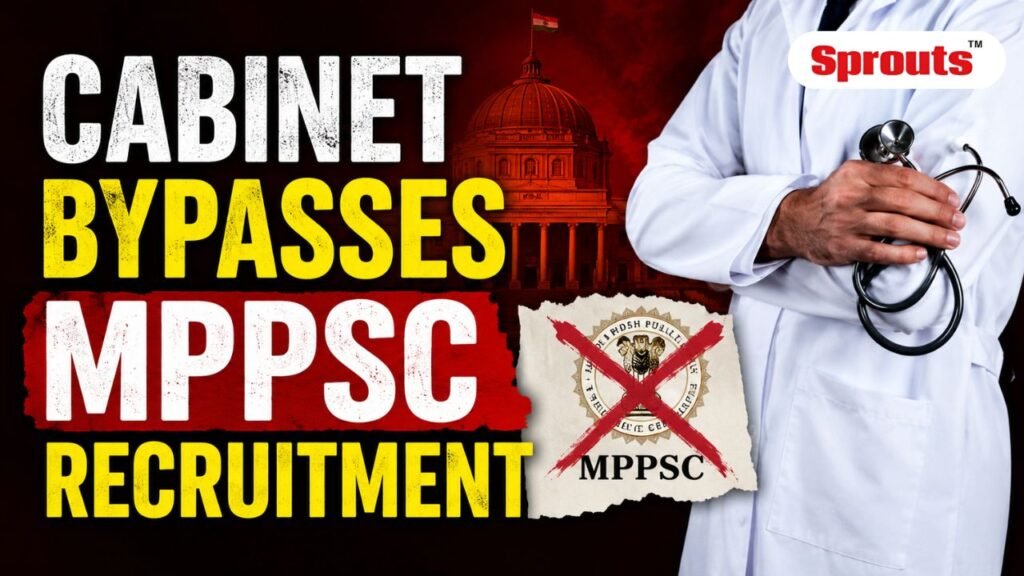
The Madhya Pradesh Doctor Recruitment policy has been revised after the state Cabinet approved direct departmental recruitment of specialist doctors for Community Health Centres in specific cases. The move aims to address long-standing vacancies, particularly in tribal and underserved areas, while reducing dependence on the conventional MPPSC recruitment route. The decision follows representations, administrative interventions, and concerns regarding specialist shortages highlighted through official correspondence. The new framework is expected to strengthen healthcare delivery and improve access to specialist medical services across Madhya Pradesh.
- Madhya Pradesh Doctor Recruitment Policy Overhauled: Cabinet Approves Direct Hiring After Healthcare Vacancy Concerns
- Investigation highlighted specialist vacancy concerns
- Central institutions monitored administrative developments
- Official grievance records show administrative movement
- Cabinet approves direct departmental recruitment
Madhya Pradesh Doctor Recruitment Policy Overhauled: Cabinet Approves Direct Hiring After Healthcare Vacancy Concerns
The Madhya Pradesh Cabinet has approved a new framework allowing direct departmental recruitment of specialist doctors for Community Health Centres, replacing the conventional MPPSC route in specific cases. The decision follows sustained representations, administrative interventions and concerns over prolonged specialist vacancies, particularly in tribal regions.
The Madhya Pradesh doctor recruitment policy has undergone a significant change after the state cabinet approved direct departmental recruitment of specialist doctors to address long-standing vacancies across Community Health Centres (CHCs). The decision follows months of representations, official correspondence and administrative interventions involving multiple institutions.
According to documents reviewed by Sprouts News, the policy change emerged after sustained investigations by the Sprouts News Special Investigation Team (SIT) and representations pursued by whistleblower Dr. Divyansh Dwivedi before state and central authorities regarding specialist doctor shortages.
Investigation highlighted specialist vacancy concerns
The investigation questioned earlier administrative claims that no vacancies existed under the National Health Mission (NHM) for MS (General Surgery) specialists despite official records indicating otherwise. The reports examined recruitment practices affecting government healthcare facilities across Madhya Pradesh.
Documents reviewed during the investigation include a June 2025 NHM administrative order, which reportedly sanctioned 52 General Surgeon posts carrying a fixed monthly remuneration of ₹1,25,000, raising questions regarding recruitment implementation despite approved positions.
Further official correspondence dated 21 August 2025 from Chief Medical and Health Officer (CMHO), Shahdol, Dr. Rajesh Mishra, informed state authorities that the tribal region lacked surgical specialists and sought immediate contractual recruitment for CHC Budhar and CHC Singhpur.
The investigation also examined allegations that approved specialist positions remained unfilled while healthcare facilities relied upon College of Physicians and Surgeons (CPS) diploma holders in certain locations. Those allegations formed part of the broader concerns raised before multiple government authorities and require determination by competent authorities wherever disputed.
Central institutions monitored administrative developments
The matter subsequently reached several constitutional and executive authorities after representations were submitted by Dr. Divyansh Dwivedi. According to available records, more than 35 petitions were submitted before constitutional offices during the course of the campaign.
Official correspondence indicates that the office of the Union Minister of State (Department of Personnel and Training), Dr. Jitendra Singh, forwarded representations to the Secretary (Personnel), Department of Personnel and Training (DoPT) on 10 September 2025 for examination.
Records further indicate that on 23 October 2025, the DoPT Vigilance Section issued a communication bearing File No. 104/52/2025-AVD-IA addressed to the Principal Secretary to the Chief Minister of Madhya Pradesh regarding the representations.
The matter also reached the Prime Minister’s Office (PMO). According to official records, communication under File No. 5999907/2026-FE was forwarded to the Chief Secretary of Madhya Pradesh, seeking an appropriate response from the state administration.
Meanwhile, the National Commission for Scheduled Tribes (NCST) initiated proceedings under its constitutional powers provided by Article 338A concerning healthcare accessibility for members of the Baiga and Gond tribal communities.
Official grievance records show administrative movement
Digital grievance records relating to Grievance No. 36556485 document the administrative movement of the complaint before the policy announcement. The timeline reflects multiple levels of scrutiny within the state’s grievance redressal mechanism.
The complaint was initially registered on 28 January 2026. Official portal entries indicate movement between administrative levels on 23 June 2026, including officers identified as Dr. Neera Choudhary (L3 Officer) and Dhanraju S. (L4 Officer).
Subsequent records dated 2 July 2026 indicate that higher-level officers directed a fresh evaluation of the grievance. On 6 July 2026, the resolution was reportedly validated and forwarded to the Directorate of Health Services (DHS) for implementation.
Also Read: Over 1,200 MP Medical Officers Seek Accommodation Relief During Mandatory Bhopal Training.
Cabinet approves direct departmental recruitment
The newly approved cabinet policy authorises the Madhya Pradesh Health Department to undertake direct departmental recruitment of specialist doctors instead of relying exclusively upon the Madhya Pradesh Public Service Commission (MPPSC) process for the identified vacancies.
According to official figures cited by the administration, 1,207 of 1,320 sanctioned specialist posts across 327 operational Community Health Centres remain vacant, representing approximately 91 percent of sanctioned positions.
Under the revised framework, vacancy positions will be updated on the MP Online portal by the 15th of every month. Departmental committees will conduct interviews and issue appointments on the second Wednesday of the following recruitment cycle.
The policy further provides that newly appointed specialists will ordinarily serve a mandatory three-year tenure at their designated Community Health Centre before transfer requests are considered, with the stated objective of improving continuity of healthcare services in rural and tribal regions.
Commenting on the development, Unmesh Gujarathi, Editor-in-Chief of Sprouts News, said the policy change demonstrates how sustained documentation, public-interest reporting and institutional engagement can contribute to administrative review. He added that the publication would continue monitoring implementation of the recruitment framework and healthcare delivery across underserved communities.
Editorial Note:
This article is based on publicly available FIR records, court case references, and reports published by multiple media organisations. The information is presented in the context of ongoing investigations and public interest reporting. Sprouts News does not make any judicial determination regarding the individuals mentioned and does not intend to defame any person or organisation. Any individual seeking clarification or wishing to provide an official response may contact the editorial team with verifiable documentation. The information is presented for journalistic and informational purposes.