

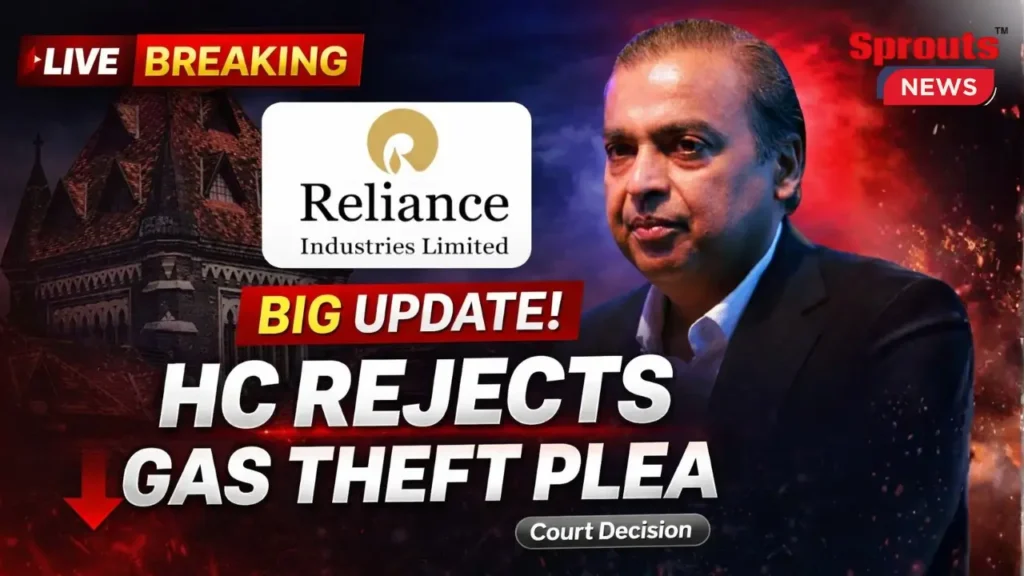
The Bombay High Court has dismissed a plea seeking a CBI probe into alleged gas theft involving Reliance Industries and Mukesh Ambani, ruling that the petition lacked public interest and bona fide intent. The court observed that such litigation could harm corporate reputation and business relationships if based on unverified claims. It emphasised that public interest litigations must meet strict legal standards and cannot be used for personal motives. The decision comes amid ongoing legal and arbitration developments related to disputes between Reliance and ONGC over gas extraction in the Krishna Godavari Basin.
- Bombay High Court dismisses Mukesh Ambani’s ‘gas theft’ plea: Key developments and what it means for the Reliance case
- Court flags ‘gas theft’ plea as misuse of judicial process
- Concerns over reputational harm to Reliance Industries
- Timeline of ONGC dispute and arbitration developments
- Delhi High Court ruling and a pending Supreme Court case
- Court questions delay, evidence, and legal standing
- Legal representation and case details
- Broader implications for PIL scrutiny and corporate litigation
Bombay High Court dismisses Mukesh Ambani’s ‘gas theft’ plea: Key developments and what it means for the Reliance case
The Bombay High Court dismissed a petition seeking a CBI probe against Reliance Industries and Mukesh Ambani over alleged gas theft, ruling it lacked public interest, suppressed facts, and could harm corporate reputation, business partnerships, and ongoing legal proceedings.
The court ruled the petition seeking a CBI probe lacked public interest, warning such actions could harm corporate reputation and business relationships.
The Bombay High Court dismissed a plea seeking a CBI probe into alleged gas theft by Reliance Industries Limited and Mukesh Dhirubhai Ambani, calling it an abuse of process.
The division bench of Chief Justice Shree Chandrashekar and Justice Suman Shyam rejected the petition filed by Jitendra Punamchand Maru, stating it lacked bona fide intent and public interest.
Court flags ‘gas theft’ plea as misuse of judicial process
The court observed that the petition, presented as a public interest litigation, was instead driven by personal motives and failed to meet essential legal standards required for judicial intervention.
Judges noted that Maru, who described himself as a social worker, could not demonstrate credible public service activity or explain his past business dealings in plastic sales.
“The professed cause and purpose behind this petition are mere pretentious projections,” the bench remarked, adding that such litigation does not serve a genuine public cause.
The bench further stated that writ petitions must involve a clear public law element, emphasising that courts act only on matters relevant to broader public interest considerations.
Concerns over reputational harm to Reliance Industries
In its judgment authored by Chief Justice Chandrashekhar, the court warned that petitions of this nature could damage corporate reputation and disrupt existing or future business partnerships.
The court highlighted that such filings may create uncertainty among stakeholders, potentially affecting commercial relationships and undermining trust in corporate entities like Reliance Industries Limited.
It added that similar petitions are often filed by disgruntled individuals, failed competitors, or rival business interests, masquerading as public interest litigation without substantive grounds.
Timeline of ONGC dispute and arbitration developments
The plea alleged that Reliance Industries Limited engaged in illegal extraction of natural gas worth over USD 1.55 billion from Oil and Natural Gas Corporation (ONGC) wells.
According to the petition, the alleged extraction occurred between 2004 and 2013-14 in the Krishna Godavari Basin off Andhra Pradesh, involving directional drilling into adjacent ONGC blocks.
ONGC officials reportedly identified the issue in 2013 and informed the Government of India, while Reliance maintained the extracted gas was “migratory” and lawfully recoverable.
An independent study by De Golyer and Macnaghten (D&M) found that gas had been accessed from ONGC blocks, leading to further scrutiny by authorities.
Subsequently, the Justice AP Shah Committee estimated the value of the gas at over USD 1.55 billion, along with accrued interest of USD 174.9 million.
Delhi High Court ruling and a pending Supreme Court case
Reliance Industries had earlier secured an arbitral award in its favour; however, a Delhi High Court division bench set aside the award on February 14, 2025.
The Delhi High Court held that the arbitral award was against public policy, allowing the Union of India’s appeal and overturning the earlier ruling in favour of Reliance.

The matter is currently pending adjudication before the Supreme Court, a fact the Bombay High Court noted was not disclosed by the petitioner.
The omission was described by Reliance as suppression of material facts, which weighed against the petitioner’s credibility during proceedings.
Court questions delay, evidence, and legal standing
The judges also questioned the delay of more than a decade in approaching the court, calling Maru’s explanation for the timing of the petition “false.”
They noted that the petitioner relied primarily on newspaper reports and failed to establish legal grounds for directing registration of a First Information Report.
“A person approaching the writ court must come with clean hands,” the bench said, stressing the importance of full disclosure and genuine intent in public interest litigation.
The court concluded that the petition lacked merit on all counts and was filed with a “tainted motive,” leading to its dismissal.
Also Read: Eknath Kharat Controversy Raises Guwahati Link Allegations.
Legal representation and case details
Advocates Rajendra Desai, Kunal Bhanage, and Akshay Pawar appeared for the petitioner, while Special Public Prosecutor Amit Munde and Advocate Jai Vohra represented the CBI.
Additional Solicitor General Anil Singh, along with Neha Patil, Aditya Thakkar, Krishnakant Deshmukh, Adarsh Vyas, Rama Gupta, and Rajdatt Nagre, represented the Union Government.
Additional Public Prosecutor SV Gavand appeared for the State. At the same time, Senior Advocates Harish Salve and Vikram Nankani, with Rubin Vakil, Ashwin Dave, Rishit Badiani, and Gaurav Gangal, instructed by AS Dayal & Associates, represented Reliance Industries Limited.
The case, titled Jitendra Punamchand Maru vs Central Bureau of Investigation (Criminal Writ Petition 5542 of 2025), underscores judicial scrutiny of public interest litigation standards.
Broader implications for PIL scrutiny and corporate litigation
Legal experts note that the ruling reinforces stricter scrutiny of public interest litigations, particularly those involving major corporate entities and high-value commercial disputes.
The judgment signals that courts will closely examine intent, disclosure, and timing before entertaining such petitions, especially where reputational and economic consequences are significant.
For readers of Sprouts News, the case highlights the intersection of corporate law, energy disputes, and judicial oversight, with the Supreme Court’s pending decision expected to shape future developments.
Unmesh Gujarathi, an investigative journalist known for exposing scams and frauds, continues to pursue public-interest stories. Readers with credible information or leads can reach out directly at 9322755098 to contribute to impactful journalism.
Editorial Note:
This article is based on publicly available FIR records, court case references, and reports published by multiple media organisations. The information is presented in the context of ongoing investigations and public interest reporting. Sprouts News does not make any judicial determination regarding the individuals mentioned and does not intend to defame any person or organisation. Any individual seeking clarification or wishing to provide an official response may contact the editorial team with verifiable documentation. The information is presented for journalistic and informational purposes.