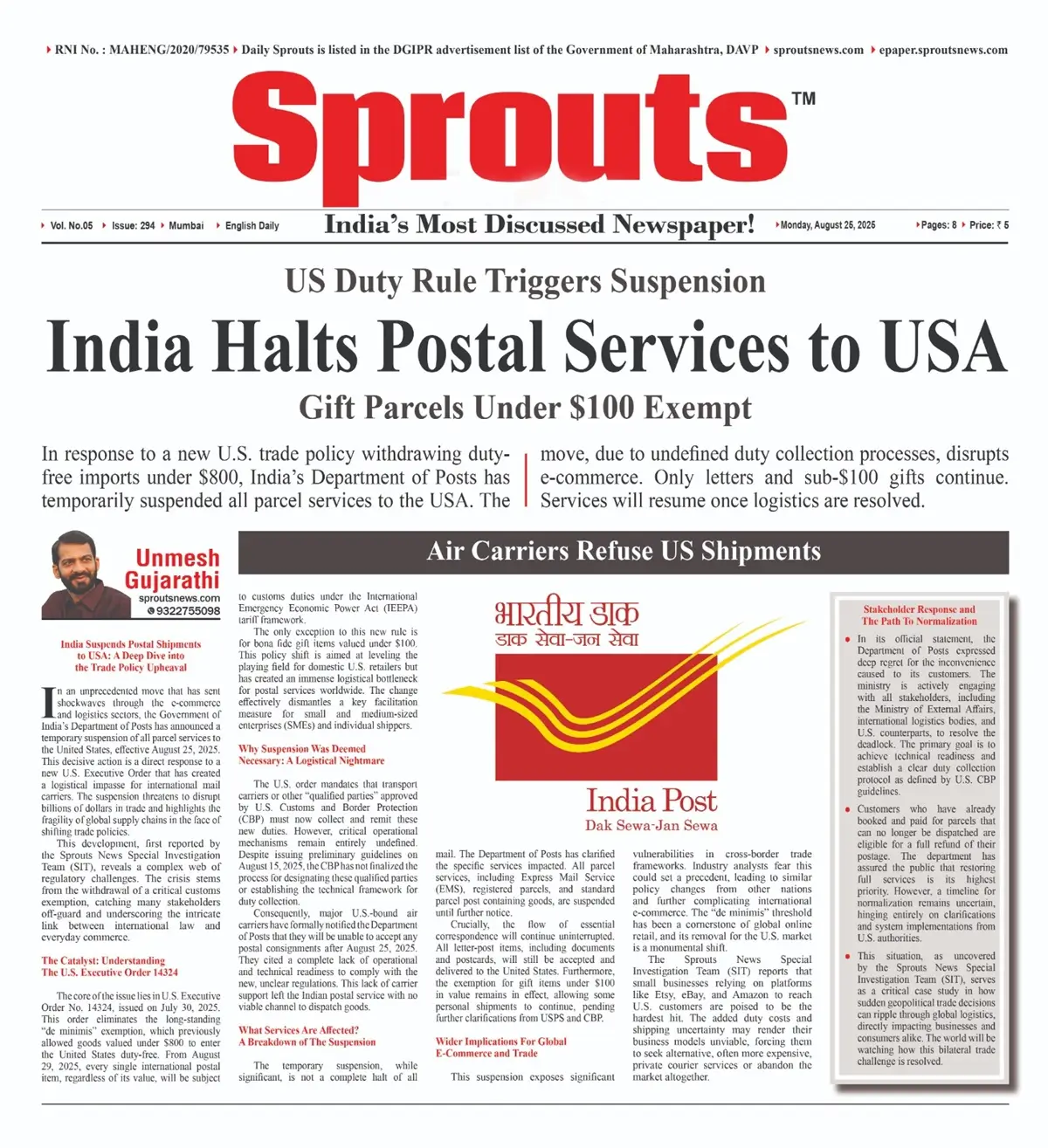
India Halts Postal Services to USA
• US Duty Rule Triggers Suspension
• Gift Parcels Under $100 Exempt
• Air Carriers Refuse US Shipments
Unmesh Gujarathi
Sprouts News Exclusive
Contact: +91 9322755098
In response to a new U.S. trade policy withdrawing duty-free imports under $800, India's Department of Posts has temporarily suspended all parcel services to the USA. The move, due to undefined duty collection processes, disrupts e-commerce. Only letters and sub-$100 gifts continue. Services will resume once logistics are resolved.
India Suspends Postal Shipments to USA: A Deep Dive into the Trade Policy Upheaval
In an unprecedented move that has sent shockwaves through the e-commerce and logistics sectors, the Government of India's Department of Posts has announced a temporary suspension of all parcel services to the United States, effective August 25, 2025. This decisive action is a direct response to a new U.S. Executive Order that has created a logistical impasse for international mail carriers. The suspension threatens to disrupt billions of dollars in trade and highlights the fragility of global supply chains in the face of shifting trade policies.
This development, first reported by the Sprouts News Special Investigation Team (SIT), reveals a complex web of regulatory challenges. The crisis stems from the withdrawal of a critical customs exemption, catching many stakeholders off-guard and underscoring the intricate link between international law and everyday commerce.
[audio mp3="https://sproutsnews.com/wp-content/uploads/2025/08/India-Halts-Postal-Services-to-USA.mp3"][/audio]
The Catalyst: Understanding The U.S. Executive Order 14324
The core of the issue lies in U.S. Executive Order No. 14324, issued on July 30, 2025. This order eliminates the long-standing "de minimis" exemption, which previously allowed goods valued under $800 to enter the United States duty-free. From August 29, 2025, every single international postal item, regardless of its value, will be subject to customs duties under the International Emergency Economic Power Act (IEEPA) tariff framework.
The only exception to this new rule is for bona fide gift items valued under $100. This policy shift is aimed at leveling the playing field for domestic U.S. retailers but has created an immense logistical bottleneck for postal services worldwide. The change effectively dismantles a key facilitation measure for small and medium-sized enterprises (SMEs) and individual shippers.
Why Suspension Was Deemed Necessary: A Logistical Nightmare
The U.S. order mandates that transport carriers or other "qualified parties" approved by U.S. Customs and Border Protection (CBP) must now collect and remit these new duties. However, critical operational mechanisms remain entirely undefined. Despite issuing preliminary guidelines on August 15, 2025, the CBP has not finalized the process for designating these qualified parties or establishing the technical framework for duty collection.
Consequently, major U.S.-bound air carriers have formally notified the Department of Posts that they will be unable to accept any postal consignments after August 25, 2025. They cited a complete lack of operational and technical readiness to comply with the new, unclear regulations. This lack of carrier support left the Indian postal service with no viable channel to dispatch goods.
What Services Are Affected? A Breakdown of The Suspension
The temporary suspension, while significant, is not a complete halt of all mail. The Department of Posts has clarified the specific services impacted. All parcel services, including Express Mail Service (EMS), registered parcels, and standard parcel post containing goods, are suspended until further notice.
Crucially, the flow of essential correspondence will continue uninterrupted. All letter-post items, including documents and postcards, will still be accepted and delivered to the United States. Furthermore, the exemption for gift items under $100 in value remains in effect, allowing some personal shipments to continue, pending further clarifications from USPS and CBP.
Wider Implications For Global E-Commerce and Trade
This suspension exposes significant vulnerabilities in cross-border trade frameworks. Industry analysts fear this could set a precedent, leading to similar policy changes from other nations and further complicating international e-commerce. The "de minimis" threshold has been a cornerstone of global online retail, and its removal for the U.S. market is a monumental shift.
The Sprouts News Special Investigation Team (SIT) reports that small businesses relying on platforms like Etsy, eBay, and Amazon to reach U.S. customers are poised to be the hardest hit. The added duty costs and shipping uncertainty may render their business models unviable, forcing them to seek alternative, often more expensive, private courier services or abandon the market altogether.
Stakeholder Response and The Path To Normalization
In its official statement, the Department of Posts expressed deep regret for the inconvenience caused to its customers. The ministry is actively engaging with all stakeholders, including the Ministry of External Affairs, international logistics bodies, and U.S. counterparts, to resolve the deadlock. The primary goal is to achieve technical readiness and establish a clear duty collection protocol as defined by U.S. CBP guidelines.
Customers who have already booked and paid for parcels that can no longer be dispatched are eligible for a full refund of their postage. The department has assured the public that restoring full services is its highest priority. However, a timeline for normalization remains uncertain, hinging entirely on clarifications and system implementations from U.S. authorities.
This situation, as uncovered by the Sprouts News Special Investigation Team (SIT), serves as a critical case study in how sudden geopolitical trade decisions can ripple through global logistics, directly impacting businesses and consumers alike. The world will be watching how this bilateral trade challenge is resolved.