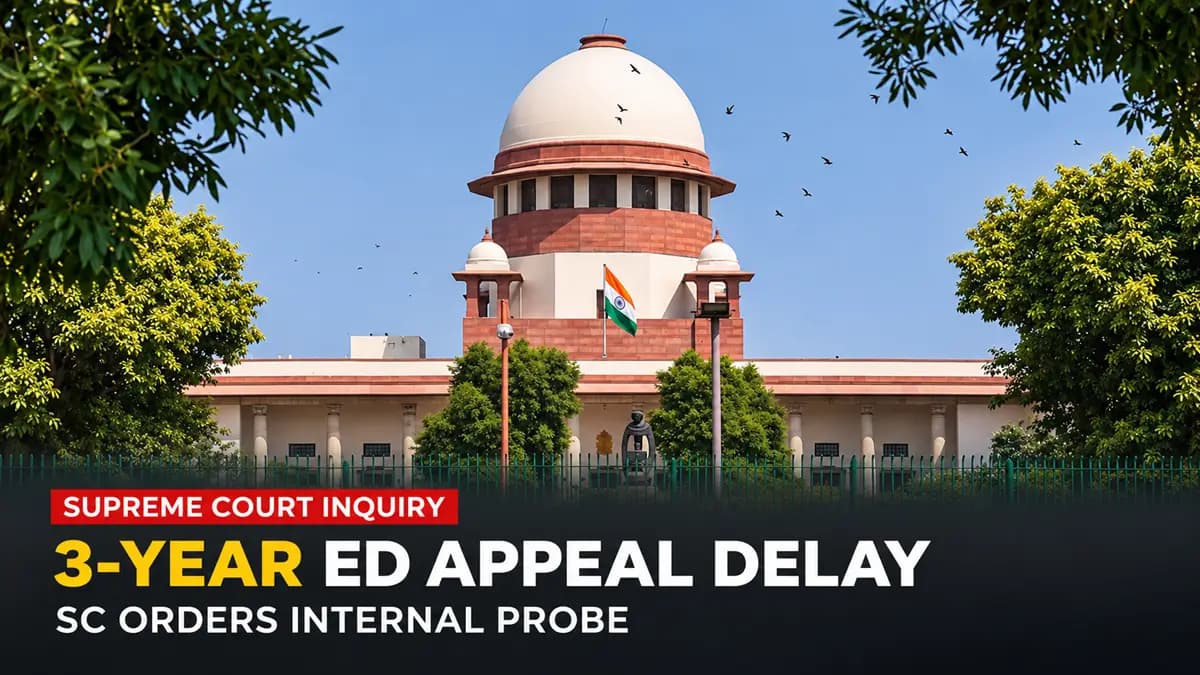
The Supreme Court ruled on November 26, 2026, that a judicial member must participate when the PMLA Adjudicating Authority hears and confirms provisional property attachments ordered by the Enforcement Directorate. A bench comprising Chief Justice Surya Kant and Justices Joymalya Bagchi and V. Mohana held that final adjudication under Sections 8(2) and 8(3) requires legal expertise because attachment can substantially affect property rights.
The Court clarified that a single judicial member may decide such cases and that the authority's chairperson need not hold judicial qualifications. Preliminary notices can be issued by non-judicial members, while past decisions will not automatically be reopened. It also asked the Centre to consider establishing multiple adjudicating authorities to address growing caseloads.
Supreme Court Rules Judicial Member Must Be Present for PMLA Attachment Confirmation
The Supreme Court has held that the PMLA adjudicating authority cannot confirm the provisional attachment orders passed by the Enforcement Directorate against any property without the presence of a judicial member.
The Supreme Court noted that the PMLA Adjudicating Authority could not have confirmed the orders of property attachment passed by the Enforcement Directorate (ED) unless it was constituted with a judicial member.
It relates to the legal requirements regarding the composition and functioning of the Adjudicating Authority under the Prevention of Money Laundering Act (PMLA).
Under Section 8 of the legislation, the authority investigates whether the properties provisionally attached by the ED are linked to alleged money laundering activities.
The judgment deals with the issue of single-member benches, especially those without judicial expertise, confirming orders of provisional attachment.
Supreme Court PMLA Ruling Addresses Judicial Representation
The Supreme Court’s ruling focuses on the role of judicial expertise in proceedings involving attachment of properties under anti-money laundering legislation.
The Adjudicating Authority plays an important role in examining the provisional attachment orders passed by the Enforcement Directorate during the course of investigation of the suspected financial offences.
Under the PMLA, the authority examines whether the properties identified by the investigators are linked to the proceeds of crime and whether their attachment should be confirmed.
The legal challenge brought to focus the practice of single-member benches deciding matters involving property attachment, including proceedings without a judicial member.
The Supreme Court ruling clarified that a judicial member must be present when the authority exercises its power to confirm provisional attachment orders.
Enforcement Directorate Property Attachment Under PMLA
The Enforcement Directorate is the central agency to investigate money laundering offences and also to enforce the provisions of the Prevention of Money Laundering Act.
Provisional property attachment is an important investigatory measure under the legislation. It allows authorities to restrict dealings in properties suspected to represent proceeds of crime.
However, such attachment orders are subject to adjudication under Section 8 of the PMLA, which provides for a statutory mechanism to examine the legality of the action.
Thus, the Adjudicating Authority is essential in balancing the enforcement powers of investigative agencies with the procedural protections available to affected property owners.
The composition of the authority is of particular importance to the Supreme Court when deciding whether provisional attachment orders should be confirmed.
Implications for PMLA Proceedings and Future Cases
The ruling has ramifications for cases of ED property attachments, especially in cases where confirmation orders were taken up by single-member benches in the absence of judicial representation.
It additionally emphasises the necessity of judicial expertise in quasi-judicial proceedings involving property rights, financial investigations and the application of anti-money laundering legislation.
The decision may require more scrutiny of the composition of the authority when matters of attachment are heard and decided under the PMLA regime.
The judgment will refocus attention on the statutory protections governing adjudication for individuals and organisations faced with property attachment proceedings.
The detailed directions in the judgment and consequential legal ramifications will make the position clear as regards pending matters and attachment orders already confirmed.
The Supreme Court ruling highlights the necessity of procedural compliance in financial probes, ensuring that the decisions on confirming property attachments are made with the necessary judicial expertise as prescribed by the law.
We at Sprouts News will keep tracking any developments on the PMLA, Enforcement Directorate probes, and what the Supreme Court verdict means.