

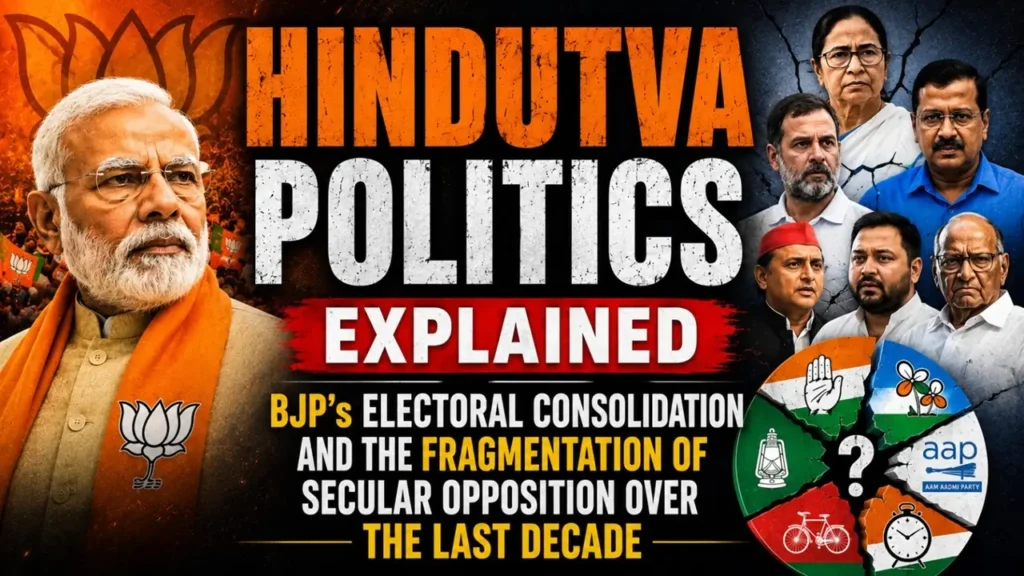
The debate around Hindutva Politics has intensified following a political commentary by Prashant Prabhakar Dhumal analysing the BJP’s electoral rise and the fragmentation of India’s secular opposition. The analysis argues that the BJP successfully consolidated the Hindutva narrative at a national level while regional and opposition forces struggled with ideological divisions and alliance instability. Particular focus was placed on Maharashtra politics, including the transformation of the BJP-Shiv Sena relationship after 2014, the Maha Vikas Aghadi experiment, and the later split within Shiv Sena. The commentary suggests these developments significantly reshaped voter alignment and ideological positioning in Indian politics.
- Hindutva Politics: BJP’s Electoral Consolidation and the Fragmentation of Secular Opposition Over the Last Decade
- Maharashtra Political Realignment and the Hindutva Consolidation Debate
- Secular Politics, Vote Fragmentation, and Counter-Polarisation Claims
- EVM Debate, Central Agencies, and “Operation Lotus” Allegations
Hindutva Politics: BJP’s Electoral Consolidation and the Fragmentation of Secular Opposition Over the Last Decade
India’s political landscape has witnessed a significant ideological and electoral transformation during the last decade, with the BJP consolidating the Hindutva narrative while opposition parties continue struggling with fragmentation and competing secular platforms.
The debate surrounding Hindutva politics, secularism, and electoral consolidation has intensified after political analyst Prashant Prabhakar Dhumal presented a detailed commentary examining shifts within Indian electoral and ideological dynamics over the past decade.
According to the analysis, the continued electoral success of the Bharatiya Janata Party (BJP) cannot be viewed solely through the lens of leadership popularity or a “Modi wave,” but rather through broader political consolidation and opposition fragmentation.
The commentary argues that the BJP succeeded in establishing near-complete dominance over the Hindutva narrative, thereby reducing the political space previously occupied by regional allies and ideologically aligned organisations.
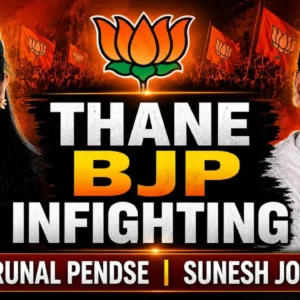
The article particularly highlights political developments in Maharashtra, where the ideological and electoral relationship between the BJP and the undivided Shiv Sena underwent a significant transformation following the 2014 and 2019 elections.
According to the analysis, the Shiv Sena under Balasaheb Thackeray once projected an assertive Hindutva position that often exceeded the BJP’s political messaging in intensity and street mobilisation.
However, the commentary argues that after 2014, the BJP strategically expanded its independent organisational structure in Maharashtra, gradually reducing Shiv Sena’s bargaining position within the alliance framework.
Maharashtra Political Realignment and the Hindutva Consolidation Debate
The analysis further states that the 2019 Maharashtra political crisis and subsequent formation of the Maha Vikas Aghadi alliance significantly altered public perception surrounding ideological consistency within regional politics.
According to the article, the BJP utilised the breakdown of its traditional alliance with Shiv Sena to question the latter’s Hindutva positioning after Uddhav Thackeray aligned with ideologically divergent political parties.
The commentary additionally refers to several politically sensitive controversies, including the Ketaki Chitale matter, Kangana Ranaut controversy, Palghar sadhu lynching case, Narayan Rane arrest episode, and mosque loudspeaker protests.
According to the analysis, these controversies collectively contributed toward reshaping the political narrative and gradually weakening Shiv Sena’s earlier image as Maharashtra’s dominant, aggressive Hindutva force.
The article also examines the later split within Shiv Sena, the emergence of the Eknath Shinde faction, and the Election Commission’s allocation of the official party symbol and organisational identity.
According to the commentary, these developments consolidated a substantial section of traditional Hindutva-oriented voters around the BJP and allied political formations, thereby reducing ideological fragmentation within that voter segment.
The article argues that while Hindutva politics became increasingly consolidated under a centralised national framework, opposition politics simultaneously experienced fragmentation across multiple regional and ideological platforms.
Secular Politics, Vote Fragmentation, and Counter-Polarisation Claims
The commentary states that parties including the Indian National Congress, Trinamool Congress, Aam Aadmi Party, Samajwadi Party, Rashtriya Janata Dal, and Nationalist Congress Party frequently compete for similar opposition voter bases.
According to the article, such competition often results in fragmentation of anti-BJP votes, thereby electorally benefiting the BJP even in situations where combined opposition vote shares appear numerically larger.
The analysis cites examples from Uttar Pradesh elections, where divisions between the Samajwadi Party and Bahujan Samaj Party allegedly split minority and Dalit vote banks during key electoral contests.
Similarly, the commentary references Goa, Tripura, Gujarat, Bihar, and Maharashtra while arguing that smaller parties and emerging alliances frequently influenced final outcomes by dividing opposition-oriented votes.
The article additionally discusses the concept of “counter-polarisation,” where attempts by opposition parties to consolidate minority support allegedly trigger broader Hindu voter consolidation behind the BJP.
According to data interpretations referenced in the commentary, Hindu voter consolidation for the BJP reportedly increased significantly during the 2014 and 2019 Lok Sabha elections, especially across northern Indian states.
The analysis further argues that caste-based political divisions were increasingly overshadowed by broader ideological and religious identity mobilisation during recent electoral cycles across several regions.
Also Read: Officials Face FIR In Mumbai University Plagiarism Case.
EVM Debate, Central Agencies, and “Operation Lotus” Allegations
The article additionally discusses allegations frequently raised by opposition parties regarding the alleged misuse of central investigative agencies, including the ED, CBI, and Income Tax authorities, for political purposes.
According to the commentary, critics often describe this phenomenon as “washing machine politics,” alleging that corruption-related scrutiny weakens once certain political figures align with the ruling establishment.
The analysis also references “Operation Lotus,” a term widely used by opposition parties to describe government formation through defections witnessed previously in states including Karnataka and Madhya Pradesh.
Further discussion within the article focuses on Electronic Voting Machine controversies and demands by organisations such as the Association for Democratic Reforms seeking expanded VVPAT verification procedures.
While the Election Commission of India has consistently defended the integrity of the electoral process, political debates surrounding transparency, vote-counting discrepancies, and electoral trust continue to remain part of national discourse.
The commentary ultimately concludes that unless opposition parties adopt stronger electoral coordination and reduce internal fragmentation, the BJP’s ideological and organisational dominance may continue in future electoral contests.
Sprouts News understands that debates surrounding Hindutva politics, secular alliances, electoral strategy, and democratic institutions are likely to remain central themes in India’s political discourse ahead of upcoming elections and alliance negotiations.
Editorial Note:
This article is based on publicly available FIR records, court case references, and reports published by multiple media organisations. The information is presented in the context of ongoing investigations and public interest reporting. Sprouts News does not make any judicial determination regarding the individuals mentioned and does not intend to defame any person or organisation. Any individual seeking clarification or wishing to provide an official response may contact the editorial team with verifiable documentation. The information is presented for journalistic and informational purposes.