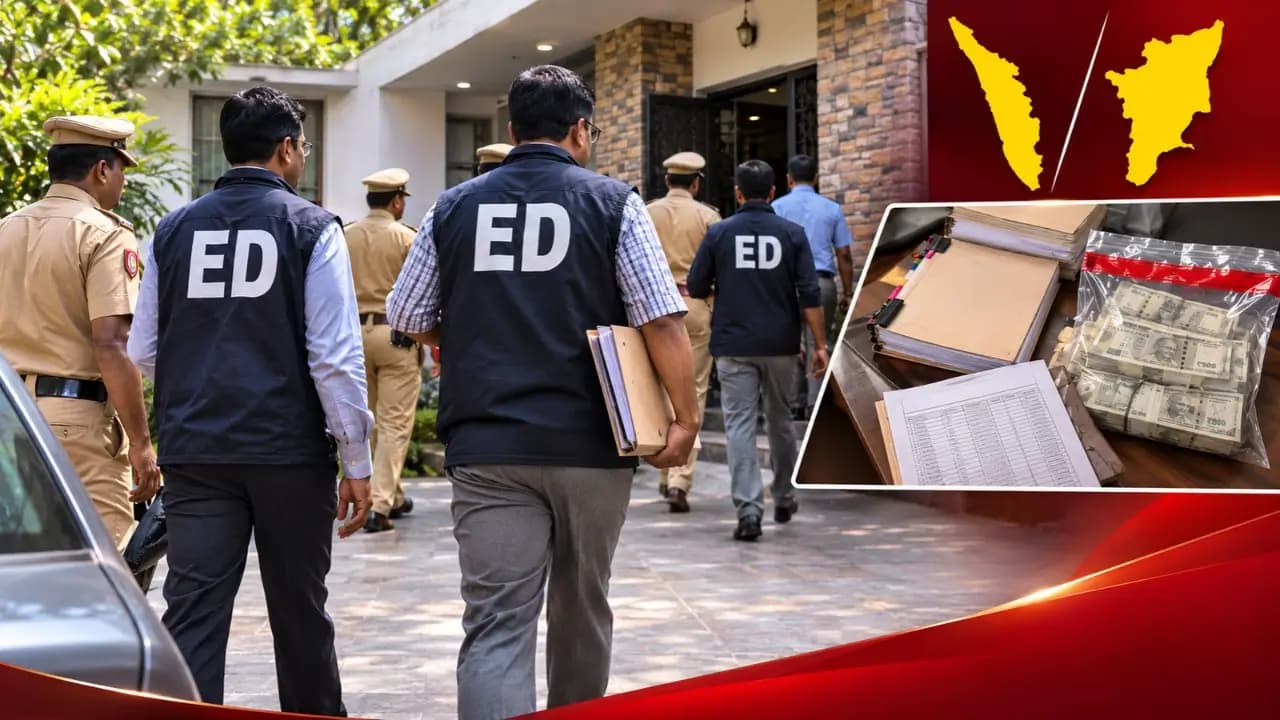
The Karnataka High Court quashed Enforcement Directorate proceedings linked to alleged land allocation and KOMUL recruitment irregularities in a November 6, 2026 judgment. Justice M. I. Arun held that the ED's PMLA powers depend on an underlying scheduled offence and do not authorise it to file private complaints when competent agencies decline prosecution. The ruling followed the closure of the original land case and the absence of separate criminal proceedings over recruitment allegations. The court also set aside related investigative actions.
Karnataka High Court ED Ruling Limits Enforcement Agency's Powers, Quashes Money Laundering Probe
The Karnataka High Court has quashed proceedings related to alleged irregularities in land allocation and recruitment, ruling that the Enforcement Directorate cannot pass its own orders on criminal investigations and cannot bypass state police.
The Karnataka High Court's ED judgment has brought clarity on the legal boundaries of the Directorate of Enforcement (ED) by ruling that its investigative powers under the Prevention of Money Laundering Act (PMLA), 2002, are derivative and not independent.
Last week, Justice M. I. Arun, in a 30-page judgment, observed that the ED is not an independent law enforcement agency and cannot investigate every allegation brought to its notice. The court pointed out that the state has the responsibility to maintain law and order.
The order came on five writ petitions filed by Y B Ashwathanarayan, K Y Nanje Gowda, K N Gopala Murthy, Nagesh N and Dr Raju Krishna C. The petitioners had challenged the seizures, summons, and proceedings initiated by the agency.
Karnataka High Court ED Ruling Addresses Land and Job Scam Allegations
The controversy started with the allegations against K. Y. Nanje Gowda, the former chairman of the Malur Land Grant Committee in Kolar district and the chairman of Kolar and Chikkaballapur Milk Union Ltd (KOMUL).
Gowda was charged with abusing his official position in recommending the allotment of about 80 acres of land to 38 persons. In 2022, a criminal case was registered for the offences under the Indian Penal Code (IPC).
In November 2023, the ED filed an Enforcement Case Information Report (ECIR) and started a money laundering investigation by treating the allegations as a scheduled offence under the PMLA regime.
Further searches reportedly found documents related to alleged irregularities in recruitment at KOMUL. These findings were the basis of a different narrative, the job scam.
But the original criminal case on land issues subsequently collapsed after the police submitted a closure report. The trial court, in exercise of jurisdiction, dismissed the complaint for not obtaining the required sanction from the state government to prosecute the public servant.
ED's Private Complaint and Section 66(2) of PMLA
After the development, the ED had shared information with the local authorities on the alleged recruitment irregularities under Section 66(2) of the PMLA.
The provision requires the agency to pass on relevant information to the appropriate authority if it suspects another law has been violated. However, no criminal prosecution was initiated by the Lokayukta Police and local authorities.
In 2024, the ED directly filed a private criminal complaint before the Special Court under Section 200 of the Code of Criminal Procedure (CrPC). The provision deals with magistrates examining complainants while taking cognisance of private complaints.
The High Court rejected this approach, holding that the ED could not assume the powers of prosecution vested in the state authorities. “If such action is allowed, the checks and balances built into the Constitution would be defeated,” Justice Arun said.
The judgment said that the agency would be put on an unauthorised higher pedestal by allowing it to file private complaints whenever state police refused to prosecute.
Also Read: Delhi's Namo Yamuna River Safari Begins: ₹500 Ticket, Route and Ride Details
PMLA Requires an Existing Scheduled Offence, Court Says
The Court reiterated that, having regard to the decisions of the Supreme Court in Vijay Madanlal Choudhary v. Union of India and V. Senthil Balaji v. Deputy Director of Directorate of Enforcement, a scheduled offence is sine qua non to prove proceeds of crime.
Justice Arun said the ED can exercise its powers only when an FIR or a formal criminal complaint has been lodged by a primary investigating agency in connection with a scheduled offence.
Also, the court clarified that the authorities specified are mentioned under Section 48 of the PMLA and their powers are subject to the statutory limitations. 66(2) does not allow the ED to act in place of the state police or to prosecute suspected offences by itself.
Karnataka High Court Quashes ED Proceedings and Orders Return of Seized Property
The High Court allowed all five writ petitions and quashed the ECIR of November 2023, the seizure order dated 6 June 2024 of the adjudicating authority, issued summons, show cause notices and the private complaint filed in 2024. The court also ordered the ED to immediately return all the seized property and articles to the petitioners.
The ruling is a major clarification of the limits of federal investigative power, the duties of state police forces and the statutory basis needed for prosecutions of money laundering. Its implications may affect the manner in which future investigations are launched and pursued under the PMLA.
As pointed out in this report by Sprouts News, the ruling emphasises that enforcement powers must stay within the confines of legislation and constitutional principles.