

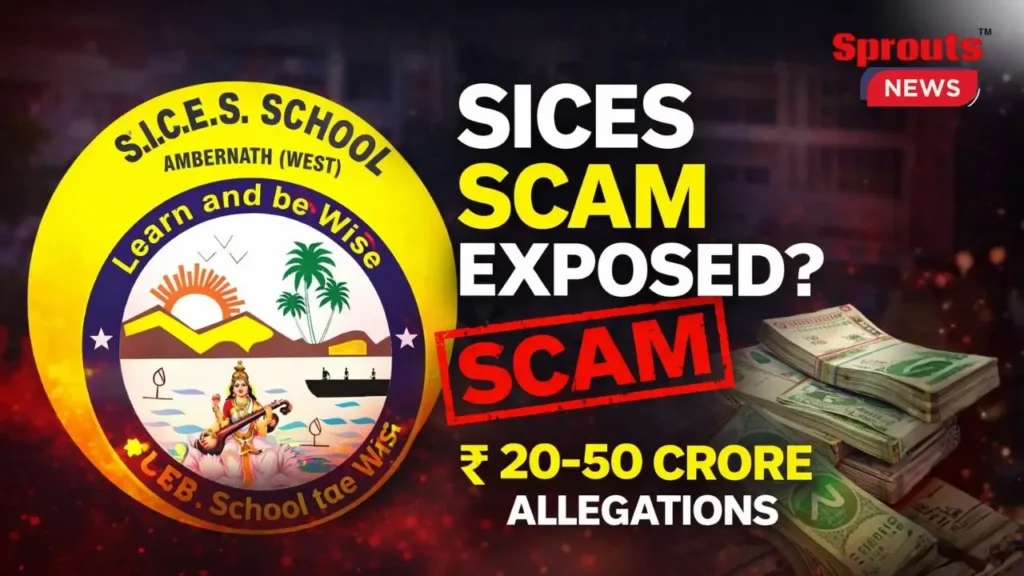
The SICES Ambernath case has gained attention after an RTI activist sought an FIR alleging illegal donations and excess fee collection by the South Indian Children’s Education Society. The complaint claims unauthorised collections over two decades, estimated between ₹20 crore and ₹50 crore, despite the institution receiving government aid. It also references a 2020 education department inquiry that reportedly flagged irregularities but did not lead to action. The matter now raises broader questions about regulatory enforcement, compliance with fee laws, and financial transparency in aided educational institutions.
- SICES Ambernath case: FIR sought over alleged illegal donations, excess fees and capitation charges
- The official inquiry report and the education department response are under focus
- BNS sections, the fee regulation law and the Capitation Fee Act invoked
- Ultimatum over FIR demand and possible Lokayukta, High Court move
SICES Ambernath case: FIR sought over alleged illegal donations, excess fees and capitation charges
Complaint by RTI activist Sudhir Sharad Gujar alleges long-running unauthorised fee collection at South Indian Children’s Education Society in Ambernath, despite government aid and prior inquiry findings.
The SICES Ambernath case has triggered fresh scrutiny after serious allegations surfaced that the South Indian Children’s Education Society in Ambernath collected illegal donations and excess fees from parents over two decades.
According to a complaint submitted by social activist and Right to Information campaigner Sudhir Sharad Gujar, the alleged collections may run between ₹20 crore and ₹50 crore.
The complaint alleges that the institution, despite receiving government grants, continued to charge parents unauthorised amounts in the name of donations and additional fees, raising questions over compliance and oversight.
The allegations relate to South Indian Children’s Education Society, commonly referred to as S.I.C.E.S., an educational institution in Ambernath that is now facing demands for criminal and administrative action.
The matter has gained significance because the complaint does not rely only on fresh allegations but also refers to an earlier official inquiry report by the education department.
According to the material cited by the complainant, a report dated November 5, 2020, by the Group Education Officer, Ambernath, recorded findings against key persons linked to the institution.
The complaint specifically names the institution’s management, the headmaster, and librarian Rajesh Nair, alleging that irregularities were identified in the official departmental inquiry itself.
Yet, despite the existence of that report, the complainant has alleged that no meaningful follow-up action was taken by the education department, fuelling concerns about administrative inaction.
The official inquiry report and the education department response are under focus
At the centre of the controversy is the allegation that the official report did not lead to disciplinary or criminal proceedings, even after findings were reportedly recorded in the departmental file.
The complaint cites the report reference number issued in 2020 and argues that the matter has remained pending for years, with no decisive enforcement visible at the institutional level.
That delay, according to the complainant, has enabled the alleged practice of collecting illegal sums from parents to continue without fear of legal consequences or regulatory intervention.
The representation raises broader concerns about whether aided institutions can continue demanding unauthorised payments while simultaneously benefiting from public funding meant to support affordable education.
It also questions whether parents, especially from middle-class and lower-income households, have effectively borne a financial burden that should not have been imposed under the law.
The allegations remain claims made in the complaint and require verification by the competent authorities, including the education department and the police, before any legal conclusions are drawn.
Also Read: ISKCON Kharghar to Celebrate Parshuram Jayanti 2026.
BNS sections, the fee regulation law and the Capitation Fee Act invoked
Sudhir Sharad Gujar has sought registration of an FIR under multiple provisions of the Bharatiya Nyaya Sanhita, arguing that the matter goes beyond administrative misconduct.
The complaint seeks action under Section 318 relating to alleged cheating, on the ground that parents were reportedly induced to pay illegal donations and additional fees.
It also invokes Section 316 for alleged breach of trust, claiming that public purpose and educational obligations were compromised through the alleged diversion or misuse of funds.
Further, the complaint refers to Sections 336 and 340, alleging false accounts and fabricated documents may have been used to mislead authorities and maintain questionable records.
Section 61 relating to criminal conspiracy has also been cited, with the complainant alleging that institutional authorities and staff acted in concert over a prolonged period.
Beyond the penal provisions, the complaint cites the Maharashtra Educational Institutions (Regulation of Fees) Act, 2011, alleging violations of Sections 7, 8, and 9.
An additional violation has also been flagged under the Maharashtra Educational Institutions (Prohibition of Capitation Fee) Act, 1987, identified as Maharashtra Act No. VI of 1988.
Ultimatum over FIR demand and possible Lokayukta, High Court move
The complainant has issued a 30-day ultimatum, warning that if no FIR is registered at the local police station, the issue may be escalated further.
According to the complaint, the next legal steps could include approaching the Lokayukta, the state government, and the High Court through a public interest litigation petition.
That warning has increased pressure on the education department to clarify whether it intends to act on the earlier inquiry findings and the present demand for criminal prosecution.
The controversy also touches a larger policy issue: how effectively Maharashtra’s education regulatory system monitors aided institutions accused of charging unlawful fees from parents.
Cases of this nature often become test matters for enforcement, because they involve school governance, fee transparency, departmental accountability, and the protection of student access to education.
As reported by Sprouts News, the case is likely to be watched closely by parents, educators, and legal observers, particularly because it combines official inquiry findings with criminal allegations.
For now, the allegations remain subject to official verification, but the demands for FIR registration and legal scrutiny have placed the SICES Ambernath case firmly in the public spotlight.
Readers’ Appeal
If you have credible information about illegal fee collection, donation scams, or similar education-related frauds, contact us at 9322755098. Unmesh Gujarathi is actively investigating such cases. Your identity will be kept confidential.
Editorial Note:
This article is based on publicly available FIR records, court case references, and reports published by multiple media organisations. The information is presented in the context of ongoing investigations and public interest reporting. Sprouts News does not make any judicial determination regarding the individuals mentioned and does not intend to defame any person or organisation. Any individual seeking clarification or wishing to provide an official response may contact the editorial team with verifiable documentation. The information is presented for journalistic and informational purposes.