

The Lokmat Media labour dispute has reached a major legal milestone after the Supreme Court of India directed Lokmat Media Private Limited to pay ₹70 lakh to employee Narendra S/o Vithalrao Patle as part of a full and final settlement. The matter originated from allegations of illegal termination dating back to 1995 and travelled through the Labour Court, Industrial Court, and the Nagpur Bench of the Bombay High Court before reaching the Supreme Court. The dispute examined questions surrounding employer-employee relationships, reinstatement rights, back wages, and compliance with labour protections under the Industrial Disputes Act, 1947.
- Lokmat Media case Latest Update: Supreme Court directs ₹70 lakh settlement for employee Narendra
- Bombay High Court judgment traced the employment dispute to the 1995 termination
- Labour Court and Industrial Court findings shaped Supreme Court proceedings
- Section 25-N findings became central to the legal dispute
Lokmat Media case Latest Update: Supreme Court directs ₹70 lakh settlement for employee Narendra
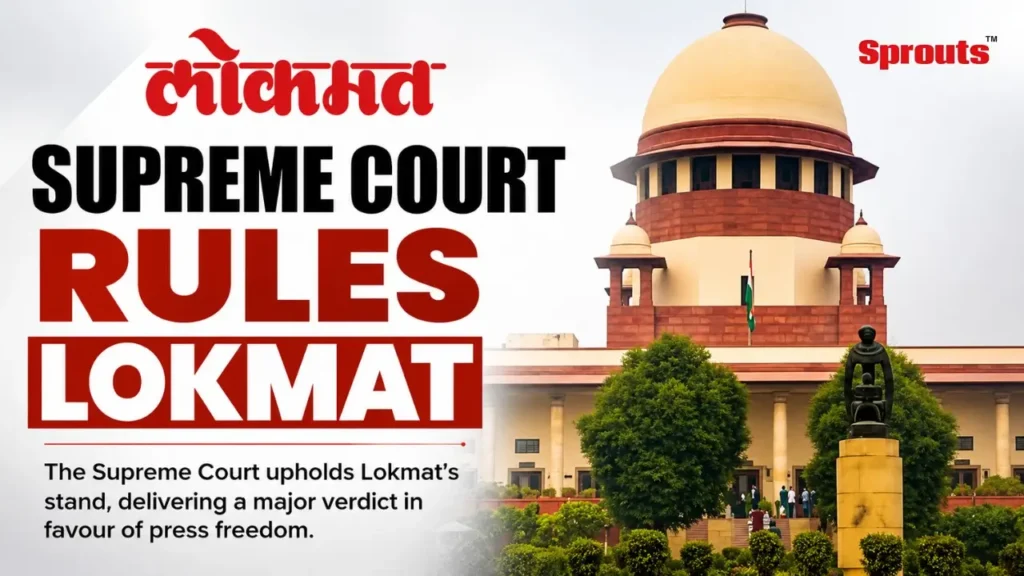
The Supreme Court of India has directed Lokmat Media Private Limited to pay ₹70 lakh to employee Narendra in a full and final settlement linked to a long-running labour dispute originating from proceedings before the Bombay High Court’s Nagpur Bench.
The dispute involving Lokmat Media Private Limited and employee Narendra S/o Vithalrao Patle has drawn renewed legal attention after the Supreme Court recorded the company’s undertaking to pay ₹70 lakh.
During proceedings before the Supreme Court on April 30, 2026, senior advocate C.U. Singh, appearing for Lokmat Media, informed the bench that the company was prepared to settle claims. The court subsequently directed payment within two weeks.
A bench comprising Justice Aravind Kumar and Justice Prasanna B. Varale reportedly issued notice in the matter while granting interim protection against the impugned order. The relief, however, remains conditional upon compliance with payment directions.
According to court records, the litigation emerged from a Special Leave Petition challenging the Bombay High Court Nagpur Bench judgment dated February 23, 2026, concerning alleged illegal termination and labour law violations.
Bombay High Court judgment traced the employment dispute to the 1995 termination
The underlying dispute centred on Narendra Patle, who alleged before the Labour Court that he had worked as a “Paster” with Lokmat Media since November 1991 before his services were allegedly terminated orally on April 18, 1995.
Court records indicate that the employee further claimed signatures had been obtained on blank papers days after the alleged termination. He subsequently sought reinstatement, continuity of service, and full back wages before the labour authorities.
Lokmat Media, formerly known as Lokmat Newspapers Pvt. Ltd., denied the allegations and argued that Narendra had never been formally employed by the organisation. The company contended that no employer-employee relationship legally existed.
The High Court judgment, delivered by Justice Rohit W. Joshi, examined documentary material, including entry cards, material issue notes, and witness testimonies, placed before the Labour Court and the Industrial Court.
One witness, Suresh Tambekar, reportedly testified that Narendra worked alongside him in the pasting department beginning in November 1991. The employer’s witness disputed the employment claim but acknowledged Tambekar’s association with the company.
Also Read: Venkatesh Gupta & Lavendra Bothra Named In Scholarship Scam.
Labour Court and Industrial Court findings shaped Supreme Court proceedings
The Second Labour Court, Nagpur, had ruled in favour of Narendra in January 2008, holding that the employer engaged in unfair labour practices under the Maharashtra Recognition of Trade Unions and Prevention of Unfair Labour Practices Act.
The Labour Court directed reinstatement with continuity of service and full back wages from April 18, 1995. That ruling was later upheld by the Industrial Court in September 2011 after Lokmat Media challenged the decision.
Before the High Court, counsel representing Lokmat Media argued that the Labour Court lacked jurisdiction because the employer-employee relationship itself remained disputed. The company also contested the award of full back wages.
Narendra’s counsel argued that the denial of employment was neither genuine nor bona fide and alleged that the company followed a practice of avoiding formal appointment documentation for certain workers.
The High Court ultimately rejected Lokmat Media’s objections and upheld concurrent findings of the Labour Court and Industrial Court, concluding available evidence sufficiently established the employment relationship.
Section 25-N findings became central to the legal dispute
A significant aspect of the ruling involved Section 25-N of the Industrial Disputes Act, 1947, which governs retrenchment procedures in establishments employing more than 100 workers.
The High Court observed that the employer neither issued the mandatory three months’ notice nor sought prior government permission before terminating services. The court consequently treated the retrenchment as legally invalid under statutory provisions.
Justice Rohit W. Joshi further held that illegal retrenchment under Section 25-N entitled the employee to consequential benefits, including back wages, particularly where termination occurred in breach of mandatory legal safeguards.
The judgment also referred to earlier rulings involving Lokmat entities, including Fulchand vs Lokmat and Lokmat Properties, Lokmat Newspaper Limited vs Prabhakar R. Choudhary, concerning disputed employment relationships and documentary evidence.
The Supreme Court’s latest direction for a ₹70 lakh settlement appears positioned to conclude the prolonged litigation that has continued across multiple judicial forums for decades. Sprouts News understands that compliance within the prescribed timeline remains critical for the continuation of interim protection.
Legal observers note that the case may continue attracting attention within labour law and industrial relations circles because of its implications regarding documentation practices, retrenchment safeguards, and evidentiary standards in employment disputes. Sprouts News will continue monitoring further developments.
For readers seeking expert insights on labour law and corporate compliance, contact Unmesh Gujarathi at 9322755098. Gain authoritative analysis on employee-employer disputes, legal settlements, and industrial relations matters. Stay informed with credible updates and practical guidance that clarify complex legal proceedings, ensuring you understand rights, obligations, and implications of high-profile cases like the Lokmat Media ruling.