Indira Gandhi Institute of Higher Education on Thadagam Road in Coimbatore has come under scrutiny over questions concerning its statutory authority to independently confer PhD degrees. Section 22 of the UGC Act, 1956, reserves degree-awarding powers for legally authorised universities and institutions. In November 2023, the Madras High Court examined the institute's recognition history in a B.Ed. Special Education employment dispute and upheld the appellant's qualification in that specific case. The judgment did not decide whether the institute could independently award PhD degrees. A UGC advisory issued on November 17, 2026, has meanwhile urged students to verify degree-awarding authority and regulatory approvals before admission.
Indira Gandhi Institute of Higher Education, Coimbatore: Questions Raised Over PhD-Awarding Authority and UGC Recognition
The statutory authority of Indira Gandhi Institute of Higher Education to independently award doctoral degrees has come under scrutiny, raising questions about regulatory compliance and academic transparency.
Questions have been raised over the PhD-awarding authority of Indira Gandhi Institute of Higher Education, located on Thadagam Road, Kanuvai, Coimbatore, Tamil Nadu, amid concerns about regulatory recognition.
The central issue concerns whether the institution possessed statutory authorisation under the University Grants Commission Act, 1956, to independently confer doctoral degrees during the relevant academic periods.
Concerns regarding reportedly issued doctoral certificates have prompted calls for documentary verification, although the available material does not independently establish that any particular PhD certificate was unlawfully awarded.
The controversy highlights the importance of distinguishing institutional registration, programme recognition and university status, which are separate legal considerations under India’s higher education regulatory framework.
UGC Act Section 22 Defines Legal Authority to Award PhD Degrees
Section 22 of the University Grants Commission Act, 1956, restricts degree-awarding powers to legally established universities, deemed-to-be universities and institutions specifically authorised through parliamentary legislation.
Recognition by a professional regulatory body, affiliation for an individual programme or registration as an educational trust does not automatically confer independent university degree-awarding powers.
Accordingly, any assessment of doctoral qualifications must establish the actual awarding university, its statutory status and the regulations applicable when the qualification was issued.
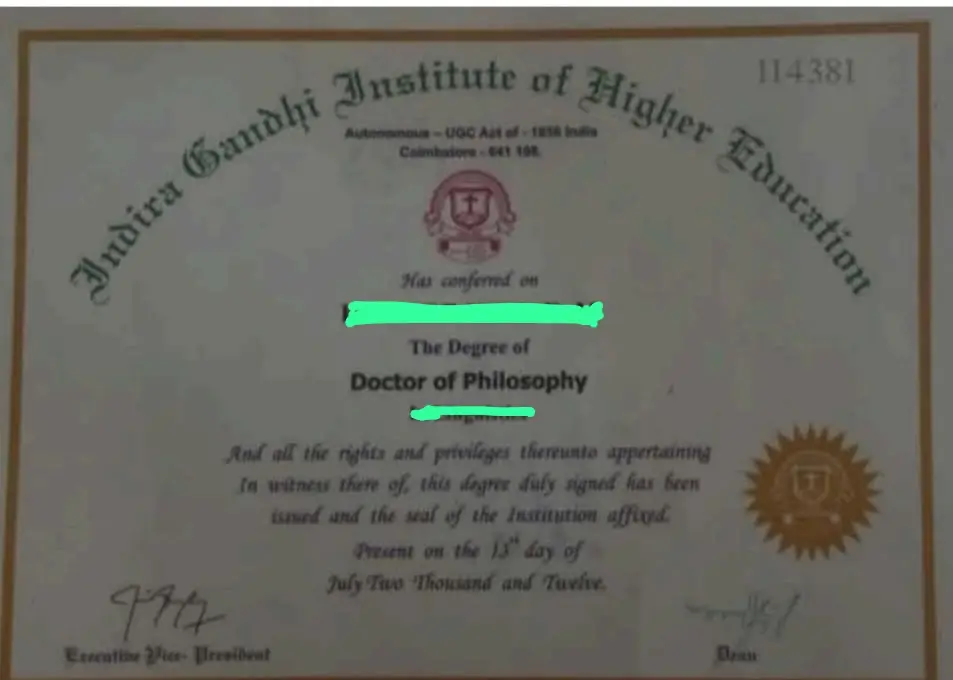
Questions have also been raised about certificates reportedly signed by a trust’s Executive Vice President and Dean without certain academic or administrative identifiers.
However, the absence of a PhD title, registration number, syndicate approval or particular university official’s signature does not, by itself, establish that a certificate is fraudulent.
Determining authenticity requires examination of the issuing authority, applicable university regulations, academic records, degree registers and any legally authorised arrangements governing certificate issuance.
Madras High Court Judgment Examines Institution’s Recognition History
The institution previously featured in Madras High Court proceedings involving C. Shalini, whose B.Ed. Special Education qualification became central to a dispute concerning employment eligibility.
In W.A. No. 145 of 2023, decided on November 8, 2023, the Court examined recognition documents involving the Rehabilitation Council of India and Bharathiar University.
The proceedings also referred to Indira Gandhi College of Special Education, Mary Kanagam Memorial Educational Trust and the Tamil Nadu Teachers Education University in examining institutional recognition.
Court records showed that the Rehabilitation Council of India granted approval in August 2006, while Bharathiar University subsequently provided provisional affiliation for the 2007–2008 academic year.
Importantly, the High Court ultimately validated the appellant’s B.Ed. qualification in the circumstances examined and directed authorities to continue her employment-related financial benefits.
The judgment concerned a specific teacher education qualification and did not independently determine whether Indira Gandhi Institute of Higher Education possessed statutory authority to award doctoral degrees.
Doctoral Certificate Verification and Institutional Accountability
The available allegations do not establish how many doctoral certificates were issued, their dates, recipients, academic disciplines or whether another legally authorised university awarded them.
These details are essential because doctoral research conducted at an affiliated institution must be distinguished from degrees independently conferred by an institution lacking statutory authority.
Verification would require documentary evidence identifying the awarding university, authorised signatories, doctoral registration records, academic approvals and the relevant statutory provisions governing degree issuance.
In a public advisory dated November 17, 2026, the UGC urged students and families to independently verify institutional recognition, programme approvals and degree-awarding authority.
The advisory also cautioned against relying exclusively on institutional advertisements, websites and promotional claims when evaluating the legal standing of educational qualifications.
Transparency Needed to Resolve PhD Recognition Questions
An authoritative determination requires clarification from the University Grants Commission and relevant academic authorities, alongside documentation establishing whether the institution independently awarded any doctoral qualifications.
No specific response from Indira Gandhi Institute of Higher Education to the present PhD-related questions has been established through the materials reviewed for this report.
The issue extends beyond one institution, underscoring the importance of transparent degree verification, regulatory accountability and protecting students, employers and academic institutions from potentially invalid qualifications.
Investigative Journalist Unmesh Gujarathi Raises Concerns Over Alleged Fake Doctorate Degrees
Investigative journalist Unmesh Gujarathi and his team have raised concerns about alleged fake doctorate degrees and questionable academic credentials, calling for greater transparency and accountability. Individuals possessing credible information or documentary evidence regarding suspected fraudulent doctoral degrees are encouraged to contact the investigation team via WhatsApp at 9322755098. The identity and personal details of informants will be treated as strictly confidential, subject to applicable legal requirements.
Roster of Individuals and Institutions Flagged in Investigations
Reports have named individuals including Tapan Kumar Rautaray Rout, Madhu Krishan, Maharshi Keshvananda, Anil Nair Thampi, Dinesh Kishor Gupta, Akepe Linus Enobi, Avinash Pawar, Joseph Legend Mfon, Musharrof Hossain and Vivek Choudhari ESRDS.
Other names cited include Siddic A Muhammed Dubai, Kalyanji Jana, Riyas Sulaima Lebbe, Francisco Sardinha, Pawan Kumar Bhoot, Dnyaneshwar Yashwant Sapkal, Sundari Thakur and Ghanshyam Sakharam Kolambe Empower Social and Education Trust Dadar.
Further names include Peeyush Pandit Piyush Pandit, Abhishek Pandey, Mahendra Shamkant Deshpande Nashik Saputara Gujarat, Lal Bahadur Rana Nepal, Sunil Singh Pardeshi, Mangesh Deshmukh and Nareshchandra Kathole Dr Panjabrao Deshmukh IAS Academy Amravati.
The list also mentions Kishor Baliram Patil, Bhivandi reporter, Vishwas Arote Akole reporter, Surykant Rawool, Tarvinder Singh, Kiran Bongale Sangli, Anwar Sheikh Pune and BuAbdullah.
Additional individuals include Lokesh Muni (Ahinsa Vishwa Bharati), Kavita Bajaj, Mansukh Damji Tank Rajkumar Tank, Gaurav Shah BJP, Anajni Kumar Delhi and Harshad Madhukar Sangle Pune.
Also named are Sandeep Marwah, film producer, Sagar Ramakant Joshi, Mira Bhayandar, Madhusudan Ghanekar (Pune), Dr Madhusudan Ghanekar, Brahmadnyan Vidyapeeth, Dr P Yohan Guntur (Andhra Pradesh), Pedditi Yohanu Hyderabad and R K Gupta, Managing Director and Vice Chancellor International.
Sreekumar N, Director, Marketing, Mission of Modernisation (MOM, Dipak Harke and Ganpat Kothari are also included in investigative listings.
Institutions cited in reports include American East Coast University, Gandhi Peace Foundation Nepal, World Culture and Environment Protection Commission, The Honorary Doctorate Award Council HDAC and World Peace of United Nations University.
Other entities named are World Human Rights Protection Commission WHRPC, Royal American University Kerala, International Global Peace University, Adi Shankar Vedic University and Socrates Social Research University.
Further institutions include Mount Elbert Central University, Maryland State University, The Open International University of Complementary Medicine Sri Lanka, American Heritage University of Southern California AHUSC and Trinity World University UK.
NGOs referenced include Dadasaheb Phalke Icon Awards Film Organisation, Shri Dadasaheb Phalke International Award Film Foundation, World Human Protection Commission and Empower Social and Education Trust.
Why the Fake Doctorate Scam Matters for India’s Academic Credibility
The proliferation of fake PhD degrees and bogus universities damages India’s academic credibility at a time when global collaborations and foreign university partnerships are expanding.
For professionals, using an unrecognised doctoral title may result in reputational harm, professional disciplinary action or legal complications in regulated sectors.
Sprouts News urges citizens to verify institutional credentials through official regulatory databases before accepting honorary titles or participating in award ceremonies.
Readers with information relating to degree fraud are encouraged to contact investigative journalist Unmesh Gujarathi and his team confidentially at 9322755098 to protect academic integrity and public trust.