The European Space Agency has launched the FLEX Earth Explorer satellite and Copernicus Sentinel-3C aboard a Vega-C rocket from Europe’s Spaceport in French Guiana. The dual-satellite mission is designed to strengthen Earth observation across vegetation, climate, oceans and environmental change. FLEX will measure the faint fluorescence emitted by plants during photosynthesis, providing data on vegetation activity and stress. Sentinel-3C adds complementary environmental monitoring capabilities. The mission also marks Vega-C’s first dual-satellite deployment using the Vespa secondary payload adapter system.
FLEX and Sentinel-3C Launch Marks New Milestone for Europe’s Earth Observation Missions
The European Space Agency has successfully launched the FLEX Earth Explorer satellite and Copernicus Sentinel-3C on a Vega-C rocket to strengthen Europe’s climate, vegetation, ocean and environmental monitoring capabilities.
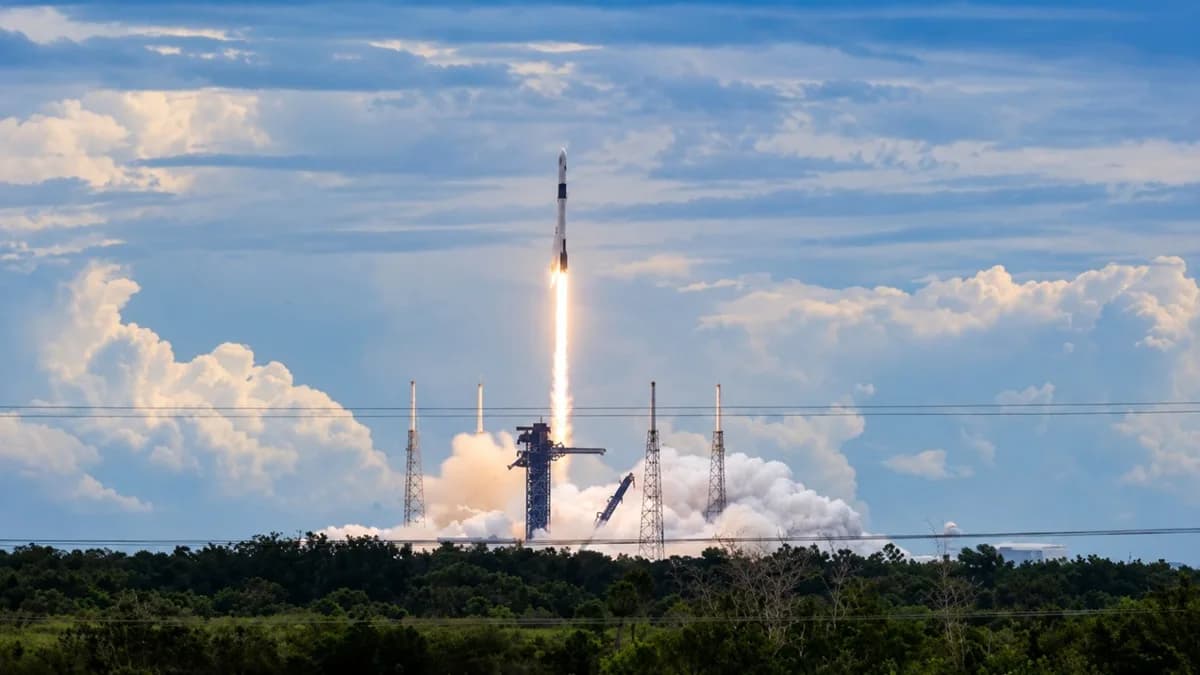
Europe's Earth observation capabilities have taken a significant step with the launch of FLEX and Sentinel-3C, both satellites being placed in orbit by a Vega-C launcher from Europe’s Spaceport in French Guiana.
Flight VV30 lifted off on 15 September at 03:21 UTC, or 22:21 local time on 14 September in French Guiana. The mission is a significant step forward for the European Space Agency’s Earth Observation Programs.
The twin launch combined two complementary scientific missions to boost understanding of Earth’s ecosystems, climate systems, oceans, atmosphere and environmental changes, according to the European Space Agency.
The launch also saw new operational capabilities for the Vega-C rocket that made its first dual-satellite deployment with the Vespa secondary payload adapter system.
FLEX mission aims to reveal hidden signals from plant life
FLEX, the Fluorescence Explorer, is one of the European Space Agency’s Earth Explorer missions to improve scientific understanding of the natural systems and environmental processes of the planet.
The satellite is intended to observe a phenomenon that is invisible to the human eye: the weak fluorescence emitted by plants as they carry out photosynthesis in ecosystems on Earth.
By using its advanced Fluorescence Imaging Spectrometer to detect and measure very weak fluorescence signals from orbit, FLEX will provide researchers with unprecedented views of vegetation activity and plant health.
The scientists believe the mission will shed light on changes in photosynthetic activity that could improve monitoring of agricultural productivity, ecosystem health, vegetation stress, and environmental responses to climate conditions.
Fluorescence levels will vary depending on plant health and environmental conditions around the plant, so FLEX data may help us better understand how ecosystems respond to droughts, heatwaves and other stresses.
The European Space Agency says the mission will provide global-scale observations to support research on climate change, biodiversity, food security and ecosystem resilience.
Also Read: Maharashtra Excise Action Draws Scrutiny After Kharghar Liquor Seizure
Sentinel-3C strengthens Copernicus Earth monitoring network
The newest Sentinel-3 mission satellite, Sentinel-3C, was launched into orbit together with FLEX, marking the continuation of a long-standing commitment to environmental monitoring.
A number of cutting-edge instruments on Sentinel-3C will provide systematic observations of the Earth’s oceans, land surfaces, ice areas and atmosphere, ensuring continuity of important environmental data sets.
The satellite will help monitor large-scale planetary dynamics and support scientific research and operational services that rely on accurate Earth observation information.
The Copernicus program provides environmental intelligence to governments, researchers, emergency services and weather services across Europe and the world through Sentinel satellites.
Mission information says Sentinel-3C will also provide essential near-real-time data for ocean forecasting and weather prediction, bolstering capabilities for environmental management and climate monitoring.
Earth observation missions are becoming more important to ensure continuity, as governments and scientists depend on long-term datasets to assess environmental trends and climate impacts, Sprouts News notes.
Vega-C demonstrates dual-launch capability in orbit
The mission also showcased the capabilities of Europe’s Vega-C launch vehicle, a 35-metre-tall rocket weighing about 210 tons at liftoff and capable of putting 2,300 kilograms into orbit.
Vega-C launches with three solid-propellant stages, followed by a fourth liquid-propellant stage to achieve a precise orbital injection, providing satellites with their specific trajectories.
For Flight VV30, Sentinel-3C was on top of the Vespa adapter inside the rocket fairing. After deployment, the adapter was opened to allow the separate injection of FLEX into orbit.
European Space Agency officials called the mission an important milestone for launch operations and Earth observation science and said it adds to Europe's capacity to observe environmental change from space.
As FLEX and Sentinel-3C move into operational phases, researchers will be watching the incoming data closely, expecting that both missions will help to further our understanding of how the Earth’s environment is changing for many years to come.