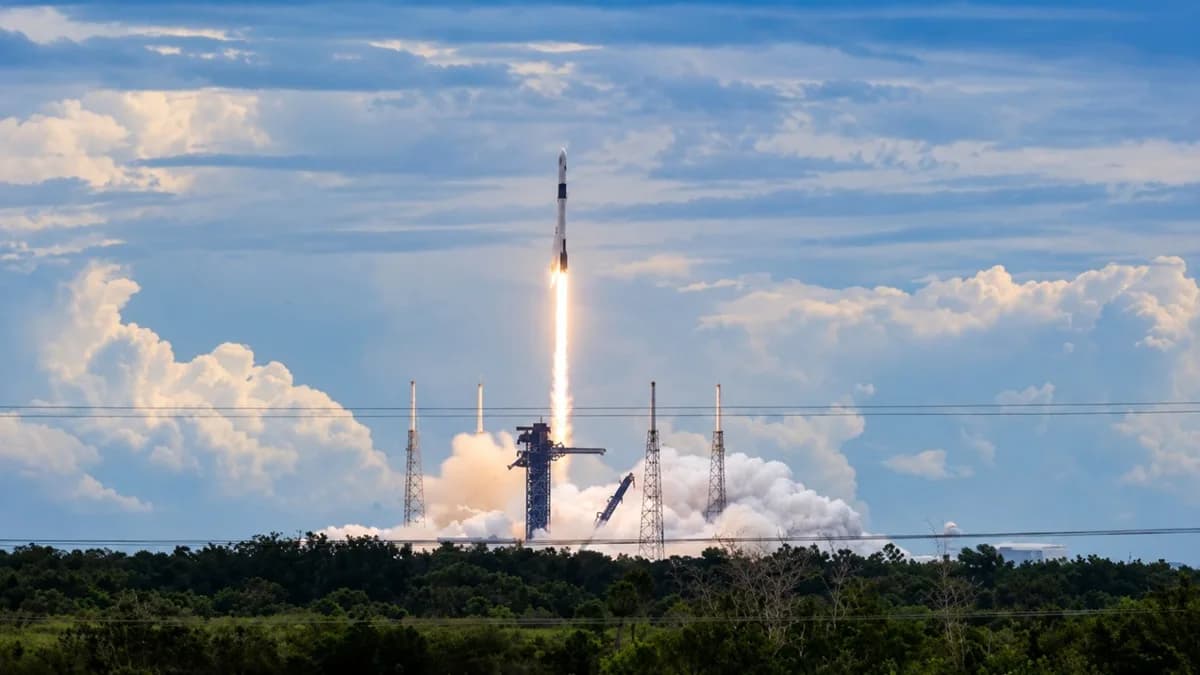
SpaceX has stacked Starship Flight 14 at its Starbase facility in South Texas as preparations intensify for the vehicle’s first orbital launch attempt. The mission is targeting September 28, pending regulatory approval, with a wet dress rehearsal planned beforehand. Ship 41 is mounted on Super Heavy Booster 21 for the flight, which is expected to last about 10 hours and include multiple orbits before a controlled Pacific Ocean splashdown. The mission will also test payload deployment and gather operational data from Starship’s V3 configuration.
SpaceX Starship Flight 14 Stacked Ahead of First Orbital Launch Attempt on September 28
SpaceX has stacked Starship Flight 14 at Starbase in South Texas and will conduct a wet dress rehearsal on September 24 ahead of the rocket’s first attempt to reach orbit.
SpaceX has completed stacking Starship Flight 14, moving the vehicle one step closer to its first orbital launch attempt after years of development and a baker’s dozen of suborbital test flights.
Pending regulatory approval, the mission is targeting a 75-minute launch window beginning at 8:15 a.m. EDT, or 12:15 GMT, on September 28.
Earlier this week, the Super Heavy first stage booster, Booster 21, arrived at Starbase’s Pad 2, where Ship 41 was moved and placed on top.
SpaceX stacked before sunrise Wednesday, Sept. 23, and is now performing final checks ahead of a try at a wet dress rehearsal Thursday.
Starship Flight 14 Marks a New Phase
Starship Flight 14 ushers in a new phase of development for SpaceX’s roughly decade-long Starship program, which has intentionally confined its thirteen prior flights to suborbital trajectories.
The next mission is set to place Ship 41 into orbit, stay there for about six revolutions, and end in a controlled splashdown in the Pacific Ocean.
The flight is expected to last about ten hours, much more than that of past Starship flights, and Booster 21 will also perform a planned splashdown in the ocean.
Unlike previous recovery demonstrations, Flight 14 is not planned to attempt a tower catch of either vehicle, leaving those recovery milestones for future missions.
So SpaceX’s immediate goal is not just orbit, and the company is getting ready to demonstrate payload deployment and collect more operational data from Starship’s V3 configuration.
Also Read: CGPSC Exam Case: ED Files Money Laundering Chargesheet Against Taman Singh Sonwani
Starlink V3 Deployment Adds Another Objective
Ship 41 is carrying 26 upgraded Starlink Version 3, or V3, satellites that would be the first such spacecraft successfully deployed into orbit.
Earlier Starship flights have been carrying a small number of V3 Starlinks, but their suborbital trajectories prevented those satellites from remaining in orbit around the Earth.
Eventually Starlink will have more than 100,000 satellites, CEO Elon Musk said, with V3 spacecraft that are designed to offer greater communications capability.
Musk said future plans also include more than one million AI data-centre satellites in low Earth orbit, but that would require regulatory approval.
As such, the planned V3 rollout directly connects Flight 14 with SpaceX’s overall Starlink expansion strategy, and orbital insertion is a prerequisite for the operational deployment of the satellites.
NASA Missions Depend on Starship Progress
Starship’s development also has ramifications beyond SpaceX’s commercial satellite network: NASA has selected the vehicle as a lunar lander for its Artemis program.
NASA expects to have an orbital Starship that can dock with the Orion spacecraft for Artemis III, and Artemis IV will fly astronauts to the Moon on Starship.
Flight 14 does not fully demonstrate the capabilities needed for those missions, such as orbital refuelling and long-term storage of cryogenic propellants in space.
Eventually SpaceX will need tanker Starship launches to ferry propellant to the main vehicles for operations beyond low Earth orbit anyway. So reliable orbital operations are key for future missions.
Sprouts News’ immediate focus is the upcoming testing sequence for Flight 14, which includes the wet dress rehearsal, regulatory clearance, and final launch preparations at Starbase.
If those steps go as planned, SpaceX will proceed toward a Sept. 28 attempt to send Starship around Earth for the first time, with the mission's results informing future development and testing.