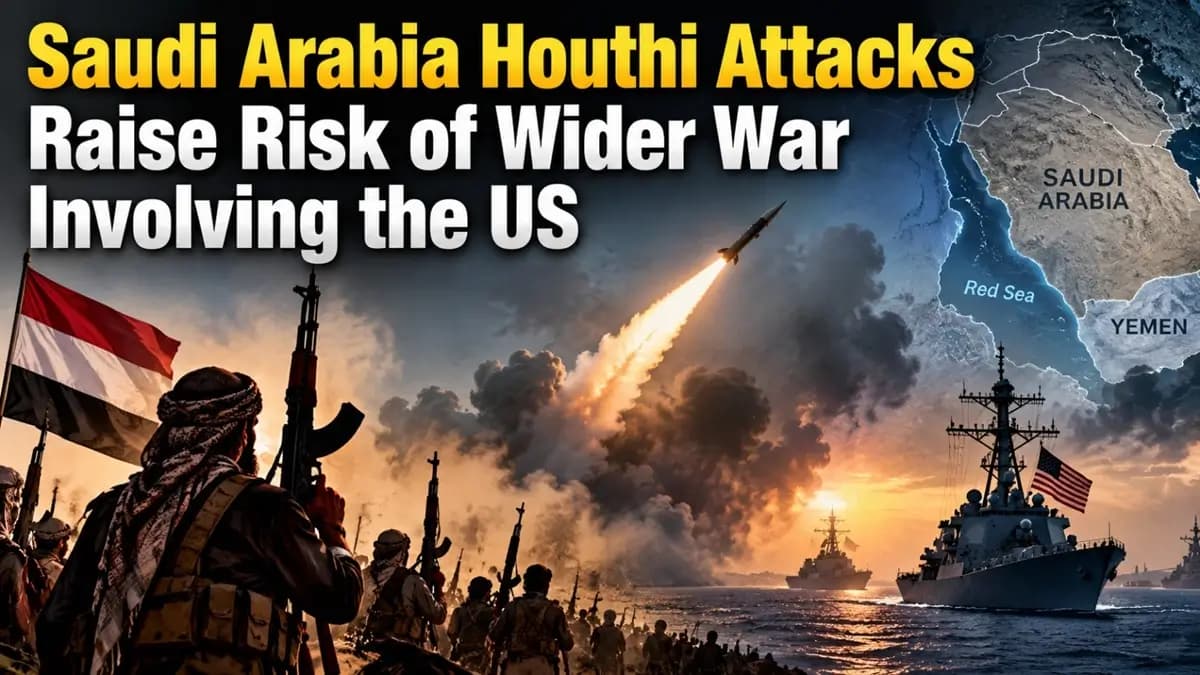
Conflict in Yemen has intensified as forces loyal to the internationally recognised government launch a counteroffensive against the Iran-backed Houthis. Saudi-backed forces reported rocket and drone strikes alongside heavy ground clashes in Taiz, al-Bayda and al-Jawf, while government officials vowed to retake Sanaa. The Houthis claimed to have repelled an assault in al-Jawf and accused Saudi Arabia of striking a prison in al-Hazm. The escalation comes amid heightened regional tensions and represents some of the most intense fighting since the 2022 UN-mediated ceasefire.
Yemen Conflict Escalates as Government Forces Launch Counteroffensive Against Houthis, Vow to Retake Sanaa
Fighting in Yemen has intensified in several provinces as forces loyal to the internationally recognised government launch a counteroffensive against the Houthis and strike routes leading to Sanaa.
Pro-government forces launched counterattacks against the Houthis on Monday as fighting in Yemen escalated, with officials saying they were seeking to reclaim the capital, Sanaa, from the Iran-backed group.
Saudi-backed forces said they carried out rocket and drone strikes on Houthi positions, as well as what they called heavy ground fighting in the provinces of Taiz, al-Bayda and al-Jawf.
The Houthis said they had repulsed an assault in al-Jawf and accused Saudi Arabia of carrying out an air strike on a prison in al-Hazm.
The Houthis said that at least seven people were killed in the al-Hazm prison strike, and that the alleged aggression would not go unanswered.
Elsewhere, Saudi Arabia accused the Houthis of wounding at least 73 civilians, including women and children, in recent attacks on the kingdom’s southern provinces.
Riyadh also warned it would respond to what it called a dangerous escalation, adding another regional dimension to the rapidly deteriorating security situation in Yemen.
Yemen fighting puts Sanaa back at the centre.
Major-General Samir Al-Sabri, Yemen’s deputy defence minister, told state television that the government had decided to take back Sanaa.
Majid al-Nuzaili, a spokesman for pro-government forces in Yemen, said the campaign was aimed at freeing Yemen from Houthi control and restoring Sanaa as a capital for all Yemenis.
Al-Nuzaili also warned civilians to stay away from the main roads leading toward Sanaa, including those linking the capital with Marib and al-Jawf through Nihm, Sirwah, Mahliyah and al-Hazm.
The escalation marks the most intense fighting since a UN-mediated ceasefire brought an end to major hostilities in 2022, although diplomatic efforts have been under way to secure durable political negotiations.
The war in Yemen started in 2014 when the Houthis took control of Sanaa, leading to a Saudi-led military intervention the following year as regional powers became directly involved.
Diplomatic hopes for a durable political settlement later faded amid wider regional tensions linked to the United States and Israel’s war against Iran.
Conflict spreads across strategic Yemeni provinces
The latest fighting erupted in July when government forces attacked the Houthi-controlled airport in Sanaa to prevent an Iranian aircraft from landing there.
Last week, the Houthis began a major offensive through western Taiz and southern Hodeidah, trying to push on to al-Makha and the strategically important Bab al-Mandeb Strait.
The Houthis had announced a blockade of Saudi ships using the waterway, a key shipping lane connecting the Red Sea to the Gulf of Aden.
Since the outbreak of the US-Israel war against Iran, Iran has begun to restrict transit through the Strait of Hormuz, increasing the importance of Bab al-Mandeb for Saudi oil shipments.
The government forces seemed to have absorbed the initial Houthi offensive, and the fighting spread on multiple fronts, said Ahmed al-Shalafi, Al Jazeera’s Yemen affairs editor.
The broader campaign could stretch Houthi forces and increase pressure, Al-Shalafi said, with fighting spreading from western Taiz and southern Hodeidah into al-Dhalea, Marib, al-Jawf and al-Bayda.
He said al-Jawf was strategically important due to its border with Saudi Arabia and its route to Saada, the main Houthi stronghold.
Al-Bayda was also described as strategically important because of its central location connecting eight governorates, four in the north and four in the south.
Also Read: Kolkata Kankurgachhi Home Searched by ED in Money Laundering Case.
Casualties and displacement increase
The World Health Organisation said Monday at least 728 people have been killed or wounded since Aug. 23, with most casualties reported in Taiz and along Yemen’s western coast.
The organisation estimated that since Thursday, around 21,000 people, or about 3,000 families, had been displaced from Taiz alone as fighting intensified.
The figures are expected to rise as the losses of Monday have not been included, said Al Jazeera’s reporter in Sanaa, Yousef Mawry.
Mawry said casualties were believed to be in the hundreds on both sides, particularly following reports of further air strikes in al-Jawf.
Rashad al-Alimi, head of the Saudi-backed Presidential Leadership Council that runs Yemen, said government forces had made significant advances in al-Jawf, al-Bayda, Taiz and Hodeidah.
Al-Alimi said that government forces will continue to perform their constitutional duties until state institutions are restored and the authority of the government is extended throughout Yemen.
“He also accused the Houthis of choosing escalation instead of peace and warned that the group would face the consequences of its actions.”
The media centre for pro-government forces said several air strikes were carried out late on Monday on Houthi positions west of Taiz, after earlier announcements of operations around al-Jawf.
Forces loyal to the government said they had launched a ground attack toward the al-Labanat mountains, fired rockets at Yatma and engaged Houthi fighters in fierce fighting.
The same media centre said government forces had reached the outskirts of Dhi Na’im district in al-Bayda in the ongoing confrontation.
Houthi response and regional risks
The Houthis denied the reported advance toward the al-Labanat mountains and said their forces had repelled the large-scale government-aligned offensive in al-Jawf.
“Dozens of government-aligned fighters were killed or wounded in the fighting,” Mohammed al-Farah, a member of the Houthi Political Bureau, said on X.
Al-Farah said Houthi forces fired ballistic missiles at reinforcements in al-Jawf, damaging or destroying dozens of vehicles and armoured vehicles.
He also said that several commanders were killed or injured, but the rival battlefield claims could not independently verify the reported losses.
The Houthis also released footage they said showed a ballistic missile hitting trucks carrying military equipment from Saudi territory at al-Wadiah camp in southeastern Hadramawt.
Video distributed by Reuters from the Houthi Media Centre showed trucks exploding and burning near the al-Wadiah border crossing on the Saudi-Yemen border.
As the fighting is now on multiple strategic fronts, any further escalation could deepen civilian displacement, raise casualties, and complicate efforts toward a negotiated settlement.